
USGS equipment used to monitor water quality after Lahaina fire
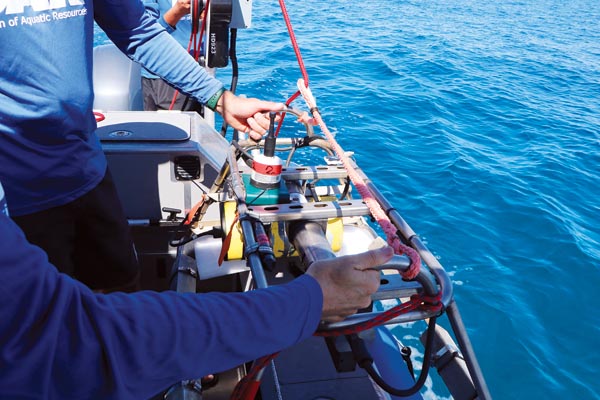
Biologists with the Division of Aquatic Resources prepare to place equipment in the waters off Lahaina for sampling on Sept. 8. Photos courtesy DLNR
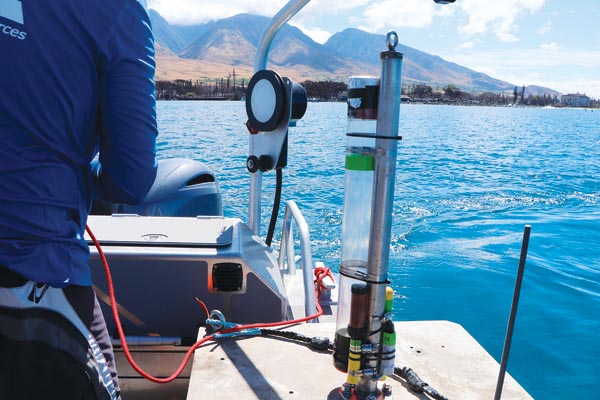
A sampling instrument on loan from the U.S. Geological Survey is seen aboard a boat in the waters off Lahaina on Sept. 8. Photos courtesy DLNR
Biologists with the Division of Aquatic Resources prepare to place equipment in the waters off Lahaina for sampling on Sept. 8. Photos courtesy DLNR
A sampling instrument on loan from the U.S. Geological Survey is seen aboard a boat in the waters off Lahaina on Sept. 8. Photos courtesy DLNR
Trending
The Maui News
Three sophisticated sampling instruments on loan from the U.S. Geological Survey are helping to monitor water quality off the coast of Lahaina after the Aug. 8 wildfire.
"The devices allow pollutants and toxins like heavy metals and pharmaceuticals to slowly slip inside a membrane and accumulate over time," explained Russell Sparks, an aquatic biologist with the state Department of Land and Natural Resources' Division of Aquatic Resources. "This mimics what a living creature like coral or fish would absorb. When the samples are analyzed, we'll have a much better idea of what the reefs are being exposed to as a result of of this fire."
DLNR said Friday that DAR, in partnership with the West Maui Ridge-to-Reef Watershed Initiative, placed devices in 15 to 20 feet of water the previous week. The initial samples will create a baseline and then DAR and the watershed initiative will work with the USGS over the next year or two to continue the process.
"During clearing and debris removal from Lahaina and after any heavy rainfall events, we'll get a better sense of what's entering the system and where it's going," Sparks said in a news release Friday.
The trio of sampling devices, including passive chemical samplers and oceanographic sensors, were dropped offshore at Puamana, as well as just outside the Lahaina Small Boat Harbor and another one further north near Mala Wharf.
"Urban wildfires create, transform, and release toxic chemicals to the environment where they enter water supplies and biota and are transported through the atmosphere and by way of runoff to the ocean," the USGS said. "We will quantify initial post-fire types and concentrations of metals and toxic organic contaminants (volatile and persistent) in Maui in terrestrial ash/soil (28 sites) and marine reef sediment (10 sites)."
The agency said target contaminants include metals, polycyclic aromatic hydrocarbons (persistent carcinogens created by biomass and fossil fuel burning), dioxins, polychlorinated biphenyls, PBDEs (flame retardants), PFAS (forever chemicals in fire-fighting foams and household products) and emerging contaminants from tire wear particles.
"The initial post-fire assessment will inform longer-term environmental and runoff monitoring related to human and ecosystem health risks from the Maui wildfires," according to the USGS.
Tova Callender of the West Maui Ridge-to-Reef Initiative singled out USGS for its quick response.
"We're appreciative of the rapid, ongoing support from USGS," Callender said. "It was very impressive how quickly it got its team together to organize all the equipment, create protocols so we could deploy on their behalf and ship hundreds of pounds of monitoring assemblies to us."
At the Lahaina Small Boat Harbor, the DAR and watershed initiative team also used a spring-activated sampler to collect sludge from the water just off a pier. Sludge will also be analyzed by the USGS lab in Santa Cruz, Calif.
Based on visual observation, Sparks said, "The water quality inside the harbor is horrible. You can see it from the surface. There's a constant sheen of diesel and other pollutants. DAR is concerned with the accumulation of micro-debris, including pieces of fiberglass, degrading marine resources if not removed. After all the vessels and debris are removed, the harbor is probably going to need some careful dredging just to prevent these contaminants from slowly and continuously releasing out onto the reef."
Sparks pointed out that their expertise and concerns are for the reefs and the organisms they support. He notes that what's bad for the ocean is probably bad for people as well.
"We will share the data with the State of Hawai'i Department of Health, the EPA, or anyone else who might have more expertise on what signifies an unhealthy scenario for people," he added.