
County looks to speed up Lahaina reentry process
Bigger zone openings, more pass distribution sites on horizon

A car exits the Kaniau Street checkpoint in Lahaina on Monday morning. Three more zones just off Kaniau Street reopened to residents on Monday as the county works to bring people back to Lahaina to check on their properties. The Maui News / COLLEEN UECHI photos
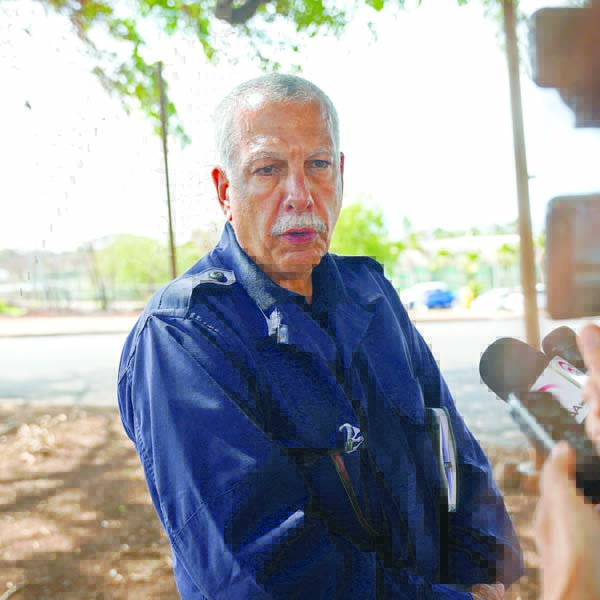
MEMA Interim Administrator Darryl Oliveira addresses the media on Monday morning outside the Lahaina Civic Center.

Dalilha Rodrigues (left) recalls happier times spent riding Go-Karts on the hills above the Lahaina Civic Center on Monday morning alongside close friend and former boss Ophelia Malacas. Before the fire burned down her Dee’s Poi Mochi food truck, Rodrigues loved being known as Aunty Dee. “Now when people call me Aunty Dee, I just like cry,” she said.
A car exits the Kaniau Street checkpoint in Lahaina on Monday morning. Three more zones just off Kaniau Street reopened to residents on Monday as the county works to bring people back to Lahaina to check on their properties. The Maui News / COLLEEN UECHI photos
MEMA Interim Administrator Darryl Oliveira addresses the media on Monday morning outside the Lahaina Civic Center.
Dalilha Rodrigues (left) recalls happier times spent riding Go-Karts on the hills above the Lahaina Civic Center on Monday morning alongside close friend and former boss Ophelia Malacas. Before the fire burned down her Dee’s Poi Mochi food truck, Rodrigues loved being known as Aunty Dee. “Now when people call me Aunty Dee, I just like cry,” she said.
Trending
LAHAINA -- The last thought Dalilha Rodrigues had when she evacuated her Lahaina home on Aug. 8 was "see you tomorrow."
The fire near Lahainaluna Road seemed so far away from her affordable housing complex at Ka Hale A Ke Ola that she left behind belongings like her bedding and the Las Vegas souvenir cups that served as the kids' coin-packed piggy banks.
But since the fire burned down the entire complex, she and her family haven't been back.
They're among the many Lahaina residents waiting for their chance to return to their properties as the county reopens designated zones across the fire-decimated town.
"It's an emotional roller coaster I can't wait to get off of," Rodrigues said Monday morning in the parking lot of the Lahaina Civic Center where she came to get financial aid for housing in Wailuku. "Restocking a home is one thing. Restarting your life all over again, that's a whole other animal. Honestly I wouldn't wish this on my worst enemy."
Last week, the first zone along Kaniau Road reopened to residents, and on Monday, restrictions on another three zones on Kuuipo, Aa and Lokia streets were lifted.
Darryl Oliveira, interim administrator of the Maui Emergency Management Agency, said Monday that the county is working to speed up the reentry process.
"We're looking at expanding our capability and capacity, open up more zones, bigger areas and being a little faster, because we really want to get people back to their properties, something that's been long awaited on," Oliveira said Monday morning outside the Lahaina Civic Center.
The three zones just down the road from the civic center reopened to residents from 7 a.m. to 3 p.m. Monday and today. The area includes about 72 parcels that were home to an estimated 250 people, according to Oliveira, who said most of the structures were completely destroyed. Maui County issued 66 vehicle passes for the three zones, though some could be for the same parcel. By about 10 a.m., more than 40 vehicles and more than 60 people had gone through, Oliveira said.
Water, hand-washing stations and portable bathrooms are available, along with volunteers to help sift through the rubble. Oliveira said he was on-site with one family who recovered her jewelry box and wedding rings, providing "a nice moment there, some closure for them."
After today, residents with a vehicle pass or ID can enter through the checkpoint from 8 a.m. to 4 p.m. daily.
Oliveira said the county hopes to make vehicle passes available seven days a week and in more locations, as well as maybe offer assisted access to the area seven days a week.
"We know there's areas where the homes did survive or the structure survived, and we want to work with those property owners about getting back," he added. "Even though they might not have water or wastewater, they can go back, start to clean their properties, work with their insurance companies, etc. So again, we'll try to be picking up the pace and try to get people back sooner."
As of Saturday, the U.S. Environmental Protection Agency had cleared hazardous household materials from 972 parcels, which is about 50 percent of the parcels in the area, Oliveira said. They've been working from the south, north and east and heading toward commercial properties in the center, which will be more complicated to clear with larger structures and different types of debris, Oliveira said. He added that the residential zones will likely continue reopening from north to south, but that the county may look at opening zones on the south end where more structures survived. The county is also working with Hawaiian Electric to restore power to homes that are still standing so people can get back to living there if they are structurally sound.
When asked about a timeline for completing the reentry process, Oliveira said, "I would say as soon as possible." The county wants to complete reentry in time for the next phase that includes debris removal by the U.S. Army Corps of Engineers, who haven't yet given the county a start date.
"They give us the assurance that they're not going to start work on a property unless the property owner has had a chance to get back as well as give them the right of entry," Oliveira said.
Rodrigues, who lost both her home and her Papalaua Street food truck, Dee's Poi Mochi, is eager to get back, saying she wishes the county would "allow us to even just go in, take care our property and pop a tent. I'd be happy with that. And I'm sure we're not the only ones."
While Rodrigues grew up in Central Maui, Lahaina has been home for more than 20 years. In 2018, the Hurricane Lane fire came so close to her kids' bedroom, the heat melted the star-shaped lights to the wall. This time, the total loss of their home and business has been tough on the family, who "went from a two-income household to one." Her kids, formerly students of Princess Nahi'ena'ena Elementary and Lahaina Intermediate, are now attending Kihei Charter and Hawaii Technology Academy, as Rodrigues is worried about them being bullied in bigger public schools after her nephew was mocked for losing his home at his new school.
Things have been tough for her older son, who told his mom and dad that "he's mad at us that we are not back in Lahaina." She's trying to balance her kids' mental health with her own, as the fire pushed her "from being the nicest person around, always bubbly and positive, (to) everything pisses me off now. I'm either super mad or I'm super sad or super stressed out."
Rodrigues grew up houseless and is determined to not let her kids experience the same thing, which is why the family decided to take a place in Wailuku that they'll need help to afford.
"I think too one of the biggest hurdles of being relocated to Wailuku or central side, is life is still going over there," Rodrigues said. "We understand it, but being from Lahaina and living over there after losing literally everything -- proud owner of five pairs of panties -- it's hard to walk into Walmart and see everybody just doing their everyday thing."
Ophelia Malacas, her close friend and former boss at Hilo Hattie, lost two jobs to the fire. She's been houseless since February after she couldn't afford an increase in rent for her Wainee Street home. Even after the fire, the west side will always be home to the Lahaina-grown former student of King Kamehameha III Elementary School.
"If people asked me, if you had a choice to live, where would you live? I'm like, you know what? In a heartbeat, Lahaina," Malacas said.
But some people, like Maria Moisa, aren't too keen to return to their properties. Moisa moved to Lahaina two weeks before the fire to serve as the property manager for the recently built affordable housing complex Kaiaulu o Kupuohi. She doesn't want to go back because "there's nothing to go back to." She lived near the top of the multistory complex and doesn't think she'd be able to find any of her belongings in the rubble.
After going to California for about a month, she came back to Maui and stayed in her car for eight days because rooms were too expensive. She was finally able to secure a hotel room and is now hoping to find one with a kitchen, as she has cancer and needs to cook healthy meals.
"There's still so much more to do," she said. "Because you come and you do paperwork and they say it's good but it never is. You have to keep coming back and bringing more and more stuff. It's just irritating to a point where I'm ready to say, just forget it."
As Moisa spoke, sirens went off as part of a test of the outdoor all-hazard warning system. Moisa paused.
"Oh now they test it," she said. "When we needed it it didn't go off."
* Managing Editor Colleen Uechi can be reached at cuechi@mauinews.com.