
Disaster funding buoys Maui amid House speaker dispute
Hawaii lawmakers still concerned about potential impacts of government shutdown

Hawaii U.S. Sen. Brian Schatz speaks to reporters in September in Washington D.C. AP photo
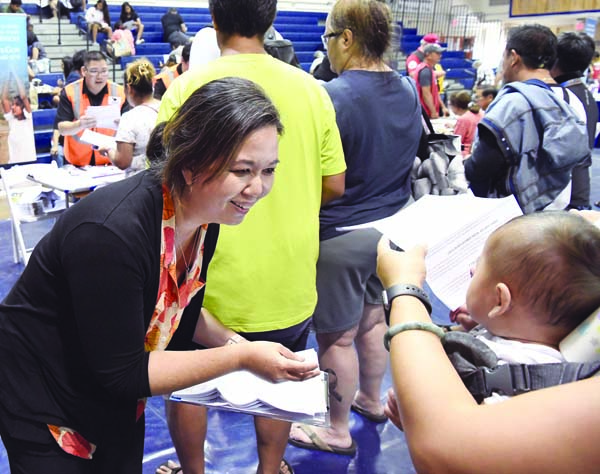
Hawaii U.S. Rep. Jill Tokuda speaks with constituents during a resource fair for fire victims in Lahaina on Aug. 26. The Maui News / MATTHEW THAYER photo
Hawaii U.S. Sen. Brian Schatz speaks to reporters in September in Washington D.C. AP photo
Hawaii U.S. Rep. Jill Tokuda speaks with constituents during a resource fair for fire victims in Lahaina on Aug. 26. The Maui News / MATTHEW THAYER photo
Trending
When the U.S. government dodged a near-shutdown at the end of September, Hawaii's congressional delegation breathed a sigh of relief.
The stopgap spending measure to keep the government funded and provide $16 billion for federal disaster relief that included Maui's wildfire recovery passed through an 11th-hour deal backed by most Republicans and Democrats.
"I was concerned all the way through," said Hawaii's U.S. Sen. Brian Schatz, a Democrat. "We had a lot of supporters on both sides of the aisle in both the House and the Senate (for disaster relief funding), but there are some pretty reckless people in Congress and they were announcing their intention to shut down the government."
"On a scale of 1 to 10, my worry was like a 7 or an 8," Schatz said.
But after the deal cost then-House Speaker Kevin McCarthy the gavel and left House Republicans deadlocked over his replacement, uncertainty has taken hold again with another deadline to fund the government looming on Nov. 17.
And while Hawaii's lawmakers say that securing disaster funding was a win for Maui, they still cautioned that some social service programs could be impacted if the leaderless House can't do business.
"We are still heading very quickly towards a potential government shutdown if we don't manage to pass the budget or to continue to do another continuing resolution," said Hawaii's U.S. Rep. Jill Tokuda, a Democrat whose district includes Maui County. "We have got a war right now in Israel and we need to be looking at the kinds of aid packages that the president has put forward as well and that requires us to have a speaker and a functioning House to be able to do all of that."
Republicans, who control the House, have struggled to reach consensus after ousting McCarthy earlier this month, unable to muster the votes to support either Rep. Steve Scalise or Rep. Jim Jordan. Lower-level candidates are now stepping forward, with Republicans choosing Rep. Mike Johnson as their latest nominee late Tuesday, hours after an earlier pick, Rep. Tom Emmer, abruptly withdrew in the face of opposition from Donald Trump and hardline GOP lawmakers, the Associated Press reported. A House floor vote is expected today.
For now, at least, the federal disaster funding will keep recovery efforts on Maui and other hard-hit places rolling.
"From a disaster standpoint, we got the money. So we don't need anything new in any new bill," Schatz said during a visit to Maui earlier this month. "But government shutdowns are terrible and should be avoided for any number of reasons. I do not think we will ever shut down but I would feel a lot more comfortable if there were somebody I could point to and call them speaker of the House."
While on Maui, Schatz visited the burn zone in Lahaina, talking with agencies like the U.S. Coast Guard, the Federal Emergency Management Agency and the U.S. Army Corps of Engineers to see what is needed since the disaster relief funding passed.
"They have the resources they need to do the debris removal," Schatz said. "That $16 billion appropriation to the disaster relief fund means that everything that FEMA needs to do, everything the Army Corps needs to do, everything the Coast Guard needs to do, is fully funded. I don't have to go and chase additional resources for any of those lines of effort."
Schatz said the higher-priority items are repairing utility infrastructure, making sure King Kamehameha III Elementary -- which is awaiting a temporary campus after its school burned down -- can operate, and getting sunken vessels out of Lahaina Harbor so it's safe to use the ocean.
Schatz has been encouraged by the across-the-aisle support for Maui. The GOP's McCarthy visited while he was still speaker, and the Republican chairman of the House Committee on Natural Resources came with a bipartisan delegation.
"We ought to be able to fight about all kinds of things in the Congress, but it should never be a debatable question whether we provide relief to those who have been victims of a disaster," Schatz said.
Tokuda has made similar comments about the House, noting how many colleagues from red and blue states have expressed sympathy and support for Maui.
But even with that backing, she worries about federal workers and some social services being impacted by a government shutdown. Programs like food stamps, women and children's nutrition, loan applications and the federal employees on Maui who range from active duty service members to TSA officers rely on "the wheels of government turning and money flowing," Tokuda said. The military and TSA are considered essential services, but they would have to work without pay during a shutdown, the White House said in September.
"There is a lot of harm that could happen if there's a government shutdown," Tokuda said Friday. "Maui especially right now is vulnerable."
Tokuda said it's unclear how much of that $16 billion will go toward Maui, as she pointed out that the pot also has to cover disasters before and after Maui's fires.
Schatz isn't worried that the Capitol Hill disputes will slow Maui's efforts -- so long as they don't drag on for too long.
"Turmoil in the House has zero impact on Maui's recovery, and that will remain true for at least six months," he said. "If the House can't put its pants on and get a Speaker and this drags on for the better part of a year, then the Maui recovery will suffer, but frankly the whole country will be in a pretty bad spot. So I am still confident that after a bunch of nonsense, they'll pick somebody and get back to governing."
Tokuda sees hope in the recent bipartisan wins -- members of both parties joined forces to avoid defaulting on the U.S. debt in May and to prevent the shutdown at the end of September. The difficult work ahead, including addressing global conflicts, will require putting "people over politics first and foremost," she said.
"If you think about the most recent government shutdown, it took Democrats and Republicans voting to make sure that we have the wheels of government turning and the lights on," Tokuda said. "Not one party alone could do that in Congress."
* Managing Editor Colleen Uechi can be reached at cuechi@mauinews.com.