
Kihei overpass could be ready in late 2025
Long-overdue project fronting high school expected to cost $16M
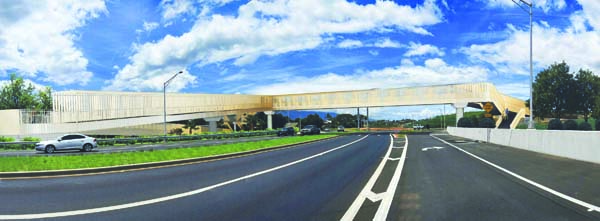
A rendering presented Wednesday shows how the proposed pedestrian overpass near Piilani Highway’s roundabout is expected to look. The Maui News / MATTHEW THAYER photos

Kihei resident Buck Joiner (right) asks G70 Principal and civil engineer Ryan Char a question during Wednesday evening’s public presentation on the proposed Kihei overpass by the state Department of Education and state Department of Transportation at Kulanihako‘i High School.
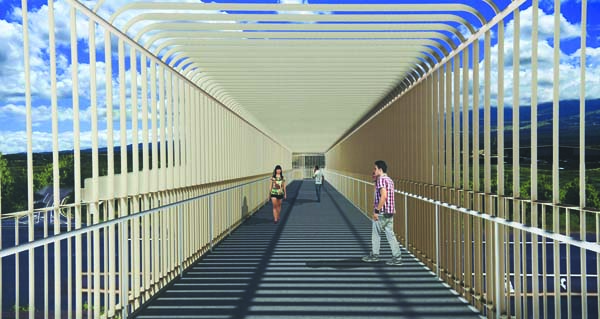
The proposed pedestrian overpass would be physically enclosed but visually open, according to a rendering.
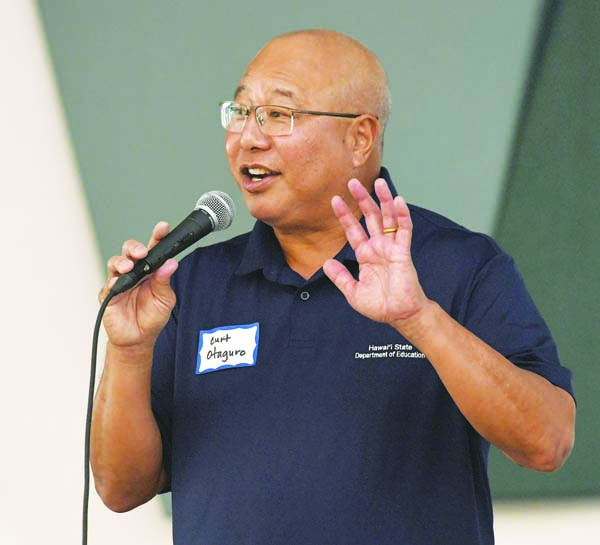
State Department of Education Superintendent of Operations Curt Otaguro speaks Wednesday.
A rendering presented Wednesday shows how the proposed pedestrian overpass near Piilani Highway’s roundabout is expected to look. The Maui News / MATTHEW THAYER photos
Kihei resident Buck Joiner (right) asks G70 Principal and civil engineer Ryan Char a question during Wednesday evening’s public presentation on the proposed Kihei overpass by the state Department of Education and state Department of Transportation at Kulanihako‘i High School.
The proposed pedestrian overpass would be physically enclosed but visually open, according to a rendering.
State Department of Education Superintendent of Operations Curt Otaguro speaks Wednesday.
Trending
KIHEI -- The long-awaited pedestrian overpass that held up the opening of Kulanihako'i High may be completed in late December 2025 and cost around $16 million, officials said on Wednesday.
"That is a fairly aggressive timeline," said Ryan Char, a principal and civil engineer at G70, a local architectural firm handling the design of the overpass project, which community members fought long and hard for so students and pedestrians could have a safe way to cross busy Piilani Highway that fronts the school in Kihei.
Char said the firm recognizes the importance of accelerating the project as expressed by state Department of Education officials.
An agreement between the county and the state allowed the school to open in August while state officials work to fulfill the decade-old Land Use Commission requirement that a pedestrian crossing be built for the school.
Members of G70, based out of Oahu, along with state Department of Education and Department of Transportation officials, spoke to around 60 people at a community meeting Wednesday evening at the new high school, sharing details on the overpass timeline, costs and design, which is 30 percent complete.
Officials are seeking community input on the design, as they are aiming to have a draft environmental assessment for the project published in December. Ideas for the overpass came out of community meetings last year.
The overpass, which will be about 20 feet above the highway, will be located just south of the Piilani Highway roundabout which intersects with Kulanihakoi Street.
The overpass will use concrete with precast girders at an estimated cost of $16 million, which is about $1.5 million less than using steel construction alternatives.
Mark Tagawa, an architect and a principal with G70, said that concrete will provide more longevity and "ease of maintenance" as it can better withstand the salty air environment in Kihei.
He said the actual crossing must span about 140 feet across the highway. There will be a 280-foot-long switchback ramp makai of the overpass bridge and a 270-foot-long ramp mauka, which will both provide more accessibility, especially for wheelchair access.
Tagawa said the ramps to the overpass are longer than ones people would recognize on Oahu, as those ramps were built decades ago when codes were not updated. The shorter Oahu ramps are hard to use if pushing a bicycle or using a wheelchair, Tagawa said.
There will also be stairs that lead up and down the bridge, which will have portions that are fully enclosed for fall protection.
Renderings of the overpass show there are no frills with the rectangular bridge spanning the highway.
"The idea was to create a bridge design that was truly very quiet and sedate without too much decoration, and the idea was that we wanted the bridge to just recede into the landscape," Tagawa said.
They are also working on fulfilling DOT standards, which include having a 17-foot, 6-inch clearance "to the underside of the structure from the highway."
The DOT will fund, own and operate the overpass, as well as providing construction oversight and selecting a contractor and construction manager.
The DOE is responsible for the overpass design, conducting community outreach, issuing annual progress reports and complying with the Hawaii Environmental Policy Act.
DOT Highways Deputy Director Robin Shishido said that last year Gov. Josh Green's administration introduced a budget line item for the overpass, but it did not make it out of the legislative session.
"But as you can see we're still early in the process, there are still things up in the air as the design process gets completed and the budget does fluctuate up and down," Shishido said.
He added that they are also looking to see if there is federal funding available, but this may come with different requirements, which could slow down the process.
Shishido said they will continue to work with legislators.
The $245 million Kulanihako'i High opened in August to around 140 freshmen and sophomores. It was a long time coming, as the school has struggled through funding and bureaucracy hurdles throughout the years, and the opening stalled because the DOE had not fulfilled a 2013 requirement from the state Land Use Commission to build an underpass or an overpass to the school for students and pedestrians.
Eventually the state and county came to an agreement earlier this year to issue a temporary certificate of occupancy with the state agreeing to temporarily indemnify the county against theoretical future claims of liability since the decided-upon overpass has not been built.
Students need to ride a bus, a school shuttle or be driven to school.
"Everybody has been adhering to the agreement that everybody arrives and leaves in a vehicle," Kulanihako'i Principal Halle Maxwell said after the meeting Wednesday evening.
But like other schools, Kulanihako'i is also dealing with busing challenges as companies deal with a lack of workers.
"So we are also experiencing that. My parents (of students) are being very patient as we work though some of the issues," Maxwell said, adding that she is grateful for the bus service going "above and beyond" to transport her students who currently live in the "walk zone" for the school.
As for the overpass, Maxwell said, "I think it looks fantastic. I'm interested to hear what the community response is and the public interaction with that."
She felt the overpass has been designed with safety in mind, and she also likes how the design blends in with the environment.
With the completion date of the overpass projected for late 2025, Maxwell estimated there could be 650 to 700 students at the school by then.
South Maui state Rep. Terez Amato, whose district includes Kihei, said after the meeting, "Ultimately nothing is more important than the safety of our students and the ability for them to receive a quality education at this incredible campus. So the timeline seems to be somewhat of an improvement. Obviously I'd like to see it sped up a little more and I'm looking forward to seeing more and getting a deeper and more in-depth update and find out how DOT plans to really get this project funded."
In the past, state officials estimated that it would take three to five years for a grade-separated crossing to be built.
In February, Amato submitted a $16.2 million federal infrastructure earmark to Hawaii U.S. Sen. Brian Schatz's office. In March she was informed by the Senate Appropriations Office that the state DOT and the Maui Metropolitan Planning Organization need to continue with the application and that Senate Appropriations will contact the state agencies and continue to work on it.
When asked if she'd heard more from Schatz's office, Amato said, "You know, since the (Aug. 8) fire everything is up in the air, so it's hard to say right now."
Kihei resident Mike Moran, a staunch advocate of getting a grade-separated crossing built prior to the school opening, said after the meeting that he was still skeptical about the overpass ever being built, noting how the DOE dragged its feet for nearly a decade to fulfill the LUC condition.
"I don't believe 'um," said Moran, who is the president of the Kihei Community Association but spoke about his personal views at the meeting.
DOE Superintendent Keith Hayashi said at a LUC meeting in February that the decision to open and push forward the school was made before he was superintendent. Hayashi said there was no intention to violate the condition or "force anyone to open." He said he believed the push to open the school "was an opportunity at that time to perhaps provide students the opportunity for Kulanihako'i."
DOE Deputy Superintendent of Operations Curt Otaguro emphasized support for the overpass at Wednesday's meeting.
"We are committed to doing this," Otaguro said.
* Staff Writer Melissa Tanji can be reached at mtanji@mauinews.com.