
Protecting water crucial to Lahaina’s recovery, panel says
Native Hawaiian Convention continues with focus on key community issues
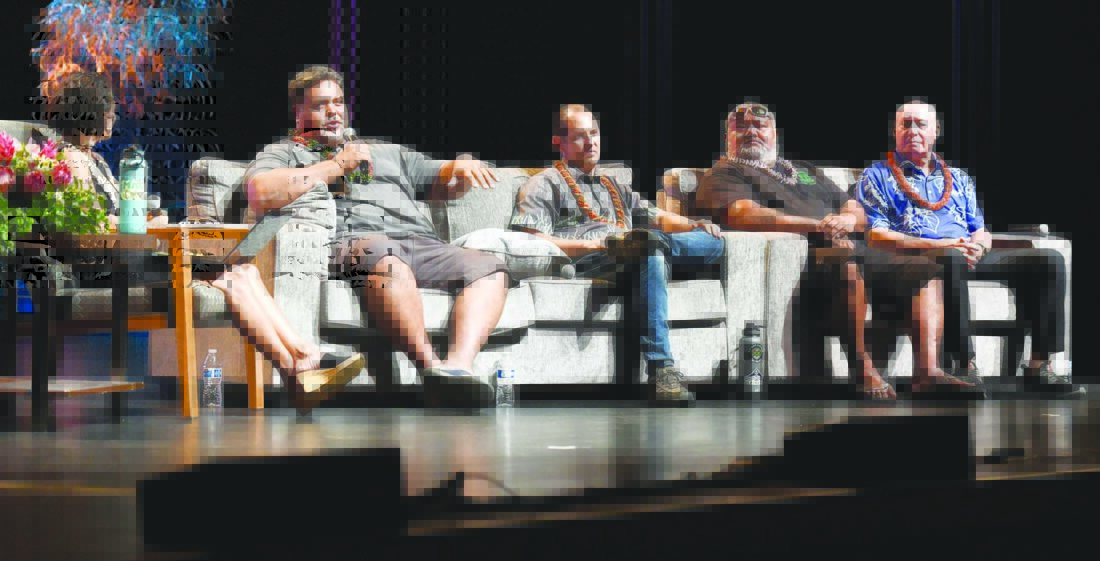
Panelist Kekai Keahi shares memories of raising kalo in Lahaina while taking part in Wednesday’s Native Hawaiian Convention panel discussion titled “Know Your Wai: Where Did the Water Go?” Also on the panel is Neil Hannahs (from right), Junior Kekiwi and Hokuao Pellegrino. Moderating the discussion is Kapua Sproat. The Maui News / MATTHEW THAYER photos
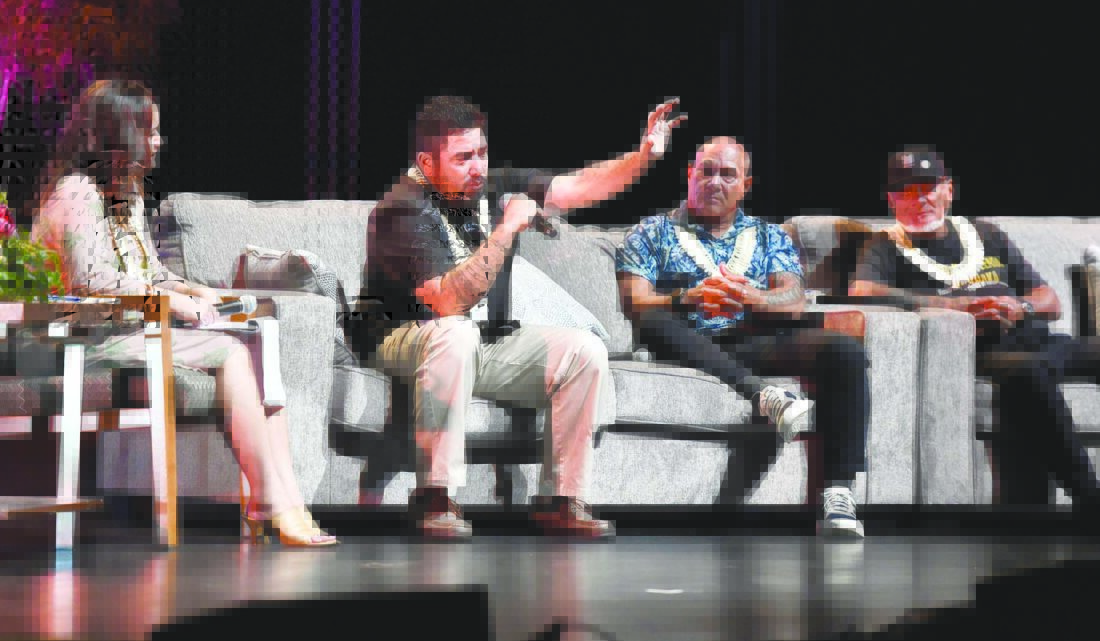
Panelist Kaipo Kekona shares an early memory of growing up in Lahaina while taking part in Wednesday’s Native Hawaiian Convention panel discussion titled “Lahaina’s Vision for the Future” with Archie Kalepa (center) and Ke‘eaumoku Kapu. Moderating the discussion is Summer Sylva.
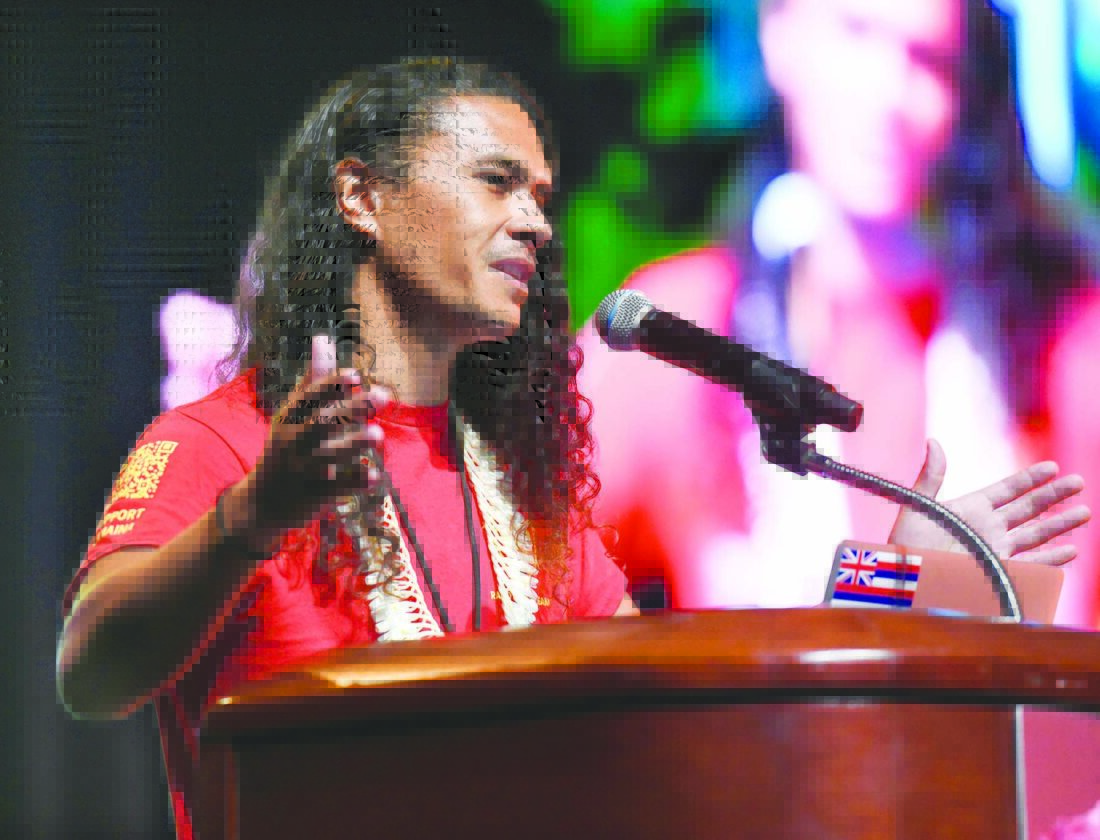
Keynote speaker Paele Kiakona describes community efforts in the wake of the Lahaina wildfires while speaking before Wednesday’s panel discussion titled “Know Your Wai: Where Did the Water Go?”
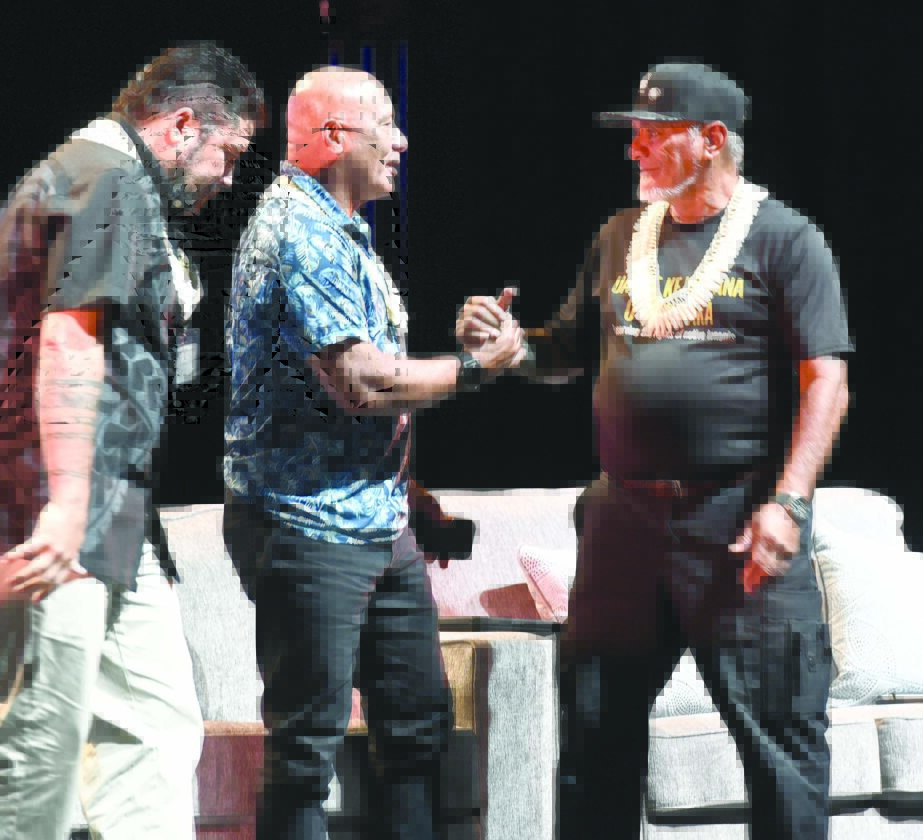
Panelists Ke‘eaumoku Kapu (from right) and Archie Kalepa shake hands at the conclusion of Wednesday’s panel discussion titled “Lahaina’s Vision for the Future” with Kaipo Kekona.
Panelist Kekai Keahi shares memories of raising kalo in Lahaina while taking part in Wednesday’s Native Hawaiian Convention panel discussion titled “Know Your Wai: Where Did the Water Go?” Also on the panel is Neil Hannahs (from right), Junior Kekiwi and Hokuao Pellegrino. Moderating the discussion is Kapua Sproat. The Maui News / MATTHEW THAYER photos
Panelist Kaipo Kekona shares an early memory of growing up in Lahaina while taking part in Wednesday’s Native Hawaiian Convention panel discussion titled “Lahaina’s Vision for the Future” with Archie Kalepa (center) and Ke‘eaumoku Kapu. Moderating the discussion is Summer Sylva.
Keynote speaker Paele Kiakona describes community efforts in the wake of the Lahaina wildfires while speaking before Wednesday’s panel discussion titled “Know Your Wai: Where Did the Water Go?”
Panelists Ke‘eaumoku Kapu (from right) and Archie Kalepa shake hands at the conclusion of Wednesday’s panel discussion titled “Lahaina’s Vision for the Future” with Kaipo Kekona.
Trending
KAHULUI -- Bringing back a canopy of trees that shaded Lahaina, using reclaimed water for irrigation and farming, and placing more of West Maui water resources into public hands are some of the goals that one Native Hawaiian community leader wants to see to improve the water situation on the island's west side.
Lahaina resident Kekai Keahi, who along with others fought for years for the return of water into Kahoma Stream, explained how life came back when the stream was restored and water flowed mauka to makai. This included the return of oopu along with fish not seen for years down at Mala Wharf. However, he still sees more work to do.
"It is not enough to rest on the interim in-stream flow standards that we fought for, for so many years," Keahi said. "It's not enough to rest on the designation for ground and surface water that we fought for, for so many years. That's not enough to replenish our aquifers, that's not enough to sustain a population on the west side. So we got to rebuild the aquifers and we got to get different ways in how we are going to do that."
Keahi was one of the panelists Wednesday morning at the 22nd annual Native Hawaiian Convention at the Maui Arts & Cultural Center in Kahului. The convention, put on by the Council for Native Hawaiian Advancement, began Tuesday and runs through Friday, with various discussion panels, entertainment, Maui crafters and a job and resource fair. The council moved the convention from Oahu to Maui after the Aug. 8 wildfires.
The convention's second day included a video premiere in the Castle Theater with noted Maui-based singers, such as Keali'i Reichel, and others across the state singing familiar songs such as "Lahainaluna." The video showed clips of Lahaina before the fires, which brought tears to some of the audience, while some of the songs had audience members clapping along.
Lahaina's history and recovery have been at the heart of many discussions at the convention.
Keahi, who sat on a panel called "Know Your Wai: Where Did the Water Go?", looked to the future and spoke about the reforestation of Lahaina, pointing to Malu 'Ulu o Lele or the "shaded breadfruit groves of Lele." The footprint of the burn zone from the Aug. 8 wildfires largely overlaps that area. Keahi said "malu" means shade.
"There used to be a canopy of trees there that used to protect the ground, that moisture in the ground, from that merciless sun we have on the west side," Keahi said. "And because of that our springs, the aquifers were plentiful. We don't have that today."
Keahi said that the Launiupoko Aquifer that Lahaina is located in has a sustainable yield out of the ground at 7 million gallons per day, as shown in the Maui Island Water Use and Development Plan. He spoke to the need of using more R-1 or recycled water that is clean enough to be used to irrigate landscape, wash cars and use for farming. Using recycled water will leave much more water that "we can keep in the ground every single day to rebuild the aquifers."
"It's hard to use the fire as a good reason why we should do something," Keahi added. "We should have been doing before the fire happened but because it happened there is a kind of break, a reset where we can really think about putting in the infrastructure that going do just that."
Keahi said another change is that needs to take place is "taking the water out of the hands of these private purveyors" and putting it back into the public's hands. Large private landowners and companies control water in key areas of West Maui, which has led to multiple disputes before the state water commission over stream flow.
When the county orders conservation measures for West Maui, residents pull back their use and "everybody get dirty car" to avoid getting fined for washing their cars, Keahi said. Meanwhile, residents look farther north to some of the resorts that operate on a private water system. They see filled swimming pools and green golf courses. He said that is like putting "salt in the wound."
"We got to live with that every single day," Keahi said.
Hokuao Pellegrino, president of Hui o Na Wai 'Eha, which has fought for stream flow on the other side of the mountain range, said that "in our backyard, we have golf courses too that are nice and green." Na Wai 'Eha means "The Four Waters," of the Waikapu, Waiehu, Waihee and Wailuku rivers.
Pellegrino, who was also a panelist at the convention, said it is up to the community "that ensures accountability," to make sure in-stream flow standards are met.
"These numbers mean nothing without the people that enforce it," he said.
Kalo farmer Jerome Kekiwi Jr., president of Na Moku Aupuni o Ko'olau Hui, sees hope for the future of water on Maui, noting how Maui County voters approved the creation of a Maui County Community Water Authority last year. The authority would look into the feasibility of acquiring long-term water leases for certain areas of Maui. Regional community boards would manage water collection and delivery systems.
Kekiwi's nonprofit hui represents East Maui farmers, and one of their members sits on the East Maui Community Regional Board created in addition to the water authority.
"Hopefully there is a good movement in that. Hopefully the county can come together," said Kekiwi.
"I hope our communities make better decisions on the take of water," he added.
As a kalo farmer, he said he takes only what he needs and lets the rest go, as there are other kalo farmers downstream.
As a Native Hawaiian, Kekiwi said, "It is your kuleana to malama the auwai."
* Staff Writer Melissa Tanji can be reached at mtanji@mauinews.com.