
Nepalese artifacts headed home after very long wait

Kihei resident Susan Bradford (from left) discusses an artifact with Uttam Ghimire, Second Secretary for the Embassy of Nepal in Washington D.C., and his wife Kabita Dahal last Friday in Maui Meadows. The Maui News / MATTHEW THAYER photos
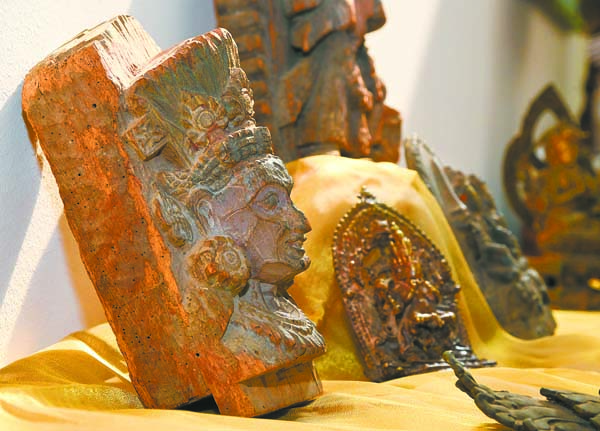
Nepalese artifacts are arranged in Bradford’s home after 50 years in storage waiting to be returned home.
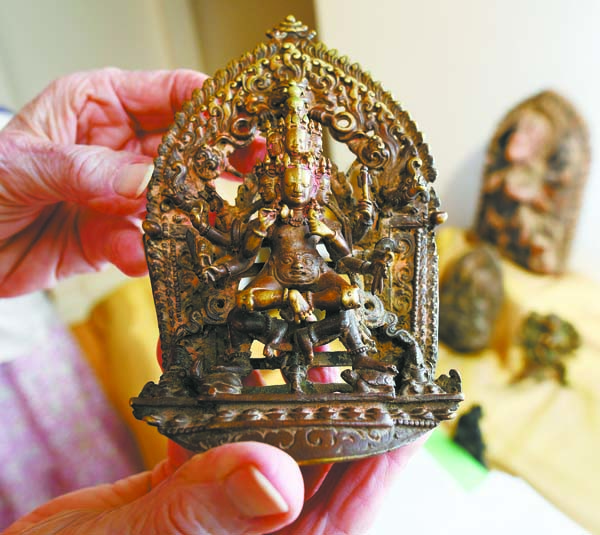
A statue of Mahishasura Mardini, goddess of power, is made of gold-plated copper and believed to date to the 13th or 14th century.
Kihei resident Susan Bradford (from left) discusses an artifact with Uttam Ghimire, Second Secretary for the Embassy of Nepal in Washington D.C., and his wife Kabita Dahal last Friday in Maui Meadows. The Maui News / MATTHEW THAYER photos
Nepalese artifacts are arranged in Bradford’s home after 50 years in storage waiting to be returned home.
A statue of Mahishasura Mardini, goddess of power, is made of gold-plated copper and believed to date to the 13th or 14th century.
Trending
The steady exodus of Nepalese and Tibetan antiquities being sold to the West alarmed the young world traveler living and studying in Kathmandu. She considered it a loss of precious heritage and wondered what she could do to help stem the tide.
"I saw them being taken away and it never felt right," said longtime Kihei resident Susan Bradford last week. "I didn't know what to do. I could have left them there, but I knew they would be sold to the West."
This was 50 years ago, in 1974, when Bradford was in the midst of a three-year stay in Nepal as part of a 10-year world journey.
"It is a magical place," the psychologist, environmentalist and author said. "I just fell in love with the place. The people are really wonderful and I wanted to do something to help."
Electing to fight fire with fire, Bradford bought 24 pieces ranging between 800 to 300 years old and had them shipped to her parents' home in Minnesota with the intention of someday returning them to the Nepalese people. For 50 years, the artifacts made of metals, wood, stone and bone, sat in storage.
"I never put them out because they never felt like they belonged to me," Bradford said.
Upon her retirement, with the situation in Nepal stabilizing, Bradford set about trying to repatriate the collection. It wasn't easy. She had the items photographed and catalogued to determine what they were before searching for the right person or agency to turn them over to. Some of the museums she contacted for help said they would be happy to take them off her hands.
"I said no, they need to go back to Nepal."
After 12 years of effort, Bradford made good on her pledge last Friday by officially turning the 24 artifacts over to Uttam Ghimire, Second Secretary for the Embassy of Nepal in Washington D.C.. Ghimire and wife Kabita Dahal flew to Hawaii to accept them in Bradford's Maui Meadows home. While on Maui, they helped arrange the packing and shipment to the Nepal Department of Archeology in Kathmandu.
"We have lost so many artifacts, and so many cultural and religious items of significance have been stolen from Nepal," Ghimire said. "People will be so happy they will be back where they belong."
Ghimire commended Bradford for her foresight and also for her willingness to champion the cause for repatriation of other artifacts currently in private and public collections. He said religion is deeply rooted in Nepal society, with many people starting the day praying in temples that now display copies of what has been taken.
"She wants to come to the front with hope it will inspire others," he said. "People are so happy to see the gods are brought home."
Bradford said appropriated artifacts from all cultures should be returned.
"The whole reason I've gone public is not only Nepalese art, but Mayan art and anything else that people have," Bradford said. "Knowing that it is the right thing to do, I really recommend it to people. It's such a good feeling knowing it is going back to where it belongs."
Ghimire said it is not yet determined where the relics are from. If the Dept. of Archeology can find the temple or family they belonged to, they will be returned. If not, they will be put on display in a museum. He urged others interested in returning Nepalese artifacts to contact the Nepalese Embassy in Washington D.C.
Though Bradford kept the items in storage, seeing them go after 50 years conjured "mixed emotions."
"It has been a long journey, a circuitous adventure," she said. "I'm glad they are going back, but they feel like they became part of the family. They are going back home."
* Staff Writer Matthew Thayer can be reached at mthayer@mauinews.com.