
Beneath the lens
Maui-based scientist to talk on June 17 at the ProArts Playhouse with a presentation on “The Adaptation of Cellular Consciousness”
Trending
The Maui News
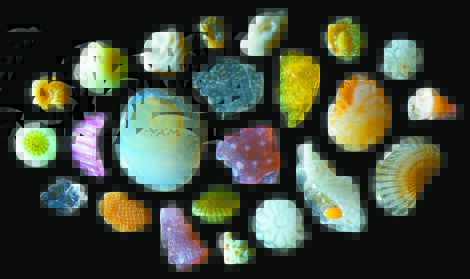
What may seem mundane to the casual viewer, Dr. Gary Greenberg transforms into majestic works of art using microphotography techniques. By magnifying common objects like a grain of sugar or sand, he reveals how nature on a microscopic level is a glorious, multi-colored wonderland.
The Maui-based scientist will talk on Monday at the ProArts Playhouse with a presentation on "The Adaptation of Cellular Consciousness," joined by filmmaker Tom Vendetti, who will screen the "Hubble 3D" documentary narrated by Leonardo DiCaprio. Greenberg will show how telescopes and microscopes have expanded human consciousness.
"It's about how telescopes and microscopes have totally changed our view of the universe that we live in over the last recent number of years," he explains. "And how that has changed human consciousness and human collective consciousness, and where is that going in the future with AI and artificial consciousness? The collective consciousness of the future of human beings is really up in the air."
Greenberg and Vendetti are currently collaborating on a documentary focusing on the material in the "Cellular Consciousness" talk, with narration by actor Stacy Keach.
After graduating from UCLA, Greenberg later earned a Ph.D. in developmental biology from University College London. During the 1990s he invented and developed high-definition, three-dimensional light microscopes, for which he was issued 19 US patents. He was the founder of Edge-3D, LLC, which develops innovative 3D imaging devices for research and industry.
Since 2001, he has focused his microscopes on common objects, such as grains of sand, flowers, and food. His amazing images can be seen in the books "A Grain of Sand: Nature's Secret Wonder," "The Secrets of Sand," and "Florotica: Revealing the Sensuality of the Micro World."
"I've been looking through telescopes and microscopes my entire adult life, and I see the world in a completely different way than most people," he notes. "These two instruments have showed us what the world out there looks like, and the world inside of us looks like, down to the most minute details. It's quite amazing, and I'm trying to get the message out about how spectacular this universe is that we live in, and that we all seem to take it for granted, and how extraordinary we are. A lot of people are missing everything that's around us and within us. So that's my message."
Strolling on Maui's sandy beaches, most of us likely have no idea about the wonder below our feet. We're walking on a vast array of sparkling jewels. "If you just see my sand grains photos, you'll probably never look at sand the same way again," he says.
The microphotography technique he developed for biomedical research he first adapted to the sands of Maui, then to the sands of the world, and, in time, to sand from the Moon.
"I've written two books on sand and the big take-home message is ordinary things are absolutely extraordinary. And the second message is everything is a snapshot in time. Those grains of sand came from somewhere and they're going somewhere, like everything else in the universe around us."
The "Hubble 3D" film and The Adaptation of Cellular Consciousness presentation will be held on Monday at 7 p.m. at the at the ProArts Playhouse. Admission is $5 and $10. It is a benefit for the Playhouse. His amazing sand images can be viewed at www.sandgrains.com.