
Comedy series about Maui life gaining traction worldwide
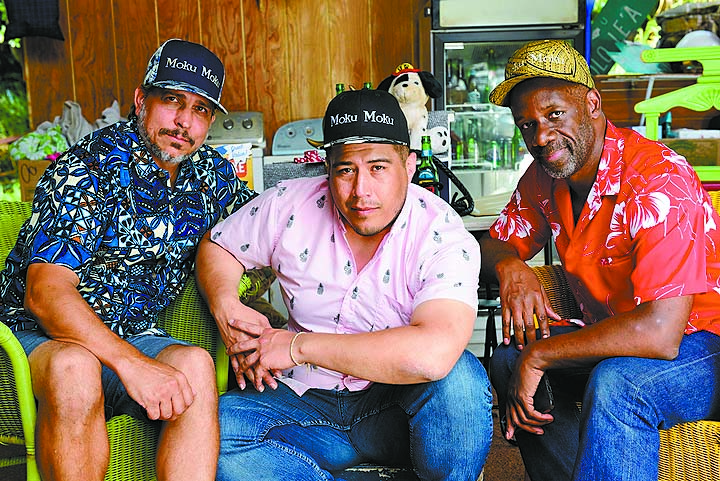
Moku Moku, the innovative Hawaiian comedy series about rural life on Maui, starring a Maui cast and made by Maui folks, recently gained global distribution through streaming on Amazon Prime.
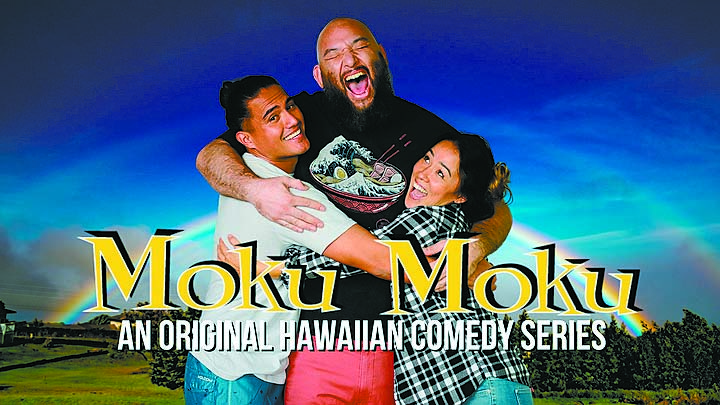
Courtesy photos
Moku Moku, the innovative Hawaiian comedy series about rural life on Maui, starring a Maui cast and made by Maui folks, recently gained global distribution through streaming on Amazon Prime.
Courtesy photos
Trending
The innovative Hawaiian comedy series "Moku Moku," about rural life on Maui, starring a Maui cast and made by Maui folks, recently gained global distribution through streaming on Amazon Prime, and it will soon be available on all Hawaiian Airlines' trans-Pacific flights.
"We're tremendously thrilled," said the show's script writer Jonathan Melikidse. "It's such a great opportunity to get on Hawaiian Airlines. The locals going out get to see the show. We're happy to be a part of that."
The Prime website entices: "follow three best friends navigating everyday life on Maui. Encounter identity crisis, understand late-stage capitalism through the price of Musubi, and learn how to survive the cost of living in paradise while keeping a smile on your face."
Described as a slice-of-life comedy set Upcountry, it features Bronson Varde as Kimo, who lives with his mom and is trying to keep hold of their family home. Actor/radio DJ Patty Lee plays Leilani, the glue of the trio, and comedian Chino LaForge plays fun loving Pili.
"Kimo lives in Olinda with his grandma, played by the incredible Kathy Collins," explained producer Brad Starks. "He loves American pop culture and loves Westerns, and watches 'Gunsmoke' and 'Bonanza.' His best friend is played by Chino LaForge, the great stand-up talent. He is the guy who's just jovial. Then you have the smartest of the three friends played by Patty Lee, a fantastic stage actress. She's the only one that owns a car. She has three or four side jobs going on, and she is the one who usually reminds them about significant Hawaiian cultural things."
The series is the brainchild of Kawika Hoke, who sought to bring the daily lives of Upcountry residents to the screen with a comedic take on their adventures. "I wanted to do what was exactly the opposite of Hawaii on TV," said Hoke. "I felt that that was at the core of trying to make a show that people would be interested in about Hawaii because as far as I was concerned, the first people that I had to impress and make it for was Hawaiians and people from Hawaii. We've got almost a century of television and nobody's really seen what a paniolo looks like in a comedy series."
Hoke and Starks met working on productions sets, including several Hallmark movies filmed in Hawaii. "We were happy to be working on productions that came to Maui, however, we were less excited about the message of the projects, like the stories were very much Mainland folks who had problems and hold up in a resort," said Starks. "The heroes of the story never interact with people who live here. They never get how diverse the community is and just how rich the culture is."
Tired of seeing stereotypical presentations of Hawaii, they began devising a show that spoke to the actual reality of local folks on Maui.
"We're working really hard on making sure that the rest of the U.S. is getting a chance to see our show and what life is really like to live in Hawaii," noted Melikidse. "Not from the perspective of the bamboo umbrellas and bikinis and beaches that you usually see on 'Hawaii Five-0' and those shows."
For inspiration they saw the success of similar cultural comedy shows like "Reservation Dogs" which explored the lives of Indigenous teenagers in a rural Oklahoma reservation, the Irish series "Derry Girls," about teen girls growing up amidst the political conflict of Northern Ireland in the 1990s, and the Canadian comedy "Letterkenny."
"In our show, the characters' lives are told, not from some Westerner's imagination, but from the hardship, perseverance, and humor of their real lives," said Starks. "This is the first time in history that local creatives on Maui have produced this kind of media content for widespread distribution. We have the unique opportunity to create a new viable economic stream on Maui that has been neglected in the aftermath of the Maui fires. There are hundreds of talented on-camera professionals living here who are forced to relocate elsewhere to find work. We would like this to be the first step to changing that."
"The biggest thing I've been oriented towards is making jobs," added Hoke. "Not only does this show have to be an artistic hit for people to watch it, but it's also got to be a successful investment. So that way we keep coming back and creating jobs. Especially since the fires, it's been a little disheartening to see the ones who've had to move away. And the ones who are constantly working off island or out of state. To me, the most important part is keeping everybody home."
The "Moku Moku" team was in the midst of completing their first season when the fires ignited Upcountry and in Lahaina. Melikidse temporarily lost phone contact with his wife and children on Aug. 8, and only found out they were alive the next day.
"The last phone call I had with my wife is she's walking to Baby Beach (in Lahaina) with my two teenagers and two friends and she's in all the smoke and telling me 'I don't know where the kids are.' Then the phone cut out. It wasn't until early the next morning I got a text from a friend. He said 'I have your wife and kids.'"
The fires shut down production and the set was transformed into a donation center. "Six of our cast and crew lost everything they owned," said Starks. "They lived on the West side."
The filmmakers are currently working on the second series. "We're hoping for more episodes, we're looking for 13," said Melikidse. "We've started scripts, so we're excited to get going on it."
"Kawika has an arc of about five seasons that he knows where he wants the show to go," Starks said. "We're really excited to continue what we've been doing."
For Hoke, he's happy that he can help keep injecting some humor into our lives and give us a break from the toil and strife of the world.
"I'm a guy who loves a great dramatic story, but in this day and age with how exhausted that everyone is with the doomscroll cycle and the everyday pains of this world, whether it's bombings in Rafah or crazy old men that we can't decide which one's in charge or not. So we have to be able to still recognize everything that's going on in life and then take a step back and breathe and then still be able to laugh about it. I think that's huge right now."