
Maui unemployment rate improves, but there’s still room for growth
Trending
Maui's unemployment rate has decreased over the past year, but there's still room for improvement.
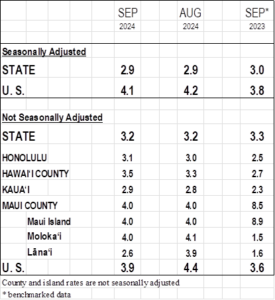
That's according to the latest statistics from a report from the Hawai'i State Department of Business, Economic Development and Tourism published Monday, which showed Maui County's not seasonally adjusted unemployment rate for the month of September at around 4%, down from 8.5% during the same time last year.
While that number is an improvement compared to the same time last year, when the county suffered economic losses alongside the tragedy of the Aug. 8, 2023 wildfire, that number is still higher compared to neighboring islands.
Honolulu saw a 3.1% unemployment rate last month, Hawai'i County's rate hit 3.5% and Kauai's rate was 2.9%. Numbers in these regions showed an increase compared to the same time last year.
Eugene Tian, chief state economist with the DBEDT research and economic analysis division, said right now there are a few industries that are showing improvement on Maui compared to 2019, including construction, informational services, educational services, and arts and entertainment.
"The construction industry is doing good. It's better than last year," he said.
According to the statistics released by the state, the total number of Maui payroll construction jobs are up about 700 compared to the same time last year.
"It's still recovering and improving," he said. "Maui is showing they are losing a labor force."
"People are moving out or they are not looking for jobs," Tian added.
Debbie Cabebe, CEO of Maui Economic Opportunity, said hope for the island's job market rests in affordable housing, homeownership opportunities and focusing on Lahaina.
“Prioritizing the rebuilding of Lahaina and expanding housing for affordable rentals and opportunities for first-time homebuyers is essential to rebuilding the economy. It’s difficult for those impacted by the wildfires to move forward if they don’t have stable shelter. If they are uncertain where they will be living, they are hesitant to commit to long term employment, creating a vicious cycle," she said.
She added: “American Psychologist Abraham Maslow has a respected theory that states that the most basic physiological needs must be met before we can move ‘up’ to the more advanced needs. These basic needs include breathing, food, water, shelter, clothing and sleep. With that they can seek safety and security, which includes health, employment, property, family and social ability. As a community, it’s important for us to show compassion and empathy while assisting with the recovery efforts.”
The not-seasonally adjusted rate for the state was 3.2% in September, the same as in August.
Moloka'i Island had a not seasonally adjusted rate of 4% and Lana'i Island saw a 2.6% rate for September. Both islands saw an increase in unemployment compared to 2023. Moloka'i had a not seasonally adjusted unemployment rate of 1.5% during September of last year, and Lana'i had a 1.6% rate.