
Judge’s ruling opens use of Haleakala Trail
Trending
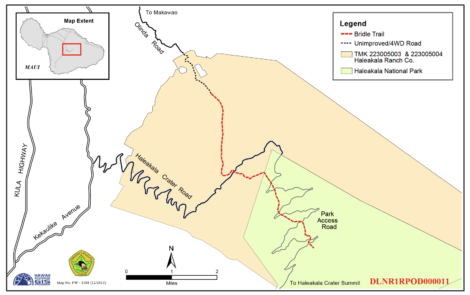
State officials have been ordered to help reclaim a publicly owned, four-mile traditional Hawaiian trail stretching from the top of Olinda Road to the Haleakala Crater.
The public trail that crosses through Haleakala Ranch has been used by pedestrians four times a year for guided tours. However, following a jury trial that ended in favor of Public Access Trails Hawai'i, or PATH, Second Circuit Judge Peter Cahill has ruled the trail should be clearly posted as public and be open to pedestrians, hikers and native Hawaiian practitioners without any fences blocking access to it.
"On the ground, it is a physical impossibility to access or use the actual Haleakala Trail without encountering the multiple fences creating a physical barrier that make hiking or use of Haleakala Trail difficult without climbing over the obstruction," Cahill said in his ruling.
The judge also indicated state officials need to help the public clearly identify the trail on the ground after the state engaged in a course of conduct that fails to locate the trail with sufficient accuracy, thereby depriving the public of access and use of it.
PATH attorney Mike Biechler said his group wants markers that clearly identify the location of the trail.
According to the group, the trail fell into disrepair following the creation of the Haleakala Crater Highway, but neither the territory, nor the state of Hawaii gave up ownership of the trail.
The group said a jury decided in 2014 the trail was publicly owned under the Highways Act of 1892 and Hawaii state statute.
But according to PATH, the state Board of Land and Natural Resources and state Department of Land and Natural Resources failed to assert ownership of the trail or order the removal of the fences, gates and other obstacles.
The group said instead, the state worked with Haleakala Ranch to limit access by offering only a handful of guided tours a year.
PATH sued the state and ranch again in May 2022 and Cahill issued an injunction in December ordering the state to stop allowing the trail to be used by anyone other than pedestrians, hikers, and native Hawaiian cultural practitioners.
The entrance to the trail at Olinda Road has a fence with a sign that says, "no trespassing," according to the judge's ruling. Cahill also said the guided hikes deny access to the public.
Public Access Trails Hawai'i executive director Dave Brown said the Olinda Road fence has a human access point, but there are barbed wire fences crossing the trail mauka that inhibit people's access.
Brown said his group is prepared to take further legal action if there is a lack of compliance.
On Friday, a representative of Haleakala Ranch declined to comment.
The Haleakala Trail is listed on the State Inventory of Historic Places and was used for centuries by the public with maps dating back to the 1800s, PATH said.
The group said the trail was used by Native Hawaiians to access Haleakala Crater and travel from Olinda to Hana. PATH said after the overthrow of Queen Liliʻuokalani, the territory of Hawaii improved and widened Haleakala Trail.
In his order filed March 18, Cahill said the state has failed to lessen the "public nuisances" in the form of one or more fences that were constructed over the Haleakala Trail. He said the nuisances prevent the public from having full access to the Haleakala Trail.
The judge said as the owner of Haleakala Trail, the state land officials were liable for their failure to abate the nuisance.