
Rescue team’s innovative work aids humpback recovery efforts
Trending
Maui whale rescue responder Ed Lyman and his partner, David Mattila, are well aware of the difficulties and dangers associated with freeing humpback whales entangled in lines.
In fact, Matilla has been on the cutting edge of whale rescues for some time now after he had ideas on developing a hooked knife to free them years ago.
In the early 2000s, there really was no manual on how to get close enough to do the job in Hawaiian waters, where a humpback whale is as large as a school bus moving across the surface and sometimes diving.
"Those knives have developed over time," explained Lyman, who works at the Hawaiian Islands Humpback National Marine Sanctuary in Kihei. "We can now reach out with a 35-foot pole."
The teams of two to three responders on Maui have learned to move quickly on a motorized inflatable boat. They have rescued 44 whales since the program began, thus helping with the species' recovery.
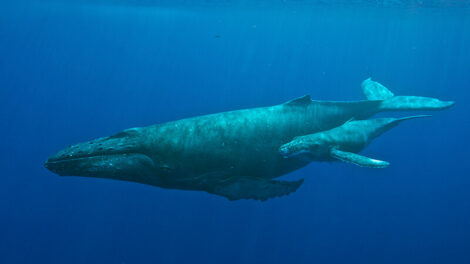
Once on the verge of extinction, humpback whales have made significant gains in certain migratory groups around the world, including the Hawaiian Islands where they generally migrate from the end of the year through May before returning thousands of miles to the Northwest Pacific and Alaska. Hawaii waters are where humpback whales give birth and prepare their young to go on their arduous trip up north.
Meanwhile, the whale rescue network begun by Mattila and Lyman has spread to scores of other countries and locations.
Mattila, who moved back to Massachusetts, has worked with the International Whaling Commission represented by more than 85 countries, and he has trained about 1,700 people from 40 countries in whale rescues.
Before a final moratorium on commercial whaling in 1985 by the International Whaling Commission, worldwide populations of humpback whales were greatly reduced, most by more than 95%, according to the National Oceanic and Atmospheric Administration. However, the move from whale hunting to whale watching has promoted tours with an economic impact of up to $74 million in Hawaii, according to the Humpback National Marine Sanctuary.
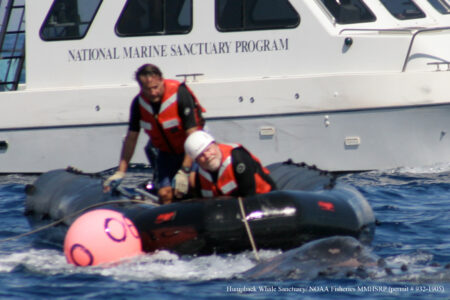
David Mattila (white hat) approaches a humpback whale in distress with his partner, Ed Lyman, in the background. Freeing whales from entangled lines is a part of the work done at the Hawaiian Islands Humpback Whale National Marine Sanctuary based on Maui. Lyman and Mattila have been on the cutting edge of recovery work involving humpbacks since the mid-2000s. Photo courtesy Hawaiian Islands Humpback National Marine Sanctuary
NOAA officials said four out of 14 distinct populations are still protected as endangered under the Endangered Species Act of 1973, though the Hawaiian Islands' stock of humpback whales is no longer listed as endangered, but the whales remain protected under federal and state laws.
As a result, it is illegal to approach within 100 yards of a humpback whale by any means or disrupt a whale's normal behavior or activity. There's also a ban on operating vessels in certain areas from Dec. 15 to May 15.
NOAA research ecologist Marc Lammers said the population of migrating Hawaii humpbacks reached a peak of 17,000 to 18,000 in 2013 before there was a sharp decline in 2014-15 due to warmer waters in the Pacific Northwest and other influences including a marine heat wave and El Nino. Scientists believe warm waters in the Pacific Northwest reduced the upwelling nutrients and food like krill for the Hawaii humpbacks, many of whom perished or moved elsewhere.
"We know there's a lot of them that stopped showing up in Hawaii," Lammers said.
He said the estimated number of Hawaiian humpbacks in 2021 was 12,300.
"Over the past three to four years, it's been relatively steady," Lammers said.
The development of new technology has helped in gathering information. Lyman said people who capture photographs of whale flukes can now enter those images into an artificial intelligence program that helps track individual whales rather than having research interns trying to match thousands of photographs.
Scientists also examine the presence of whale songs to help estimate their numbers, and aerial drones are being used to assess the condition of the whales.
Sanctuary Superintendent Kim Hum said Lyman is the best at what he does.
"Ed makes us better people, and he deeply cares about what he does," she said. "It's a dangerous job. In many cases, because the whales are entangled, they're angry and scared."
Hum said the rescue response team does the work in a way that's safe for them and the whale.
Mattila, who recently retired, also has high praise for Lyman's work with whale rescue teams.
"He's the best trainer out there," Mattila said.