
State officials ask judge to adjust order opening trail to public
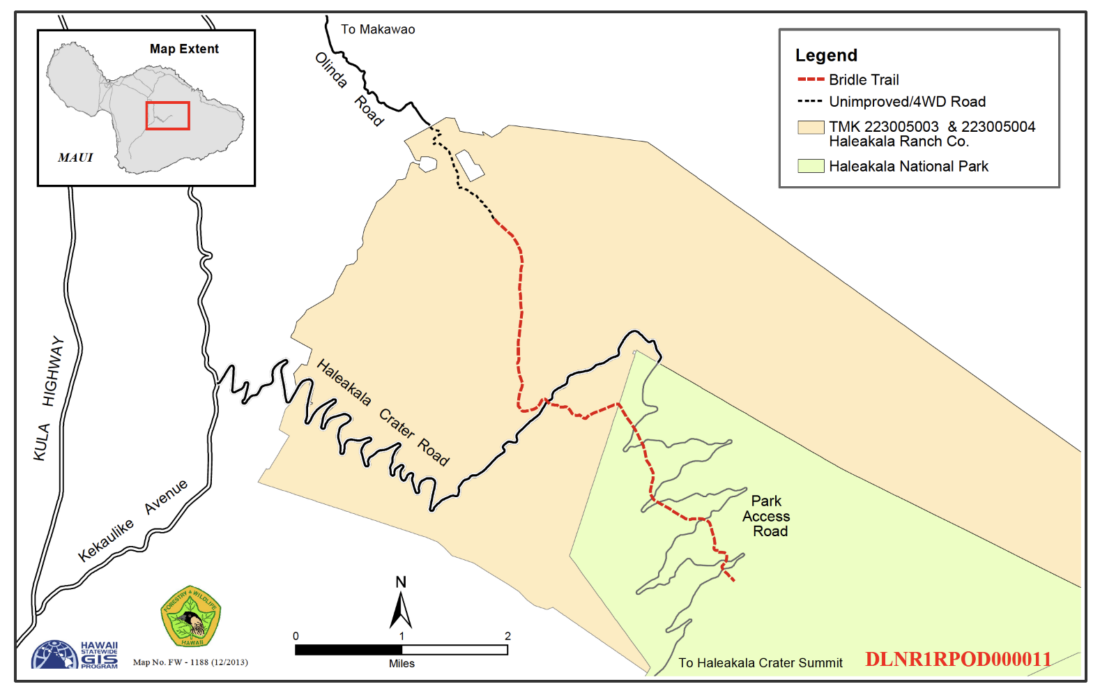
Second Circuit Judge Peter Cahill has ordered the state to carry out its mandate to protect the public use of a traditional Hawaiian trail. The trail, with hash marks, starts at the top of Olinda Road and extends about four miles to Haleakala National Park. Photo courtesy Hawai‘i Division of Forestry and Wildlife
State land officials have asked Maui Circuit Court Judge Peter Cahill to broaden his ruling on a traditional trail above Olinda Road to include the use of motor vehicles for certain purposes, including a Birds, Not Mosquitoes project.
In a request dated March 28, the Department of Land and Natural Resources asked the court to change an injunction, saying a court order issued on March 18 limits the use of the trail to hiking, walking and running or for traditional and customary practices. According to the request, by allowing public access to the trail, it prevents the department’s vehicles from driving the route.
The department also said the order would also limit its firefighters from using Olinda Road in the event of a wildfire, and eliminate its ability to control invasive species such as gorse and maintain critical watersheds.
The department said the current court order would also limit the Haleakala Ranch Company’s ability to access its property, and cut off vehicular access to other private properties, which make use of Olinda Road.
Also filing a response was the agricultural business Mahi Pono, which says it uses Olinda Road to service the water supply at the Olinda Water Treatment Plant and Pi’iholo Water Treatment Plant.
Cahill’s order instructed state land officials to help reclaim a publicly owned, four-mile Hawaiian traditional trail stretching from the top of Olinda Road to Haleakala Crater.
But following a jury trial in favor of Public Access Trails Hawaii, or PATH, in 2024, Cahill ruled the trail should be clearly posted as public and open to pedestrians, hikers and native Hawaiian practitioners without any fences blocking access to it.
Cahill said the state has failed to lessen the “public nuisances” in the form of one or more fences that were constructed over the Haleakala Trail.
The judge said that, as the owner of Haleakala Trail, the state was liable for its failure to abate the nuisance. The judge also indicated state officials need to help the public identify the location of the trail on the ground.
PATH attorney Mike Biechler said state officials testified they did not know the exact location of the trail during the trial.
Biechler said his clients support state officials conducting a survey to ensure the trail is accurately identified and creating a barrier to prevent deer from having access to the land while allowing the public access.
The Haleakala Trail is listed on the State Inventory of Historic Places and was used for centuries by the public with maps dating back to the 1800s. According to PATH, the trail was used by Native Hawaiians for centuries to access Haleakala Crater and cross to the Hana side of Maui.
PATH said that after the overthrow of Queen Liliʻuokalani, the territory of Hawaii improved and widened Haleakala Trail, and a jury decided in 2014 that the trail was publicly owned under the Highways Act of 1892 and Hawaii state statute.
But PATH said the state Board of Land and Natural Resources and state Department of Land and Natural Resources failed to assert the state ownership of the trail or order the removal of the fences, gates and other obstacles.
Local News
Photo of the Day: A Caress

Barry Wurst: ‘Zootopia 2’ delivers a steady stream of laughs for family audiences
Teen dies from injuries sustained in Haleakala Highway crash
Maui police said Friday that a 19-year-old man who was critically injured in a head-on crash on Haleakala Highway ...
Justice Department sues 4 more states for access to detailed voter data
The U.S. Justice Department is suing four more states as part of its effort to collect detailed voting data and ...
6.9 magnitude earthquake causes small tsunami waves off northeastern Japan
TOKYO — A 6.9 magnitude earthquake shook northeastern Japan and caused small tsunami waves but no apparent ...
AAA Hawaii: Gas prices remain down; state among top destinations for travelers
Hawaii gas prices continue to remain near their lowest levels of the year, according to AAA Hawaii. On Thursday, ...