
Marine debris research center may be closing
Trending
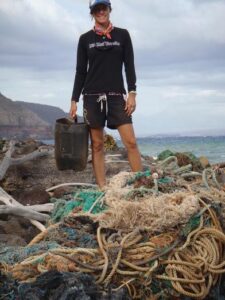
Maui resident Cheryl King, founder of environmental Sharkastics, helps collect marine debris with volunteers so it can be sent to the Center for Marine Debris Research on Oahu. The center could have to close its doors due to funding. Photo courtesy Sharkastics
Scientist Jenn Lynch (left) works at the Center for Marine Debris Research in Waimanalo, Oahu, where she looks at ways to recycle plastic fishing nets and other objects. Standing next to her is Katie Stevens, a project manager. Photo courtesy
Research scientist Jenn Lynch has been conducting tests to recycle Maui marine debris into pavement and planks -- projects by her estimate that could involve finding a use for 200 tons of plastic debris a year.
But Lynch said she may have to shut down her Center for Marine Debris Research on Oahu because of government funding cutbacks.
"We are facing dire fundraising problems," said Lynch, the center's co-director. "What's happening today is unprecedented."
Lynch said the center needs about $2 million a year to continue its research, part of which pays for the Maui-based nonprofit group Sharkastics to remove marine debris at Ka`ehu Beach every month and ship it to the center.
The government grant funding from five different sources ends in March. The center has been in operation since 2019.
Sharkastics founder and chief scientist Cheryl King leads a group of volunteers monthly to remove plastic -- everything from toothbrushes to golf balls and fishing gear. King said they have collected 6 tons over the last six years in an area where green sea turtles nest and monk seals rest.
Bordered by Waiehu and Iao streams, Ka`ehu Bay was once filled with taro patches and a sacred lauhala grove, dedicated for recreation to Hawaiian royalty.
About 64-acres of the Paukukalo coastal wetlands belongs to the Trust for Public Lands and provides beach access and a resource for traditional cultural practices for the Paukukala Hawaiian homestead community.
Besides Sharkastics, volunteers come from various groups including the Hawaii Wildlife Fund, Malama Hawaii and the nonprofit Ka`ehu.
"If the volunteers didn't do it, the reef would be covered with debris," said King.
King said the Great Pacific Garbage Patch, estimated at approximately 100,000 thousand tons, has been floating closer to Maui, and she's been seeing an increase in debris from Asia and the U.S. continent.
Much of the debris has been sent to the center for analysis to find the country of origin.
The nonprofit Pacific Whale Foundation is also a partner, answering a marine debris hotline on Maui and removing the rubbish and sending it also to the center.
Lynch said the center is also receiving marine debris from the Surfrider Foundation on Kauai, Hawaii Wildlife Fund on the Big Island and a nonprofit group from the Papahanamokuakea Marine Debris Project.
Lynch said the center is having discussions about Pacific Ocean pollution with the Taiwanese government and Korea Sea Grant and plans to present a research paper at the North Pacific Marine Science Organization conference in Japan in December.
The Center for Marine Debris Research also started a new program on Nov. 22, paying longline fishing boats that go out into the Northern Pacific a dollar for every pound of marine debris brought back to Honolulu.
"It's been a huge success," she said.
She said she's also in the process of testing marine debris materials working with the state Department of Transportation using plastic fishing nets in pavement in five sections along a mile of Fort Weaver Road.
Another project involves laboratory testing in Omaha, Nebraska, to make planks from plastic fishing net materials.
"Evidence shows recycling plastics is best for the environment," Lynch said.
She said other alternatives are not as desirable -- burying it in a landfill takes up space, shipping debris to another place is costly and usually transfers the problem to a poorer area, and burning trash into energy releases gases into the air, including carbon dioxide.
Lynch, who has a doctorate in marine environmental toxicology from Duke University, was a research biologist for 22 years with the National Institute of Standards and Technology, under the U.S. Department of Commerce, developing best practices for recycling plastic.
She founded the center in 2019 as a joint institute with NIST and Hawaii Pacific University, establishing a microplastic chemistry laboratory in Waimanalo and a plastic recycling research facility in an industrial area in Kalihi.
Lynch said her organization has applied for a couple of government grants but has not heard back from the grant organizations yet. The center is also seeking financial support from private organizations.
"We have every finger and toe crossed," she said.