
Reflecting and rebuilding: Army Corps of Engineers looks back on two years of hard work and emotions
Trending
After two years of yeoman work assisting in the cleanup and restoration of Lahaina in the aftermath of the 2023 wildfires, the U.S. Army Corps of Engineers' work on Maui is winding down.
Cortland P. Henderson, deputy chief of public affairs for the Honolulu Corps of Engineers,
said the recovery field office will close sometime in spring 2026 following the completion of the debris' relocation to the temporary disposal site at Olowalu. He said the Honolulu office will still provide remote support as needed.
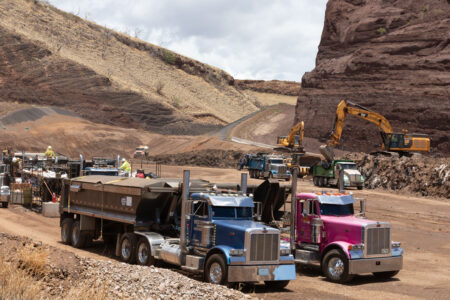
According to Henderson, the final phase of the mission involves transferring debris from the temporary site in Olowalu to the permanent site near the Central Maui landfill.
He said other missions, such as support for the King Kamehameha III Elementary School, are now in an operations and maintenance phase.
"Our role in the temporary housing mission is also winding down; the completion of three final micro-sites will provide an additional 40 temporary housing units, bringing the total to more than 200."
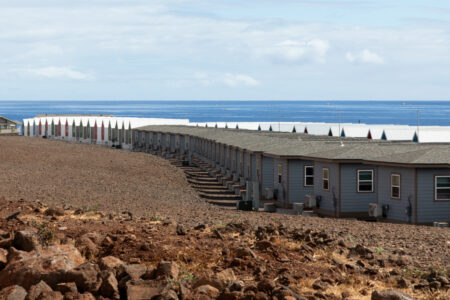
The Kilohana temporary housing site was built by the U.S. Army Corps of Engineers to house Hawaii wildfires survivors. Kilohana means “lookout point.”
Henderson said that despite the crisis conditions, it has been an honor working with relief groups both on the state and federal levels, as well as nonprofits and the people of Maui.
"The greatest challenge was the unprecedented scale and complexity of the mission," Henderson said while reflecting on the last two years. "This involved a multi-phased operation to remove approximately 400,000 tons of fire debris, first from the town of Lahaina to a temporary location, and then transferring it all again to the permanent disposal site once it was ready."
Henderson said the daunting challenge was conducted with "deep reverence for the cultural and archeological sensitivities of the people and history of Lahaina."
Henderson said from Day One, the safety of the public and the protection of Maui’s environment were top priorities. "We are grateful for the community’s patience and trust as we worked to clear the way for Lahaina to begin the next chapter of its story, guided by the vision of its people," he said.
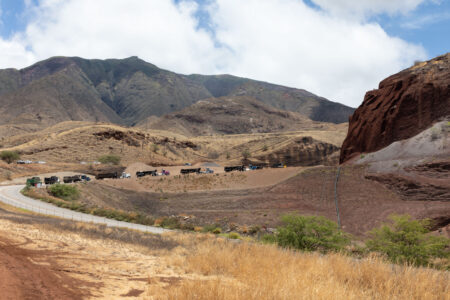
A convoy of U.S. Army Corps of Engineers trucks winds its way through West Maui.
Photo courtesy U.S. Army Corps of Engineers/Duy Ta
Maui County Mayor Richard Bissen has praised the the corps' efforts.
"We are profoundly grateful to FEMA and the U.S. Army Corps of Engineers for exhibiting extraordinary leadership while carrying out this historic mission to support Maui's wildfire recovery," he said.
"From clearing thousands of properties and expediting the construction of a temporary elementary school to leading the safe transfer of 400,000 tons of Lahaina’s wildfire debris, their work has helped restore hope and paved a path forward for our community," Bissen continued. "They have walked alongside us with diligence and care, giving our families the ability to rebuild, providing a place for our keiki to learn and grow, and honoring the memory of those we've lost."
At its peak in the aftermath of Aug. 8, 2023, there were more than 2,200 corps personnel from across the country volunteering to support the mission, Henderson said.
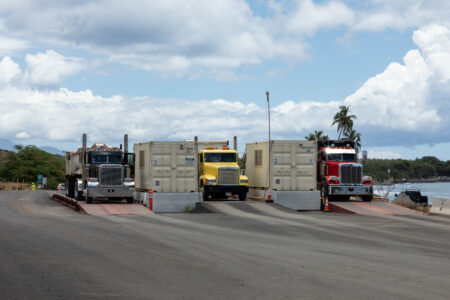
Trucks filled with debris stop at a weigh station.
Photo courtesy U.S. Army Corps of Engineers/Duy Ta
On Maui, there were approximately 190 corps members composed of more than 120 on-site staff and 70 remote subject matter experts. Henderson said the remaining on-site team consists primarily of staff from Honolulu.
He also said the emotional toll, the human tragedy, was not lost on corps personnel.
"The most arduous aspect was the emotional weight of the mission," Henderson said. "Balancing the urgency of the recovery with the meticulous care required to honor the community and its sacred lands was a responsibility we took very seriously. Ensuring the safety of the public and our workforce while navigating this difficult emotional landscape was a constant, deliberate focus."
The corps began their transition out of Maui in February, when the Honolulu office assumed operational control of the recovery field office in Lahaina.
"Currently, we have approximately 20 corps personnel on Maui, consisting of both military members and civilian employees. Their primary tasks are focused on oversight of contractual requirements, quality assurance, project management, and administrative support," he said.
Henderson said out of the tragedy and the Herculean scale of the work that needed to be done came an appreciation for Maui and its people.
"It has been a profound privilege to serve the people of Maui. We have been consistently humbled by the strength, grace and resilience of the Lahaina and Maui communities. Their spirit of aloha and kōkua in the face of unimaginable adversity has been the driving force behind this recovery. Witnessing the community come together to support one another has been a powerful and inspiring experience for our entire team."
Henderson said the corps wants to emphasize that this historic mission was a true partnership.
"Our success was only possible through the seamless collaboration with FEMA, the Environmental Protection Agency, the state of Hawaii, Maui County, our executing contractors, and numerous local community organizations."