
Trending
Some Kula residents say a proposed restoration of the new state Kamehamenui Forest Reserve lacks details on controlling wildfires and keeping pasturelands as firebreaks.
"It's a safety issue for us," said Jordan Hocker, the board president of the Kula Community Association. "We need to know those details because the function of ranching now is preventing the fire risk."
Drafts of the Kamehamenui Forest Reserve Management Plan and Environmental Assessment were discussed at a public meeting Oct. 15 in Kula.
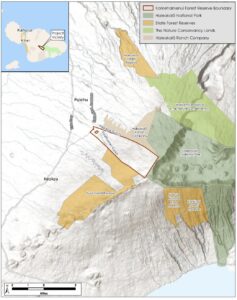
The environmental assessment found the management plan would not have a significant environmental impact on the 3,433-acre reserve that rises from 2,957 feet elevation to 9,700 feet on the northwestern slopes of Haleakala.
Acquired by the state in 2020, the land contains 1,171 acres at the top of the reserve, overlapping federally designated critical habitat for 10 plants and two bird species. The native birds are mostly limited to the heavily forested mid-elevations.
The report said wild animals, invasive plants, wildfire and climate change are a constant threat to the watershed and native plants and animals.
The plan calls for restoring 75% of the reserve to native forest, including 2,210 acres of the upper reserve in the first phase, 714 acres in the mid-elevations in the second phase and 510 acres in the lower western portion of the reserve in the third phase.
The plan also calls for three locations for camping and proposes a phased approach to withdrawing portions of the land from the grazing.
According to the state, the timing of moving from one phase to the next will be determined by the availability of funds and resources. The plan does designate some grazing along the edge of the reserve.
According to Albert Perez, the executive director of Maui Tomorrow, the management plan lacks details about how to mitigate forest fires near residential communities. Perez said the community is very sensitive because of the loss of 19 homes, including 16 in Kula and three in Olinda, during the 2023 wildfires in the Upcountry area.
"I support the forest restoration, but I want to make sure it's done right," Perez said. "I don't want to create another hazard."
Perez also said he believes grazing should be allowed to continue in the lower portion of the reserve.
Hocker said the plan lacks details on whether ranchers on the makai end of the reserve will be able to continue to use the pastures for grazing, which can serve as an effective firebreak between forested and residential areas.
"Our main concern is how will this plan be carried out," Hocker said.
Kyle Ellison, the executive director of Malama Kula, said he is grateful for the presentation during the Oct. 15 meeting, but historically, there have been studies done about how to reduce fire hazards in Upcountry areas.
"There seems to be a bottleneck in the implementation of the plans," said Ellison, whose group has helped to clean up wildfire trash on public and private properties. "I feel that's where the angst comes from."
Ellison said none of his neighbors' homes survived the wildfire, and he feels there is a need for more water tankers and better access to fire suppression devices.
Rancher Teresa Thompson commended state forestry officials for trying to preserve the mauka portion of the reserve for restoration, but Thompson questioned the use of parts of the reserve for recreational visitors.
She worries the recreational uses could help spread invasive weeds or lead to fires similar to the Polipoli fire in 2007 started by a cigarette.
She said ranchers have lost too much grazing land on Maui and more pastures should be maintained in the lower section to control the spread of fires.
Thompson said the southern portion of the reserve has been used by dozens of small ranchers in the past to prepare their livestock for sale and shipping them to feedlots in the U.S.
"It's really important to us," she said. "Because of the drought and the deer, we have had to cut back our herds."
A number of local groups reported that they felt rushed going through the 724-page document after first seeing it at the Oct. 15 meeting.
Residents said while they have participated and expressed their ideas about the reserve in workshops held in 2022, they did not get a copy of the draft of the management plan or environmental assessment until earlier this month. The deadline for comments ended Oct. 23.
The state Department of Land and Natural Resources did not respond to a request for comment.