‘Analogue’ named Hawaii Word of the Year, a counterpoint to Merriam-Webster’s ‘slop’

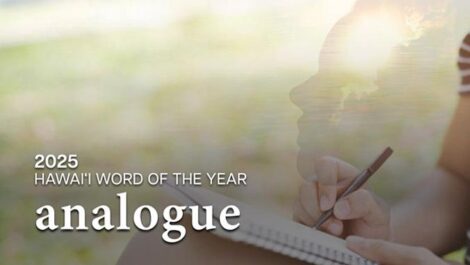
The University of Hawaii at Manoa’s English department has selected “analogue” as the 2025 Hawaii Word of the Year. Photo courtesy University of Hawaii at Manoa
The University of Hawaii at Manoa English department has selected “analogue” as its 2025 Word of the Year for Hawaii, highlighting “the enduring value of human-centered thinking, creativity and interpretation in an age of artificial intelligence.”
According to John David Zuern, a professor and chair of the English department, many students are contemplating careers in writing, teaching, law and other fields involving communication, interpretation, critical thinking and creativity.
Zuern added that many of the students who are concerned about how GenAI might affect their future prospects are looking to more traditional ways of learning.
“They have welcomed opportunities to engage in what might be called ‘analogue intelligence,’ reading printed texts and annotating them by hand, drafting essays on paper, hand-crafting their own books, and taking part in oral presentations and performances in class,” Zuern explained.
UH Manoa faculty members and students making up the English Majors Association leadership came up with “analogue” as the word this year. The selection was announced shortly after Merriam-Webster revealed “slop” as its Word of the Year for 2025.
First used in the 1700s to mean soft mud, slop is now further defined as “digital content of low quality that is produced usually in quantity by means of artificial intelligence.”
“It’s such an illustrative word,” said Greg Barlow, Merriam-Webster’s president, in an interview with The Associated Press. “It’s part of a transformative technology, AI, and it’s something that people have found fascinating, annoying and a little bit ridiculous.”
AI video generators like Sora have allowed new users to quickly create realistic clips based merely on text prompts. But a flood of these images on social media, including clips depicting celebrities and deceased public figures, has raised worries about misinformation, deepfakes and copyright.
Such content has existed online for years, but the tools are more accessible now. The word “slop” often evokes unpleasant images of mud-caked pigs crowding around a dirty trough, or perhaps a bucket of steaming, fetid stew.
For some, the word induces dread, but to Barlow, it brings a sense of hope.
The dictionary’s president says the spike in searches for the word reflects that people have grown more aware of fake or shoddy content, and desire the inverse.
“They want things that are real, they want things that are genuine,” he said. “It’s almost a defiant word when it comes to AI. When it comes to replacing human creativity, sometimes AI actually doesn’t seem so intelligent.”
Zuern said the English department at UH Manoa sees “analogue” as a counterpoint to “slop.”
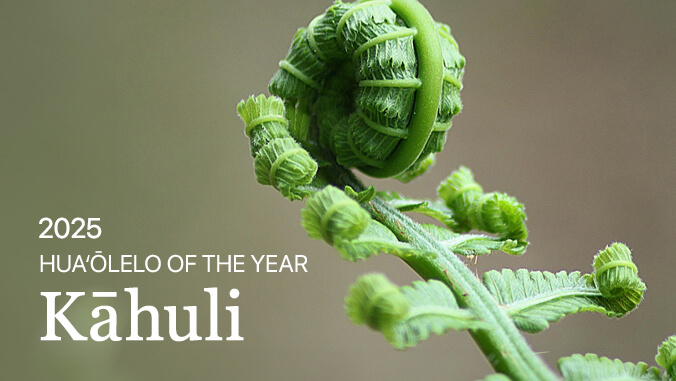
Selected by the University of Hawaii Hilo Ka Haka ʻUla o Keʻelikōlani, College of Hawaiian Language, “kāhului” is the 2025 Hawaiian Word of the Year. Photo courtesy University of Hawaii Hilo
Hawaiian Word of the Year: Kāhului
Selected by the University of Hawaii Hilo Ka Haka ʻUla o Keʻelikōlani, College of Hawaiian Language, the 2025 Hawaiian Word of the Year is “kāhuli,” which means to change, alter or overturn.
Drawn from the opening lines of the Hawaiian creation chant known as the Kumulipo, kāhuli describes the transformation that warmed the earth and unfolded the heavens, catalyzing the formation of the universe itself, according to the university.
“Kāhuli speaks to transformation at a fundamental level — not surface change, but the kind of shift that reorders everything,” said Kaʻiu Kimura, director of the Hawaiian language college.
The selection reflects change on multiple fronts, including federal shutdowns, rising costs reshaping island economies and climate disasters whose recovery continues across our communities.
“The word kāhuli acknowledges that transformation can feel disruptive, but it’s also how new worlds emerge,” Kimura said. “We’re living through an era of kāhuli politically, environmentally and culturally.”
By selecting kāhuli, it is meant to remind people that transformation is both inevitable and essential.
“Kāhuli distinguishes between forces that merely break things and forces that break us free — from complacency,” Kimura noted. “It insists we unsettle what doesn’t serve us to make space for what must come next.”
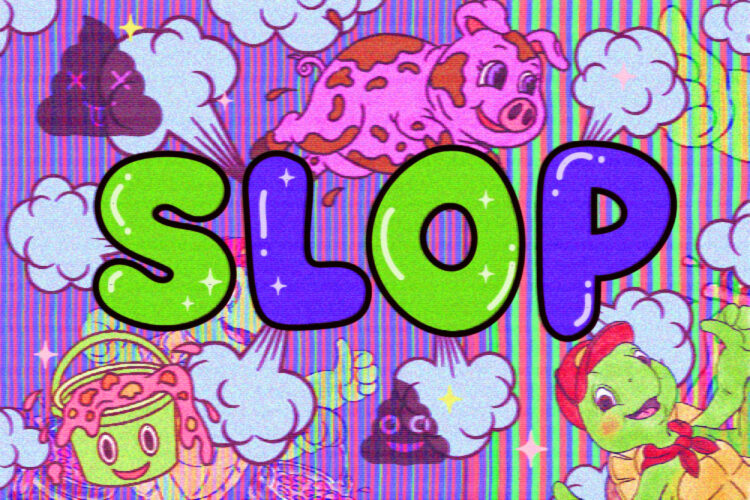
Merriam-Webster has named “slop,” as its Word of the Year for 2025, giving a nod to AI-generated content that has flooded digital platforms. (AP Illustration / Peter Hamlin)
Expanding vocabularies
To select the word of the year, the editors at Merriam-Webster review data about which words have risen in search results and usage. Then they come to a consensus about which word best reflects the span of the year.
Over the years, there are words that are consistently looked up, but they’re filtered out as the dictionary’s editors pick the one that best defines the year at hand.
“Words like ‘ubiquitous,’ ‘paradigm,’ ‘albeit,’ ‘irregardless,’ these are always top lookups because they’re words that are on the edge of our lexicon,” Barlow said. “‘Irregardless’ is a word in the dictionary for one reason: It’s used. It’s been used for decades to mean ‘regardless.'”
Rounding out Merriam-Webster’s top words of 2025 were:
6-7 — The viral term exploded in popularity over the summer. It’s an inside joke with an unclear meaning, driven by social media. It can be traced back to rapper Skrilla’s 2024 song “Doot Doot (6 7).”
“It’s self-referential,” Barlow said. “It’s all the rage, but it’s not a defining term.”
Performative — The “performative male” is online shorthand for a disingenuous guy who pretends to like things women like in order to earn their trust. There’s also a spate of influencers who’ve been called performative for posting surface-level ” kindness content.” The word is versatile, since it extends to stunts in national politics, grandstanding on social media and even the nature of the UN General Assembly.
Gerrymander — There’s a long national history of partisan gerrymandering in the U.S. To retain Republican control of Congress, President Donald Trump has urged maps to be redrawn before the 2026 midterm elections. That’s led to GOP moves in Texas and Indiana to draw districts to their advantage, as well as a counter effort in Democrat-led California.
Touch grass — The definition of this popular internet phrase is “to participate in normal activities in the real world especially as opposed to online experiences and interactions.” It was a serious contender for Merriam-Webster’s word of the year, since it’s used to “describe the aspiration for many people to take a break from their digital addiction,” Barlow said.
Conclave — A conclave is the centuries-old election of a pope that derives its name from the Italian “con clave” — meaning “with a key” — to underscore that cardinals are sequestered until they find a winner.
Some learned the meaning from the titular film in 2024. Others found out in real time when Pope Leo XIV became history’s first American pope in May 2025. “It was so event specific, but the spike (in searches) was huge,” Barlow said.
Tariffs — Originally from Italian and Arabic for “free of charge,” the word entered English centuries ago. The definition is “a schedule of duties imposed by a government on imported or in some countries exported goods.”
Lake Chargoggagoggmanchauggagoggchaubunagungamaugg — Yes, you read that correctly. “The name of this lake delighted and baffled us when it started clogging the Top Lookups list on Merriam-Webster.com,” the dictionary’s editors said. In the Roblox game Spelling Bee!, the Massachusetts lake’s name can be encountered in special modes. But in New England? It’s known as Webster Lake.
The Associated Press contributed to this report.
Local News
‘Analogue’ named Hawaii Word of the Year, a counterpoint to Merriam-Webster’s ‘slop’
Workshops set to help Maui’s farmers, ranchers obtain micro grants

Federal judge upholds Hawaii’s new climate change tax on cruise passengers
County to launch four new electric buses

Back to work: Defending champion Seabury Hall kicks off MIL season strong