
Dave Russell goes from singing conductor to Grammy gold
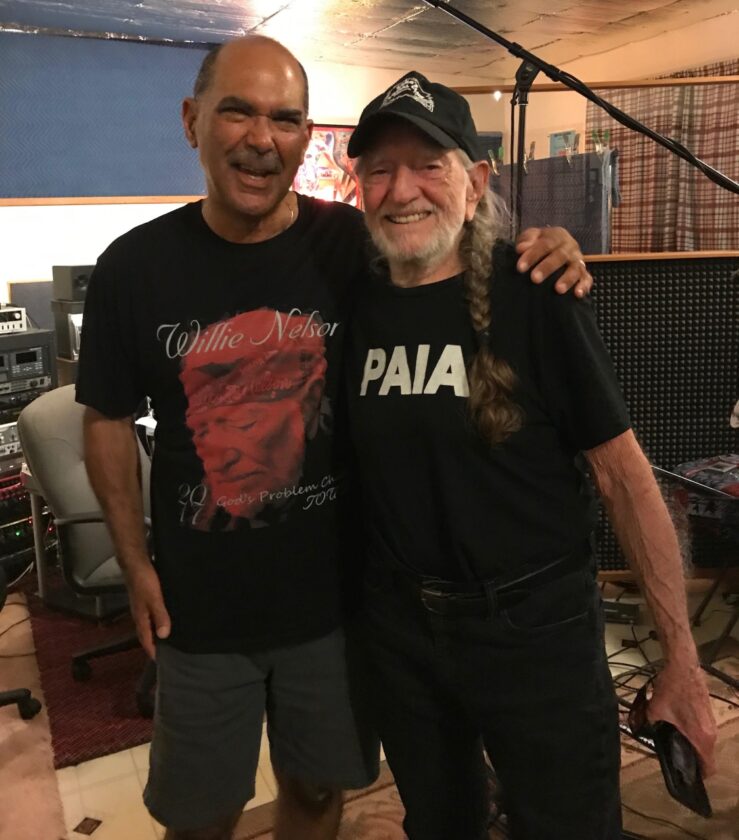
Dave Russell poses for a photo with Willie Nelson in Paia. Courtesy photo
When Dave Russell walked into George Benson’s Lahaina Sound Recording Studio to record a song as the singing conductor on Lahaina’s Sugar Cane Train, he had no idea his world would change and he would eventually become a Grammy-winning recording engineer.
“The train would go by George’s house,” Russell recalled. “Ladies and gentlemen, on your right hand side of the train, the home of jazz guitarist George Benson, and I would strum a little bit of ‘On Broadway.’ The singing conductor job was a blast.”
In time, he would work with an array of artists including Steely Dan, Willie Nelson, Michael McDonald, Kris Kristofferson, the Doobie Brothers, John Denver and Benson, and open his own studio in Paia. He won a Grammy Award for working on Steely Dan’s record, “Two Against Nature,” partly recorded on Maui.
Back in his early days, prompted by his wife to record an original song, Russell stopped by Benson’s Lahaina studio.
“I recorded the single and fell in love with the process,” he said. “I think I impressed them a bit because I recorded live steam-locomotive sounds and brought it into the song for a sound effect.”
Mesmerized, he offered to pay off part of his recording expenses by volunteering at the studio.
“I said I’ll make coffee, I’ll clean, I’ll do whatever you might need,” Russell recalled. “I kind of knew George prior to that because the train went by his house five times a day, and George liked the train. He’d come to the station with his young boy, and we’d get him on the locomotive.”
After a year, Russell was offered a paying job, and he became the studio’s chief engineer.
During this time, he worked on Brother Noland’s “Native News,” Cecilio & Kapono’s “Good Times Together,” Hapa’s debut and recordings by Keola Beamer, along with albums by John Denver and Randy Travis, and with Benson’s “Big Boss Band,” “Twice The Love” and “Irreplaceable.”
He won a Nā Hōkū Hanohano award for engineering for Henry Kapono’s “Song For Someone” and was nominated for his “The Wild Hawaiian” album.
After the breakup of Steely Dan, while living on Maui, Walter Becker had begun producing some acts and using Benson’s studio, which is where he met Russell.
“We became kind of close then,” Russell explained. “His next move was to build his studio in Ulupalakua. A year had gone by, and he called me up and said, ‘Would you like to run the studio?’ I couldn’t say no.”
Russell spent 13 years at Becker’s Hyperbolic Sound studio located on Ulupalakua Ranch land.
What was it like working with Becker, who was known as an exacting perfectionist?
“I was worried because I heard so many stories about Steely Dan, changing drummers, 20 guitarists, going through people really quickly,” he said. “But he turned out to be the kindest, most generous person. He knew what he wanted with music and worked really hard to get there. No question about it, Donald (Fagen) too. I just loved him.”
During his time in Ulupalakua, Russell worked on Fagen’s Grammy-nominated “Kamakiriad,” Becker’s solo album “11 Tracks of Whack” and some jazz projects. When Steely Dan reunited in 1993, they began working on new songs.
“They were writing again,” said Russell. “They were total friends and worked well together. We laid basic tracks down in New York and brought those back (to Maui). We would work a bit in Hawaii and then back to New York for a couple of years.”
The resulting “Two Against Nature” won four Grammy Awards, including Album of the Year and Best Engineered Album Non Classical.
“I was so blessed to be working with those guys,” said Russell. “They used so many professional session players that every take they did was amazing. I’m thinking to myself, ‘I’m sitting here hearing it live through this high-fidelity equipment and I’m actually getting paid.'”
When Becker moved back to New York City, Russell opened his own Paia Town Recording studio. That’s when he began working with more legends like country music icon Willie Nelson.
“We recorded his vocal and guitar work on the Doobie Brothers’ album (“World Gone Crazy”),” said Russell. “Gail Swanson had Willie sing a duet with her on her album, and then Willie brought his producer and we worked on his ‘God’s Problem Child’ album. Recently, Willie did the duets (album “Jake & Friends”) with Jake Shimabukuro, and the last thing I did with Willie was Edie Brickell’s song ‘Sing to Me, Willie.'”
Hawaii artists like Willie K, Keali’i Reichel, Steve Grimes and Andrew Molina have all employed his Paia studio services. The Doobie Brothers’ Pat Simmons and Michael McDonald recorded there.
“Mike has been here several times,” Russell noted. “I was so blessed to have him here. He did some vocals for the Doobie Brothers and worked with Jake Shimabukuro here, too.”
After 40 years with such a storied career in the recording business, Russell retired and closed his Paia studio.
“I still get a few calls coming in,” he said. “But you’ve got to draw the line sometime in life. My wife, Mary, retired, too. So we’re going to hang up our headphones.”
Local News
Hot Kupuna Nights returns to Lahaina on Jan. 17
The Maui County Office of Recovery, in collaboration with Hawaiian Music Perpetuation Society, will hold Hot ...
Nonprofit distributes record number of meals set in December
The nonprofit group Hale Kau Kau in Kihei served a record 5,785 free meals in December. The meals included 2,419 ...
Young Brothers names new president
Dave Russell goes from singing conductor to Grammy gold

Broadway stars to rock with Maui Pops Orchestra
Maui braces for possible end to FEMA rental assistance and more housing strain for fire survivors
Nearly 1,000 households displaced by the catastrophic 2023 Maui wildfires are anxiously awaiting word on whether ...