
Groups in Kula continue work to reduce wildfire risk
Trending
More than two years after a wildfire consumed his house and 25 other homes in Upcountry, Kula resident Thomas Liu has rebuilt his main residence and is working with various groups to make sure a similar disaster doesn't happen again.
Liu, 85, recalled how winds blowing 50 to 80 mph drove the fire through the nearby gulch before it burned his house and several others.
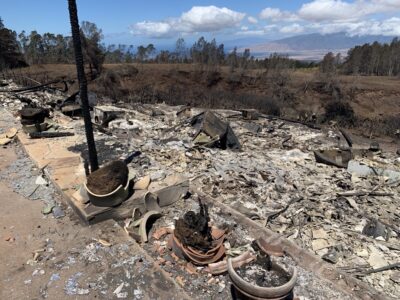
Kula resident Thomas Liu's home was destroyed in the 2023 wildfire in Kula. Photo courtesy Kula Community Watershed Alliance
Liu said he decided to rebuild because of help from neighbors and other people who provided him with food and shelter after the fire. They're also helping clear the nearby gulch to prevent future fires.
"It's the support of the community," Liu said. "The people are wonderful."
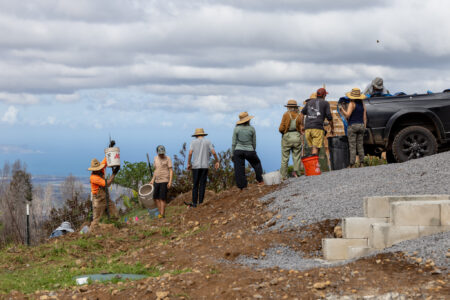
Members of the Kula Community Watershed Alliance and other volunteers help clear the slopes of wattle trees and other brush that pose a wildfire hazard near Thomas Liu's residence. Photo courtesy Kula Community Watershed Alliance
Alliance helps in replanting
The nonprofit Kula Community Watershed Alliance has volunteered to help to clear the gulch near Liu's home and other wildfire risk areas, and replant the area with less flammable native Hawaiian plants.
Sara Tekula, the alliance's executive director, said the intent is to return the land to native habitat and increase its potential as a watershed, as native plants generally consume less water than alien species.
"Understanding how water moves through our specific landscapes is essential for restoring burned areas wisely," said Tekula.
The alliance includes volunteers and 71 Kula property owners who were impacted by the wildfire.
The nursery ranges from low-growing plants like Hawaiian ferns to koa tree saplings.
"The species list is long -- everything from canopy trees to shrubs to ground covers to ferns -- all are native to this area of the island and propagated from seeds collected from wild native trees found within Kula," Tekula said.
The alliance has also established a 60-foot firebreak for 1.5 miles that can be used by firefighting vehicles, and the group is also working with the state Forestry and Wildlife Division on a 10-year plan to manage 310 acres of undeveloped land, part of which was burned during the wildfire.
"It's going to include managed grazing and land restoration together," she said. "They can be complementary practices."
She said financial support came from a number of entities, including the Maui Strong Fund of Hawaii Community Foundation, Hydro Flask, Maui Fires Relief Fund (Hawaii Rotary District 5000 Foundation), the U.S. Forest Service and the state Surface Water Protection Branch.
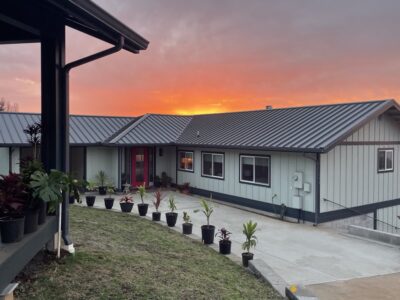
The Kula Community Watershed Alliance is helping replant burned wildfire areas in Kula with native plants that will be more fire resilient. Photo courtesy Kula Community Watershed Alliance
Malama Kula reduces waste
The organization Malama Kula, composed of Kula property owners, has begun a green waste collection program.
Malama Kula executive director Kyle Ellison said one of the goals of his group is to reduce the amount of fuel that could burn in a wildfire and develop a defensible space in Kula.
Malama Kula has established several areas where people can put their green waste into bins in Kula. Ellison said the arrangement has helped to encourage landowners to reduce dumping into gulches and removed more than 3,300 truckloads of green waste.
It also has turned about 1.6 million pounds of trees including eucalyptus and wattle into chips to create ground cover and mulch to stabilize soil and prevent erosion.
The chips are also used to create firebreaks around the perimeters of properties.
Ellison said Malama Kula has a kupuna program that offers to pick up cut branches and trees from homes of residents who are 65 years old or older.
Group awaits response
In May, the Kula Community Association sent a letter to Gov. Josh Green seeking state help in the development of two 500,000-gallon water tanks to fight future fires in the Upcountry area.
Association president Jordan Hocker said she hasn't yet heard back about the request. Gov. Green's office said on Monday that it has referred the association's letter to the division for a response.
The division has said that it plans to establish about two to three water tanks where helicopters can dip their water buckets to fight fires within the next couple of years.
Association board member Brendan Balthazar said the division's idea of installing helicopter dip tanks may work when weather conditions are ideal, but helicopters can't fly in high winds.
Balthazar, a former firefighter, said if the weather causes a power outage, the county also won't be able to pump the water through the fire hydrants.
He said one alternative would be to build the two 500,000 gallon tanks at a high elevation, so even if there is an electrical outage, gravity would create enough pressure to fill mobile tankers to fight a wildfire.
"That makes more sense than the dip tanks," he said.