Taro growers seek local decision-making
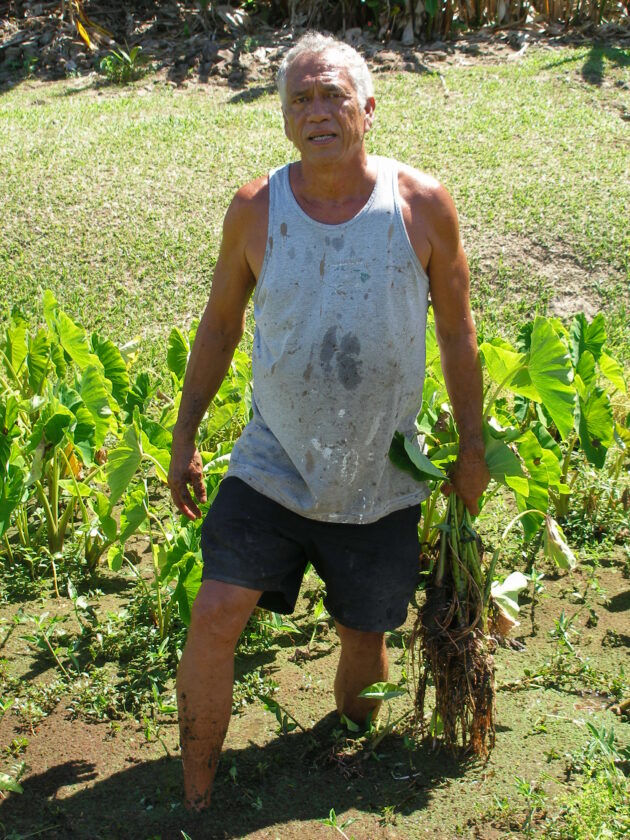
Wailua taro grower Ed Wendt said he’s been battling to have a fair amount of water for his plants for decades and while the situation has improved, East Maui farmers still need help. Photo courtesy of Wendt family
East Maui farmer Ed Wendt recalled how at one point in the 1980s, stream water into his and other neighboring taro patches was so low for years that many, including his son, focused on keeping a few plants alive by trucking in water. This was at a time when a large portion of the water was diverted to irrigate thousands of acres of sugarcane elsewhere.
“We were in survival mode. It was sad,” said Wendt, who can trace his family growing taro back six generations.
“I fought to get the water returned.”
He said a shift in laws and rulings by the state Supreme Court has helped to enable some farmers like him to receive a steady flow of water over the last several years.
Minimum stream flow standards were ordered by the state Commission on Water Resource Management in 2018, including diversions by East Maui Irrigation, a subsidiary owned by pioneer sugar growing firm Alexander & Baldwin Inc.
East Maui Irrigation is now owned by the Canadian-based pension fund Mahi Pono, which purchased 41,000 acres of Alexander & Baldwin land on Maui.
In December 2025, Mahi Pono received a one-year revocable permit from the state land board to continue managing the diversion of water by East Maui Irrigation. But there are plans to have East Maui residents eventually assume management control.
The system conveys water from East Maui sources to the Kamole Weir water treatment plant in Makawao, supplying water to Upcountry residential and agricultural areas and to Central Maui for other uses, including irrigation.
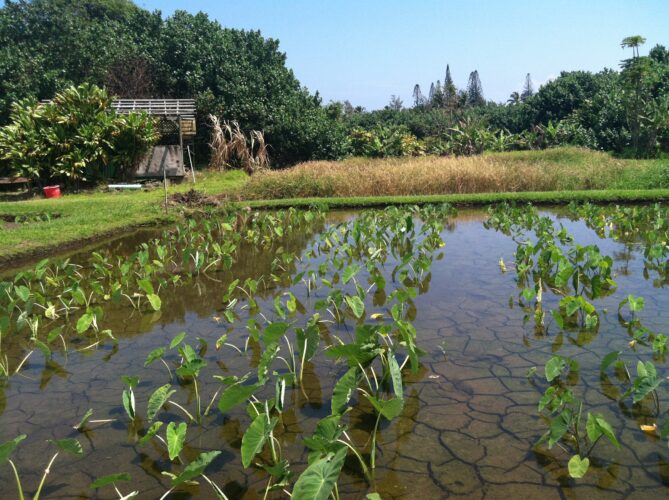
Based on a Maui County charter amendment, the East Maui Regional Community Board, ‘Aha Wai O Maui Hikina, is moving forward with plans to eventually manage stream diversions from Nahiku to Huelo. Gary Kubota/Maui News
East Maui known for independence
Wendt’s taro farm is located in the Keanae-Wailua region along Hana Road, a densely tropical area that sometimes seems frozen in time, with more than 40 one-lane bridges and a posted speed limit of 10 to 15 miles an hour.
In 2000, the road was recognized by the White House for its historical and cultural significance and named the “Hana Millennium Legacy Trail.”
Along the road near Nahiku is Piilanihale, one of Hawaii’s largest heiau where 15th century stone platforms serve as a reminder of a once thriving Hawaiian community.
In the past, the East Maui community has insisted on keeping one-lane bridges one-lane to slow traffic on a heavily traveled visitor corridor, even if the action means losing federal funding assistance.
The county backed off on replacing the Make-Man Bridge with a two-lane bridge and kept it one-lane with space for pedestrian traffic.
Maui voters support local water control
Public sentiment has also been changing on Maui with a move away from long-term private control of the stream diversions to giving local communities more authority over water resources.
In a charter amendment in 2022, Maui County supported giving East Maui residents increasing control over streams and tributaries, authorizing the establishment of the East Maui Water Authority.
The authority, a county department created to acquire, manage and control water collection and delivery systems in the Nahiku, Keanae, Honomanu and Huelo areas, is guided by the East Maui Regional Community Board, ‘Aha Wai O Maui Hikina.
The department is developing a watershed management plan with the aim of ensuring an efficient and sustainable distribution of water resources that includes local expertise and Hawaiian knowledge of the areas.
The board began conducting a series of community workshops in Keanae, Wailuku and Haiku last year, inviting the public to discuss key projects to improve the water system.
The workshops were held in collaboration with the community associations in Haiku and Kula.
“The most important thing is everybody including Mahi Pono and Upcountry residents have water rights now, and we need to sustain this thing,” Wendt said.
The East Maui Water Authority has said it is having meetings with Mahi Pono and the community and creating staff positions to obtain long-term rights to manage the collection and distribution of water.
Authority director Gina Young has said consideration of a long-term lease for East Maui water is inappropriate at this time given the changing weather patterns, historic drought conditions, and significant information gaps.
The county supported House Bill 2434 calling for a maximum of a five-year lease.
Although supported by the Democratic Party of Hawaii, the bill died last week after the state Board of Land and Natural Resources opposed aspects of it, including a maximum five-year license term, saying a longer period would be needed to make long-term plans.
Acting state land board chair Ryan Kanakaole said he was also worried about an increase in his staff’s workload without additional funding and he encouraged continued discussions to achieve the bill’s stated goals.
Mahi Pono declined comment on the death of House Bill 2434.
The East Maui group Na Moku ‘Aupuni o Ko’olau Hui, including lineal descendants of taro farmers, said they’ll continue to push for local control.
“We just keep pushing through,” said Jerome Kekiwi, Na Moku’s president.
“We’re just doing what we feel is right.”
Kekiwi said his group opposed the state issuing the one-year revocable permit to Mahi Pono.
He said on some days, he finds the water isn’t flowing into his taro patches and has to walk up the mountain to cut through hau trees and other overgrowth to repair a breach.
“We need help cleaning the waterways,” he said.
Wendt said he supports efforts by East Maui residents to control diversions in their area and sees how the authority managing water resources will eventually switch to the East Maui
Water Authority.
He said he was also in favor of building more reservoirs and water tanks to provide water and wildfire protection to residents in Upcountry Maui, including Kula.
“We need to look at alternatives,” he said.
Wendt said about five years ago after the state water commission’s ruling to increase the flow of the Wailuanui Stream, he noticed the return of a certain kind of seaweed algae and schools of fish and his taro yield increased.
“There’s been a tremendous difference,” he said.
Wendt said the state water commission did not issue 100 percent of what was requested by East Maui taro farmers and hopes that with better management, more will be given, but what’s already been given has improved the future of some taro growers.
He said he’s been able to expand the cultivation of his taro and his son and grandchildren have taken over the cultivation of his taro patches.
“I’m very thankful for that,” he said.
Local News

Society honors 2026 in a special way
Healthwise Maui: Experts answer your health-related questions
EDITOR'S NOTE: Physicians, providers, and administrative staff who practice at Maui Health hospitals and clinics ...

UH scientists discover 10 new species of Hawaiian moths

Photo of the Day: Lahaina low tide
Ka‘ana Mana‘o: Big things are happening on Lāna‘i
In December, we took you to our farm on Molokai. This month we take you to our Education Center on Lāna‘i ...