
Utility criticized for power shutdowns, above-ground wooden poles
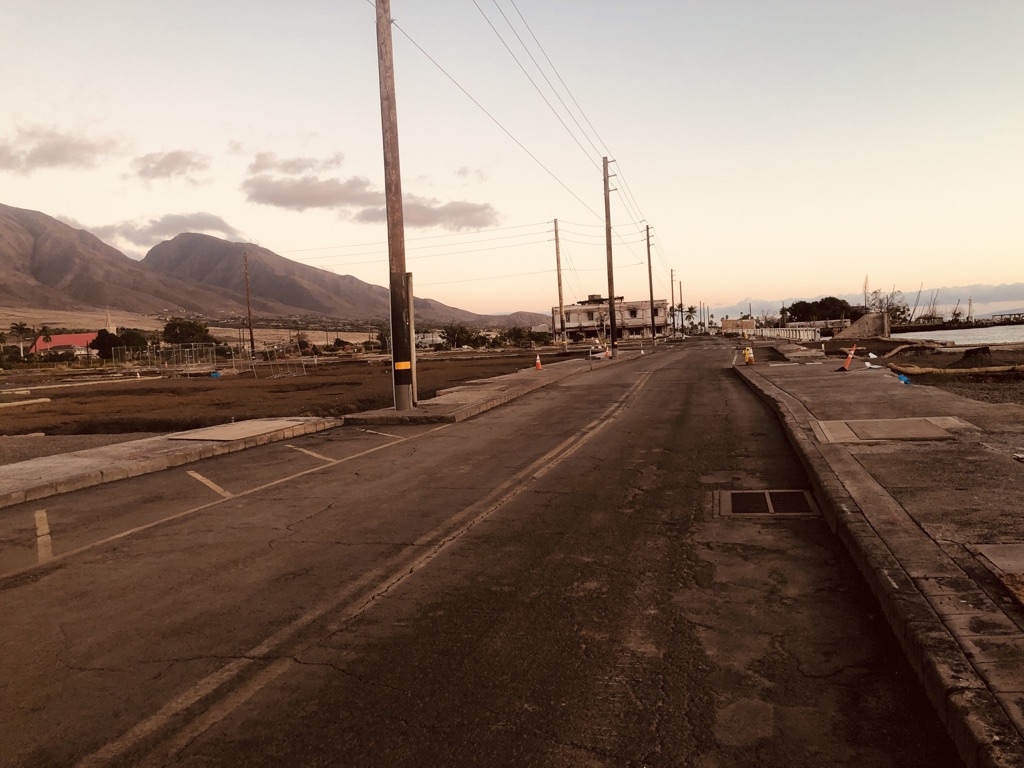
Hawaiian Electric has been criticized for installing wooden poles along Front Street, when wooden poles toppling in high winds contributed to the 2023 Lahaina wildfire. The public utility said these poles were installed as part of immediate restoration efforts to meet customer service requests and that the poles are upgraded with new fire protection and termite prevention mesh and in a vertical configuration that helps to prevent the conductors from coming in contact with each other during high winds. The photograph was taken in November 2024 along Front Street. Gary Kubota/Maui News
Hawaiian Electric’s policy of shutting down service in certain areas of Maui County to avoid the risk of downed power lines sparking wildfires has prompted public criticism.
Maui resident Joseph Pluta said he sees the Public Safety Power Shutoffs (PSPS) as a failure in the public utility providing the right infrastructure.
“I don’t think Hawaiian Electric maintains its infrastructure system, and the public suffers,” Pluta said.
Pluta whose home was destroyed in Lahaina to a wildfire in 2023 said he doesn’t understand why Hawaiian Electric is continuing to install wooden poles on Front Street instead of underground lines, when it was the toppling of wooden power poles that contributed to the disaster.
“It’s utterly ridiculous,” he said. “They should maintain the infrastructure and do the fixes.”
His family suffered additional damage because he had installed a $30,000 hyperbaric chamber at his residence to help to treat his wife’s debilitating mental condition — a facility that also burned in the wildfire.
His wife is now living with a caregiver.
Pluta and other residents have also raised questions about how the utility’s shutdowns during high winds might affect people living at home who rely upon medical equipment to survive, including breathing aids.
The new policy, taking effect in July 2024, triggers shutdowns partially based on high winds and humidity.
Winds with gusts of 80 miles an hour prompted shutdowns on Feb. 9-10 to about 10,000 West Maui customers.
An earlier shutdown of 330 customers occurred in Upcountry Maui in July 2025.
Power critical for home care
Kula resident Dick Mayer said he uses a device to help him breathe better at night while sleeping and he knows there are others who have similar devices.
They might need a place to recharge or receive an emergency battery pack from the county, he said.
“For some people, it is critical,” he said.
“For us, it’s important to have a good backup system and somebody should figure that out,” he said.
Neither Maui County nor leading health provider Maui Health could provide an accounting or estimate as to the number of patients in Maui County relying on power for medical devices.
Mayer said the County of Maui Emergency Management Agency should work with the medical community to have a study conducted on the emergency services needed to assist residents relying on electricity to sustain their health.
County, Maui Health have emergency generators
Maui County officials said it has backup generators at a number of police and fire stations on Maui, Lanai, and Molokai.
“The majority of the backup generator power will be dedicated to supporting the facility’s essential operations,” the county said.
“The county will evaluate establishing temporary service centers to provide charging capabilities as warranted by the situation or incident, on a case-by-case basis.”
Maui Health said Maui Memorial Medical Center, Kula Hospital, and the Lanai Community Hospital have emergency generators in place to maintain operations during a power shutoff.
Maui Health spokesperson Mahie Wong said its facilities can expand resources to care for a surge in patients if needed during a natural disaster or other emergency situations.
“In the event of a power outage, we are able to maintain our operations at full capacity using generators at each of our three hospitals on Maui and Lanai, ” she said.
“Preparing for electrical outages, including potential prolonged outages, is part of our standard emergency planning.”
Wong said individuals who need power for medical equipment should go to the nearest emergency shelter, many of which have dedicated electrical service for medical device plug-in, or call 911 in an emergency.
“Our hospitals have generators to ensure uninterrupted care for patients already in our facilities, as well as for any necessary patient transfers from other hospitals or care settings, which are coordinated by state and county agencies,” she said.
Maui Health advises those who require medical devices to visit Hawaii Electric’s website or contact Maui Electric to determine whether they live in a PSPS area.
Maui Health said patients who require medical devices to assist them in living should create a personal emergency plan that includes finding an alternate place to stay with power.
“These individuals should also fill out HECO’s Medical Needs Communication Form to sign up for advanced notice of a PSPS.”
HECO has additional PSPS preparation information available on its website at www.hawaiianelectric.com/psps.
The county has backup generators at:
Police stations: Wailuku, Kīhei, Hāna, Kaunakakai, Lahaina, Lānaʻi City
Fire stations: Wailuku, Kahului, Pāʻia, Hāna, Kīhei, Lahaina, Napili, Wailea, Lānaʻi City, Kaunakakai and Hoolehua on Molokai.
County Buildings: 200 S.High Street (Kalana O Maui Building)
Maui Health has emergency generators at Maui Memorial, Lanai Community Hospital, and Kula Hospital.
Hawaiian Electric says power shutdowns are last recourse
Hawaiian Electric said it does not have large capacity emergency generators on Maui to enable the public to charge their communications devices including computers and smartphones but it is in ongoing discussion with various partners on such a mobilization in the future.
Hawaiian Electric spokesperson Shayna Decker said the company can’t divulge details because of confidentiality laws but it has been asking all customers to please contact its call center to inform them if any occupant at a residence is on life support or has other medical needs dependent on electricity.
Decker said the PSPS program is just one part of Hawaiian Electric’s strategy to keep the community safe and is considered a “last line of defense” to help protect communities and properties.
She said Hawaiian Electric has expanded its Wildfire Safety Strategy to include installing underground facilities and reducing the risk of wildfires started by utility equipment.
She said in high risk areas, they are deploying covered conductors, power lines that are protected by heavy-duty insulating material which helps to prevent bare wires from sparking if they touch another line or fall to the ground.
Decker said a pilot program is planned to convert about two miles of above-ground lines to underground utilities in Lahaina.
She said part of the prevention program includes enhanced inspections of electrical assets and expanding hazardous tree removal to create a wider clearance for power lines.
Hawaiian Electric’s plan may be viewed at Wildfire Safety Strategy: https://www.hawaiianelectric.com/documents/safety_and_outages/wildfire_safety/2025-2027_wildfire_safety_strategy.pdf
If you or someone in your household relies on an electric or battery-dependent medical device, download and print out: https://www.hawaiianelectric.com/documents/safety_and_outages/wildfire_safety/psps_medical_needs.pdf
If an occupant at a residence is on life support or has other medical needs dependent on electricity, sign up for emergency outage communications to stay informed here: https://www.hawaiianelectric.com/safety-and-outages/wildfire-safety/public-safety-power-shutoff/psps-sign-up
Local News
Utility criticized for power shutdowns, above-ground wooden poles
Treecovery helps Maui wildfire recovery
Pet of the Week: Mack
The Pet of the Week is submitted by the Maui Humane Society to promote adoptions at the Maui Animal Shelter and ...
Photo of the Day: MFD training session
Feasibility study underway for new Kapalua recycled water treatment plant
Hawaii Water Service has selected Carollo Engineering Inc. to complete a feasibility study for a decentralized ...
Aloha Mākena Endowed Scholarship applications open through March 2
Mākena Golf & Beach Club is now accepting applications for the Aloha Mākena Endowed Scholarship, an annual ...