Maui County mayor says housing remains top priority in State of the County address
Bissen applauds county’s fire recovery work in annual address
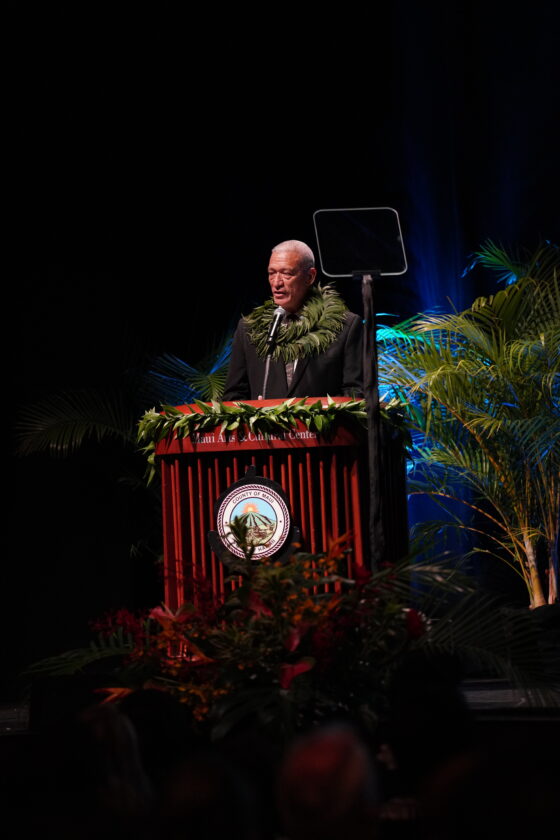
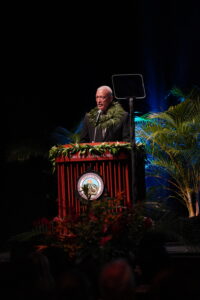
Mayor Richard Bissen addresses the audience during his fourth State of the County address on March 5 at the Maui Arts & Cultural Center. Eli Pace/The Maui News
As Maui County Mayor Richard T. Bissen Jr. delivered his fourth State of the County address, he celebrated new housing developments, applauded fire recovery work and implored any local families who might be thinking about leaving the county to reconsider.
“My No. 1 priority is to keep our people home,” Bissen said at the end of his remarks. “If you are thinking about moving away from Maui County, please don’t. Change is not coming. Change is here.”
The State of the County address in the Maui Arts & Cultural Center’s Castle Theater on March 5 came as Bissen seeks a second term. Also running for mayor are Maui County Council Vice Chair Yuki Lei Sugimura and West Maui real estate broker and former planning commissioner P. Denise La Costa. Candidates have until the June 2 deadline to file to run for office. The primary will be Aug. 8, and the general election is Nov. 3.
In his State of the County address, Bissen highlighted his administration’s work on Bill 9 and the progress that’s been made rebuilding Lahaina, both of which have been central issues for the challengers in the upcoming election.
However, Bissen didn’t back down on either front. He said his administration has advanced housing and infrastructure projects countywide at the same time they’ve worked to navigate “the largest recovery effort Hawaii has ever faced.”
In his remarks, Bissen celebrated how far the work has come and detailed some of the upcoming priorities and projects for 2026.
In addition to increasing affordable housing and recovery work from the 2023 Maui wildfires, Bissen also highlighted new infrastructure projects, what’s being done to address the number of people who are unhoused and efforts to improve the quality of life across the county.
Top priority
Bissen said addressing the lack of affordable housing in Maui County has been his administration’s top priority since taking office. “Our plans and partnership are working as we continue to deliver housing across Maui Nui,” he added.
Bissen said House Maui is serving as a community-driven framework that brings government action, philanthropic investment and private sector participation together around community-identified priorities.
“Under House Maui, we’ve made direct commitments to use county-owned land, infrastructure and resources to reduce costs and accelerate housing for local families,” Bissen said.
Bissen said 10 affordable housing projects are either currently moving forward or have already been completed in West Maui, including the recently finished Kaiāulu O Kūku’ia project with 200 units and the Kaiāulu O Kupuohi project with 89 units.
Bissen also highlighted seven other county-supported rebuilds in progress in West Maui, including the Front Street Apartments (238 units), Lahaina Surf (111 units) and 250 units that are coming through Community Development Block Grant single-family rebuilds and new builds.
The Kaiāulu O Nāpili is another affordable housing project in the pipeline, and Bissen said it will deliver 153 units, all of which will be affordable housing units, once complete.
In South Maui, 222 affordable homes were built over the last three years, and Bissen said projects call for 592 more units to be constructed from 2026 to 2030.
Other developments are happening in the Central Maui and the Upcountry area, and work is being done on Lanai with projects like Kaiaulu O Lana’i, which is delivering 72 rental and rent-to-own units, Bissen said.
Based on figures provided by the mayor, Maui County has delivered affordable housing at an accelerated rate in recent years with 293 homes annually from 2023 to 2025 after an average of 98 new units per year from 2013 to 2022. Bissen said that’s expected to increase to 414 units per year from 2026 to 2030.
Bissen added that 880 affordable and workforce homes were built countywide over the past three years, but 2,839 affordable and workforce units are expected to be delivered from 2026 to 2030.
“Through the collective work of the county, the state, House Maui, private and nonprofit developers, and our community partners, we are generating real, sustained momentum to confront our housing crisis and deliver homes that keep local families in Maui Nui,” Bissen said.
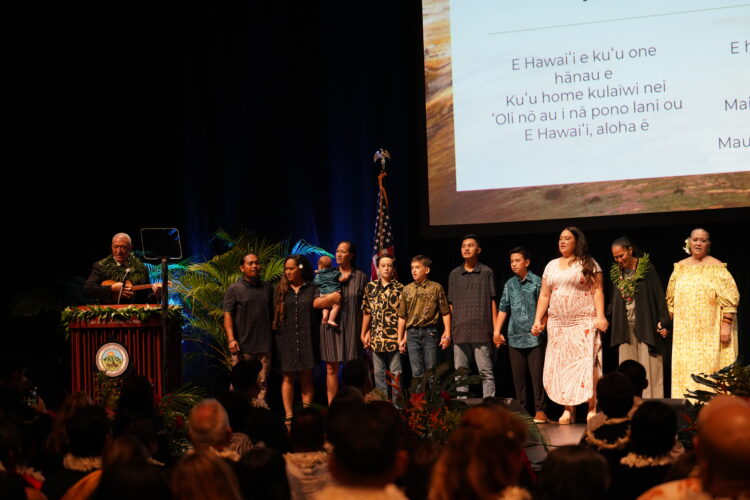
Maui County Mayor Richard Bissen plays the ukulele as he leads the audience in “Hawaiʻi Aloha” with his family members on stage during the State of the County address March 5 at the Maui Arts & Cultural Center. Eli Pace/The Maui News
New infrastructure
Housing cannot happen without infrastructure, and Bissen announced that over the next five years, Maui County will invest more than $1.29 billion on infrastructure that supports housing, including water, wastewater, road and drainage projects.
Bissen described the Central Maui Wastewater Reclamation Facility as an essential piece in expanding the housing supply in the area, saying it would serve an estimated 2,700 existing residences in addition to 2,000 new homes as well as businesses, schools and other facilities.
“This year alone, more than $125 million will be proposed to start construction on this project,” Bissen said. “Once complete, it will unlock additional housing capacity in Central Maui, reduce reliance on the Kahului wastewater plant located in a tsunami inundation zone, expand opportunities for wastewater reuse and support the new Central Maui school in Waikapu.”
Another major project in Central Maui is the Waiale Road Extension, which Bissen said has $80 million invested and will support housing growth in Waikapu by creating a transportation and utility corridor and improving emergency access.
In West Maui, water system upgrades are advancing wildfire recovery efforts and housing stability. Bissen said the Lahaina Waterline Improvement Project is set to get under way in the coming months, alongside four new wells, a storage tank and reservoir, and improvements at the Mahinahina Water Treatment Facility, which will unlock the capacity for up to 3,500 additional housing units.
Other projects in the Upcountry area are expected to provide up to 3,000 additional homes when completed.
The Department of Hawaiian Homelands is another important part of expanding housing in Maui County, according to Bissen, who said that eight DHHL projects have been identified since 2023, representing more than 1,100 homestead opportunities in Maui County.
“Every homestead delivered means one fewer family needing housing,” Bissen said. “These homes cannot move forward without infrastructure.”
Next step for Bill 9
Bissen has faced criticism for championing Bill 9, a controversial piece of legislation that passed the Maui County Council 5-3 on second reading in December. Signed into law by Bissen after its passage, Bill 9 sets up a three-year timeline for West Maui and five-year timeline for South Maui to take back the legal status granted to thousands of nonconforming short-term rentals grandfathered into apartment zones.
During the State of the County, Bissen celebrated the passage of Bill 9 while saying the work is not yet done.
“(Bill 9) represents a return to balance for our community, balance to continue to welcome visitors and guests to our island home while protecting our community’s greatest asset: its people,” Bissen said.
However, he said the next step for Bill 9 is to continue working with Maui County Council to create new zoning districts that would allow some of the units to continue operating as short-term rentals where it’s deemed appropriate.
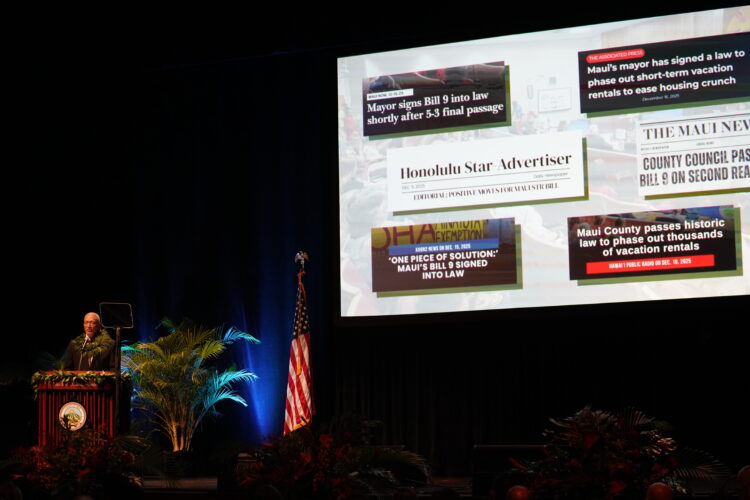
Maui County Mayor Richard Bissen applauds the passage of Bill 9 as he delivers the annual State of the County address on March 5 at the Maui Arts & Cultural Center. Eli Pace/The Maui News
Wildfire recovery
As the recovery effort from the 2023 Maui wildfires stabilizes, Bissen said the county is putting additional resources into commercial property permitting and the adoption of design guidelines to support the rebuilding process.
“Recovery also means ensuring stability for survivors,” he said. “Temporary housing is critical to that stability as families plan for what comes next.”
Bissen called securing a one-year extension of FEMA’s housing assistance “a key milestone” for 946 of the approximately 1,400 families who survived the fire.
Additionally, the Community Development Block Grant Disaster Recovery program action plan was approved in June, and Maui County was awarded $1.6 billion in disaster recovery funding, which is helping support new housing programs for wildfire survivors.
Bissen also applauded “the largest debris operation in state history,” with more than 400,000 tons of wildfire debris fully removed from the temporary disposal site in Olowalu to the permanent disposal site next to the Central Maui Landfill.
The development of the permanent disposal site will also give the county 10 additional years of landfill capacity.
Bissen said the county’s expedited recovery permitting program has decreased the average time for permit approvals for wildfire survivors down to 44 days.
“Today, approximately 300 sites are actively under construction,” Bissen said. “To date, 151 permits have been completed, meaning structures including single, multifamily and some commercial properties are fully constructed and may be occupied.”
Additionally, he said 552 more permits have been approved and 336 are in the pipeline. In total, more than 456 residential and multi-family units have been built in Lahaina since the wildfire.
Bissen also pointed to the reopening of the Lahaina Small Boat Harbor on Dec. 15 as a sign of recovery, and he added that the county is moving forward with construction of the Lahaina Bypass farther north.
Bissen said the county has made conditional awards to 21 infrastructure projects, putting more than $563 million into wastewater, transportation and water investments to support recovery, housing and resilience.
“These investments also strengthen partnerships among the county, Kamehameha Schools and the state as we work together to rebuild King Kamehameha III Elementary School at a new site in Kuʻia, ensuring the school remains in Lahaina,” Bissen said.
Bissen said the restoration of Mokuʻula and Loko o Mokuhinia is being intentionally woven into Lahaina’s long-term recovery too.
“This work goes beyond physical restoration,” Bissen said. “It is about healing land, culture and community, and rebuilding with purpose, respect and ʻike kūpuna.”
Supporting residents
In his annual address, Bissen referenced a number of ways the county is supporting its residents.
The mayor gave a shoutout to the return of Hot Kupuna Nights in West Maui and to Kaunoa Senior Services for expanding its presence with a new Lahaina location at the YMCA’s West Side Resource Center.
Shifting to what’s being done to help unhoused people on Maui, Bissen said that over the past year, 876 individuals and family household members were placed into housing through Maui County’s Coordinated Entry System, including veterans, individuals experiencing chronic homelessness and young adults.
“Mental and behavioral health services are critical to homelessness prevention and long-term stability,” Bissen said.
The county has also given support to Aloha House, Maui’s only nonprofit licensed residential substance abuse treatment provider, which Bissen said recently expanded its capacity with a new 12-bed dormitory, representing an approximate 25% increase in treatment availability.
“We are also laying the groundwork for additional solutions,” Bissen said. “The county has executed a contract to launch the Safe Parking Pilot Program, providing a safer and more structured option for individuals living in their vehicles, and we continue to collaborate and work to provide low barrier housing options for our most vulnerable.”
Bissen also said the Maui Police Department is showing progress promoting public safety with violent crime down by 3% and property crimes down by 14%.
The Maui Fire Department also added 29 new positions and is advancing the Haiku and Olowalu Fire Stations. Meanwhile, Bissen said the Department of Parks and Recreation is making investments in facilities across the county, such as the Lahaina Civic Center and the new skate park at the Lanai Youth Center, among many others.
Other quality-of-life developments Bissen highlighted included the inaugural Wailuku Film Festival this June and the return of the Maui County Fair after a six-year pause.
“More than 118,000 people attended over four days, including an estimated 30,000 on opening night, making it the most attended fair ever, and one of the most memorable gatherings in recent history,” Bissen said.
Mālama ‘āina
Stewardship of natural resources was another point of focus for Bissen, as he said the county is advancing a comprehensive approach that balances water conservation with the need to support kuleana uses, housing, agriculture and long-term resilience.
“This includes expanding recycled water use, modernizing and developing new potable and wastewater systems county-wide, and the acquisition of private water systems,” Bissen said.
“That is why, alongside developing new water sources, we are taking decisive steps to strengthen public stewardship of water systems in West Maui. Historically, only 25% of these systems, representing all water, have been publicly owned.”
Bissen announced that the county is in negotiations with Kamehameha Schools, Maui Land & Pineapple Company and West Maui Land to acquire key water system assets, including the Olowalu and Launiupoko irrigation and water companies, the Honokōhau Ditch System and multiple wells and related infrastructure.
“We appreciate these entities’ willingness to work with us for the public’s benefit, and for Kamehameha Schools’ partnership on our ongoing recovery efforts and generational commitments to our ʻāina and people,” Bissen said.
According to Bissen, Maui County is taking steps toward long-term agreements for water security while protecting resources.
“Once complete, water systems in West Maui, including both drinking and irrigation, will transition from 25% to 65% publicly owned,” he said. “More importantly, public stewardship of drinking water systems will increase from 45% to 93%, representing a major step toward restoring balance and ensuring this essential resource is managed in the public trust.”
Bissen also talked about watershed and flood protection, the work of the East Maui Water Authority and other environmental stewardship and sustainability.
Economic development
Bissen said the county is transforming the Office of Economic Development from a primarily grant-focused office into a strategic driver of long-term economic resilience.
“Today, OED’s mission is anchored in four pillars — construction and rebuilding trades, health care, technology and innovation, and creative industries,” Bissen said.
He said this will help build workforce pipelines that expand hands-on learning for the next generation and help connect youth to emerging career pathways.
“Our economy continues to show signs of promise,” Bissen said. “Recovery and rebuilding efforts are helping fuel our economic engine, creating jobs and supporting local businesses across Maui County.”
Bissen also said Maui’s visitor industry is showing growth. According to a recent economic forecast from the University of Hawaii Economic Research Organization, Maui is leading the state in visitor spending recovery, with real visitor spending increasing more than 9% last year.
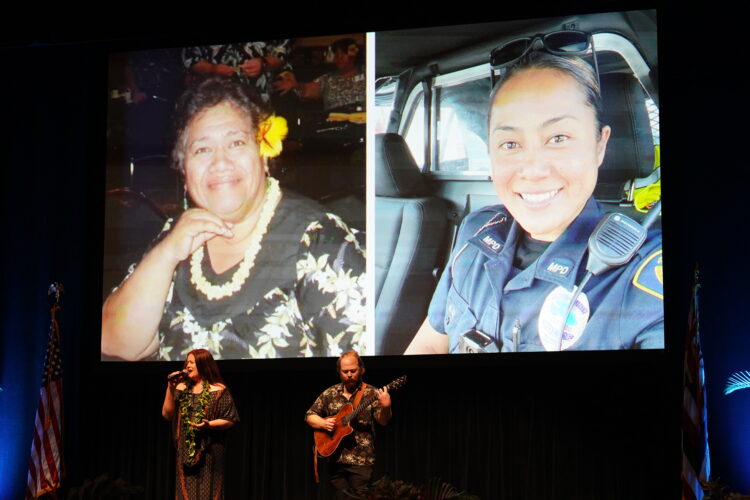
With Josh Hearl on guitar, award-winning singer-songwriter Amy Hānaialiʻi sings a tribute to Maui Police Officer Suzanne O and Maui County Council member Tasha Kama during Mayor Richard Bissen’s State of the Community address on March 5 at the Maui Arts & Cultural Center. Eli Pace/The Maui News
Music and tributes
The State of the County address featured a tribute from award-winning singer and songwriter Amy Hānaialiʻi honoring Maui Police Officer Suzanne O and Maui County Council member Tasha Kama. During the tribute, Hānaialiʻi sang “Light a Candle for Me” with large images of Officer O and Kama smiling projected behind her.
Officer O was killed in the line of duty on Aug. 15 when she was shot while responding to a call at the Paia Sugar Mill.
A Maui County Council member since first winning election in 2018, Kama was a spiritual leader and community advocate. She died on Oct. 26 surrounded by family and loved ones at Maui Memorial Medical Center. She was 73 years old.
Hānaialiʻi also sang “Aloha is the Bridge” and “How Do You Know Where You Are Going If You Don’t Know Where You Are From?” as Josh Hearl accompanied her on the guitar.
The Kuikawa Trio, a young up-and-coming group from Maui, entertained the audience for almost an hour as guests were finding their seats before the ceremony. The Maui Fire Department Color Guard sang “The Star-Spangled Banner” and “Hawai’i Pono’ī.”
‘Ōiwi Resources Director Kapono’ai Molitau offered a pule to open the event, and Anthony Takitani served as the master of ceremonies. The State of the County closed with Bissen picking up a ukulele and leading the audience in a singing of “Hawai’i Aloha.”
A video of the address is available at Maui County’s Facebook page at facebook.com/countyofmaui.
Local News
Maui County mayor says housing remains top priority in State of the County address
Once `target island’ becomes a symbol of rebirth
Groups mark first two homes rebuilt in Lahaina through partnership

Bassel & The Supernaturals, Syrian heart, Midwest soul
ProArts Playhouse opens Tony Award-winning musical ‘Rent’ on Friday
Before he leaves Maui to move to New Mexico, Jesie Rocetes is directing and choreographing the ProArts Playhouse ...