Once `target island’ becomes a symbol of rebirth
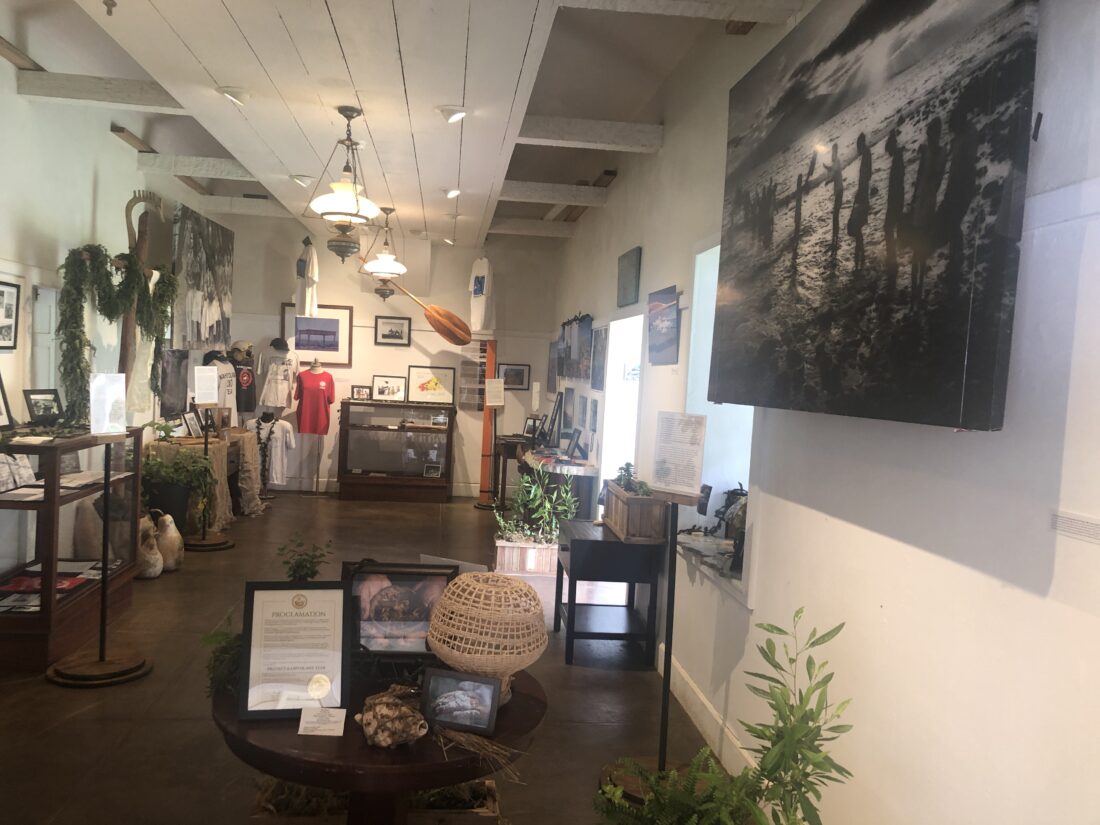
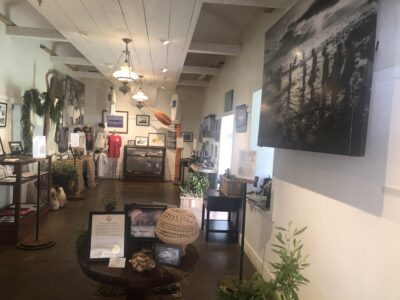
A history of Kaho‘olawe commemorating the 50th anniversary of a pivotal protest against the bombing of the island is displayed in an exhibit at the Bailey House Museum in Wailuku through April 3. Gary Kubota/The Maui News
While he was in a military helicopter being removed from Kaho’olawe for protesting the bombing of the island, Molokai resident Walter Ritte recalled having an profound experience.
“Something happened to me I couldn’t explain,” Ritte said. “It started from my toes and came into my body. … All I could hear was the island saying, ‘I’m going to die.’ Right there, that changed my whole life. I decided we cannot allow that island to die.”
The protest by Ritte and eight others of the Protect Kaho’olawe Ohana in 1976 sparked efforts that helped eventually halt the bombing.
An exhibit at the Bailey House Museum commemorating 50 years since the protest is available for viewing from 10 a.m. to 2 p.m. Tuesday through Friday until April 3. General admission is $10, but the museum offers discounts for children, seniors and kamaʻāina.
Kaho’olawe is nearly twice the size of Manhattan island and owned by the government of Hawaii. Kaho’olawe was used as a bombing range by the U.S. military for 50 years, starting in World War II.
The military returned the island to the state of Hawaii in 1994 after prolonged protests and a lawsuit.
Under the jurisdiction of the state-appointed Kaho’olawe Island Reserve Commission, the island remains unoccupied as a reserve but has undergone the clearing of ordnance in some areas that allows occasional cultural activities and replanting to help to control erosion.
Portions of the island contained heiau or Hawaiian temples, and the top of the island was known as a sacred place where Native Hawaiians were trained in traditional navigation.
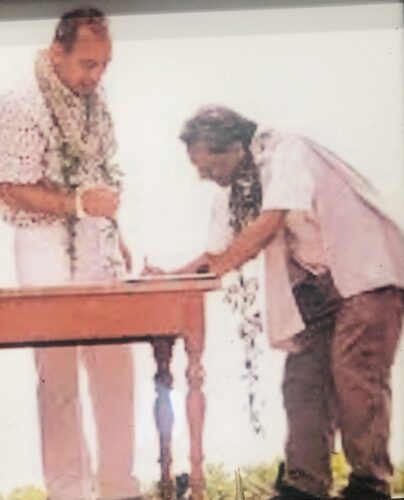
Noa Emmett Aluli, standing next to Gov. John Waihee, signs the document conveying Kaho’olawe island from the Navy to the state of Hawaii on May 7, 1994. Aluli, co-founder of the Protect Kaho’olawe Ohana, signed as the new chair of the state Kaho’olawe Island Reserve Commission. Photo courtesy Kaho’olawe Island Reserve Commission
A cultural rebirth
The photographs in the exhibit reflect how the protest and move to heal the island became a vehicle for cultural revival.
Under monthly accesses started by Ohana co-founder Emmett Aluli, thousands of volunteers have received cultural training and work at select portions of the island where they plant native grasses, shrubs and trees to prevent erosion.
“They were taught to be cultural practitioners and connect to the land in a spiritual way,” Ohana project organizer Davianna McGregor said.
McGregor said the Ohana also re-established cultural events on Kaho’olawe, including the Makahiki season on the island in 1982.
An opening Makahiki chant, written by Nalani Kanakaole, called for the god Lono to bring the winds, clouds and rains to nourish and regenerate the island.
Hawaiians also built a traditional hale as a meeting lodge.
On a trail near Hakioawa Bay, a memorial plaque stands honoring the memory of Keanae resident Kimo Mitchell and Molokai entertainer George Helm. Both protestors disappeared while paddling on surfboards in the channel between Kaho’olawe and Maui.
The Navy ended its $400 million ordnance removal project in 2004, clearing 75% of the island’s surface of ordinance. About 10% of the island — or 2,647 acres — was cleared to a depth of four feet.
However, 25% remains uncleared, and access is closed and requires an authorized escort.
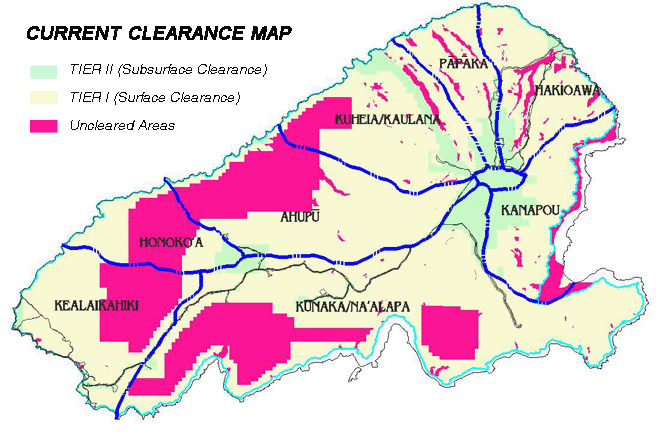
A map of Kaho’olawe illustrates the safe areas from those that still have ordnances. Photo courtesy Kaho’olawe Island Reserve Commission
Work focuses on restoration
A major part of the Kaho’olawe Island Reserve Commission’s work has been focused on the stabilization of erosion and restoration of parts of the island.
According to the state, in the early 2000s an estimated 1.9 million tons of soil on Kaho’olawe was lost per year due to erosion.
Besides ranching of cattle and sheep, the island was home to as many as 50,000 goats for 200 years, ending 1993 when the goats were eradicated.
Funding from the Clean Water Act is helping to re-establish native plants with a nursery. Because rainfall is low on Kaho’olawe — about 10 to 25 inches a year — the commission has developed a roof catchment system that collects and stores about 450,000 gallons on island to irrigate the plants.
Commission Executive Director Michael Naho’opii said as a result of the restoration work, the island has become greener, low-lying native shrubs and grasses are growing in accessible areas, and rain water is percolating into the land to the point that the Hawaiian flagtail fish aholehole are returning where there are fresh water seepages.
At the commission’s base camp, 280 solar panels provide battery power enough for drinking water and showers and dormitory space for more than 50 volunteers.
Naho’opii said he receives a little more than $610,000 from the state for its operation, in addition to the funding of 16 positions.
He said besides receiving some monies from Maui County and nonprofit foundations, the plan is to eventually build a museum, office building and community center in Kihei to generate revenue.
A small portion of the land is now used as a boat storage facility.
Naho’opii said with enough space for an open air lawn, the site overlooking the ocean could be used to hold events, including concerts.
By state law, there are no commercial activities allowed on Kaho’olawe.
“So we have to think of ways to generate income outside of Kaho’olawe,” Naho’opii said.
Ritte, once hunted as an outlaw activist on Kaho’olawe 50 years ago, was honored by the Maui County Council in 2025, recognizing his lifetime of advocacy, environmental stewardship and dedication to Hawaii.
Ritte said he’s glad that the bombing has stopped but disappointed that the military hasn’t finished clearing ordnance from the island. He said the island is resilient and will find a way to restore itself.
“We just got to let the next generation and the next generation watch as it heals itself,” he said.
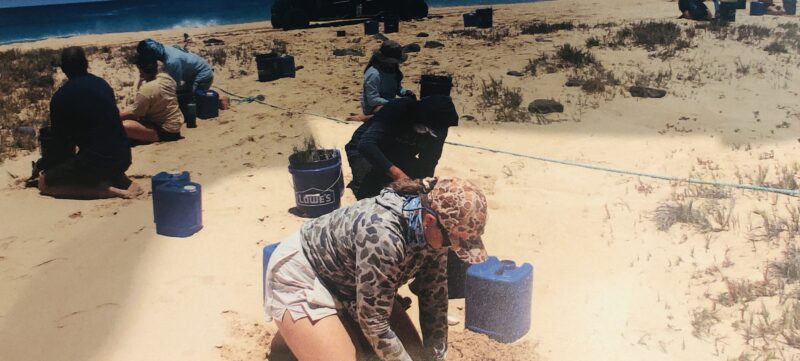
State officials estimate at least 15,000 people have visited Kaho’olawe island to undergo cultural training and stewardship as volunteers to help in restoring the once denuded island. Photo courtesy Kaho’olawe Island Reserve Commission
Local News
Maui County mayor says housing remains top priority in State of the County address
Once `target island’ becomes a symbol of rebirth
Groups mark first two homes rebuilt in Lahaina through partnership
Bassel & The Supernaturals, Syrian heart, Midwest soul
ProArts Playhouse opens Tony Award-winning musical ‘Rent’ on Friday
Before he leaves Maui to move to New Mexico, Jesie Rocetes is directing and choreographing the ProArts Playhouse ...