The ferocity of the downpour that brought the latest Hawaii flooding surprised even meteorologists
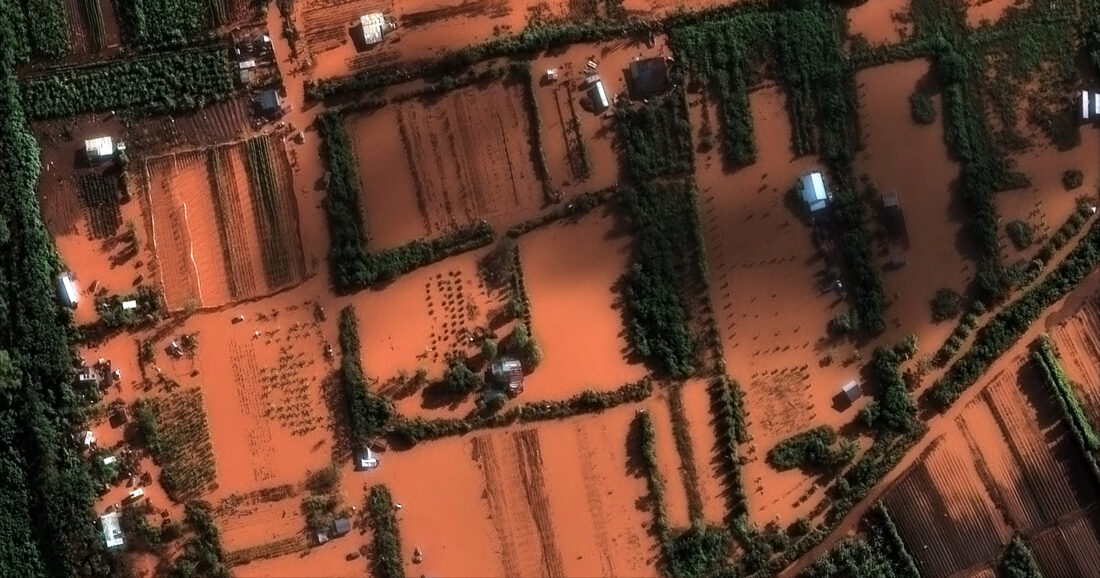
In this satellite image provided by Vantor is a closer view of flooded fields and buildings, Monday, March 23, 2026, in neighborhoods near Waialua, Hawaii. (Satellite image 2026 Vantor via AP)
HONOLULU — Crews on Tuesday began evaluating damage from a surprise downpour that sent floodwaters raging through a neighborhood near downtown Honolulu — the latest bout in a series of storms and flooding that have pummeled the state over the past two weeks.
Residents along Oahu’s North Shore, famous for its big wave surfing, were cleaning up from the worst flooding to hit Hawaii in two decades when a storm Monday unleashed several inches of rain on the southern part of the island. Reddish-brown torrents gushed along roads in the Manoa Valley, a few miles east of downtown Honolulu, sweeping away parked cars and swamping much of the neighborhood.
“I was shocked to see how much flash flooding there was in my area,” said resident Andrew Phomsouvanh, who recorded video of streets transformed into a confluence of rapids. “The water just keeps coming.”
Maile Mills knew there was nothing she could do to save her Honda Civic, which she had parked on the street in front of her Manoa office building, when she saw the water reach the car’s door handles. The flood pushed the vehicle onto the curb. The car was totaled, and silt and muddy water covered parts of the interior and the engine compartment.
“It looked like rubber ducks in a pond,” Mills said. “All the cars started to float.”
The ferocity of Monday’s downpour even took National Weather Service meteorologists aback. They knew that lingering instability from a powerful winter storm system called a “Kona low” could yield more rain, but their models aren’t good at predicting how much moisture can remain in such systems, said forecaster Cole Evans.
“When you think it’s over it’s not quite over,” he said Tuesday.
The downpour, which dumped 2 to 4 inches (5 to 10 centimeters) of rain per hour, was highly localized: One rain gauge in the upper part of the valley recorded 6 inches (15 centimeters), while the airport a few miles away got just one-hundredth of an inch (less than a millimeter).
Honolulu Mayor Rick Blangiardi called it a “classic rain bomb,” and he said that earlier in the day, the skies were sunny.
“We had no warning,” he said Tuesday as he toured the damage.
The Kona low was moving off to the east, Evans said, and it should not pose further risk of bursts like Monday’s burst. Flood watches were in effect for parts of Maui and the Big Island.
There were no immediate reports of deaths or serious injuries, but authorities said hundreds of homes on Oahu’s North Shore had been damaged by last week’s flooding, which came as heavy rains fell on soil already saturated by downpours from a winter storm a week earlier.
More than 230 people had to be rescued. The water pushed houses off their foundations, floated cars out of parking spots and left walls, floor and counters covered with thick, reddish volcanic mud.
Evacuation orders covered 5,500 people north of Honolulu, and some residents fled on surfboards as water reached waist or chest high.
Farms around the state reported more than $9.4 million worth of damage as of Monday, according to a survey conducted by Agriculture Stewardship Hawaii, the Hawaii Farm Bureau and other organizations.
Even before Monday, Gov. Josh Green said the cost of the storm could top $1 billion, including damage to airports, schools, roads, homes and a Maui hospital in Kula. He called it the state’s most serious since flooding since 2004, when floods in Manoa inundated homes and a University of Hawaii library.
Green’s office said Tuesday he had submitted a major disaster declaration request to the Trump administration.
Molly Pierce, a spokesperson for the Oahu Emergency Management Agency, said that in addition to volunteers and public workers who have been cleaning up, a contract company had arrived to begin collecting, sorting and removing large piles of debris.
She called the storm system “extremely unusual” but that officials were cautiously optimistic Tuesday that the rains are finally ending.
“Most of us have not seen something that just keeps going like this,” Pierce said. “We feel like we keep getting punched down. But we’ll keep getting back up.”
The intensity and frequency of heavy rains in Hawaii have increased amid human-caused global warming, experts say.
Local News
Authorities suspend search for woman swept away in floodwaters
The ferocity of the downpour that brought the latest Hawaii flooding surprised even meteorologists
Donation drive to support Molokai flood recovery
In response to the recent flooding that has impacted families across Molokai, a coalition of community ...

Maui Food Bank airlifting food to Molokai
Hawaiian Electric: Scammers are targeting businesses on Maui and Oahu
Hawaiian Electric is alerting customers to a string of scams that are likely connected and mostly targeting ...