
Memories from Maui shape acclaimed poet Noʻu Revilla’s work
Trending
In response to the 2023 Lahaina fires, Native Hawaiian poet Noʻu Revilla collaborated with Brandy Nālani McDougall and Dana Naone Hall to co-write the five-page poem "Aia hea ka wai o Lahaina" (Where is the Water of Lahaina).
Borrowing its refrain from the ancestral mele "He Mele no Kāne" (Where is the Water of Kāne), the poem was composed as a water song, connecting the wildfires with the history of colonial deforestation and water diversion in Hawaii.
"Brandy and I were both born and raised on Maui, and both teach at (the University of Hawaii Manoa)," Revilla explained. "When the fires happened in 2023, we wanted to support Lahaina, and one way was the collaborative poem which we composed with the incredible Dana Naone Hall. The poem is part elegy for the catastrophic loss, part protest for the historical, systematic theft of water that made the wildfires possible, and of course, the poem is also part love letter to the ways the community rallied together and protected each other in the aftermath."
U.S. Poet Laureate Ada Limón subsequently published the poem in the acclaimed anthology "You Are Here: Poetry in the Natural World."
Revilla will present a reading at the Hui No'eau Visual Arts Center on June 4, sharing from her collection "Ask the Brindled" and her forthcoming second book, which she is working on while in residence at the Merwin Conservancy.
A creative writing teacher at UH Manoa, Revilla's first book, "Ask the Brindled," was selected as a winner of the 2021 National Poetry Series. The title is a nod to the brindled skin of moʻo and their role as protectors.
Hawaii State Poet Laureate McDougall praised Revilla's work as poetry "for the gut" and "'Ōiwi poetry at its finest and fiercest."
Growing up in Waiehu, Revilla vividly recalls her childhood in her poems. In "Slang for waterlogged woman," she wrote, "When our cane fields burned, I ran with the girls of wriggling bodies and licked the black snow of Kahului."
About her father in "Smoke Screen," she wrote: "No bathroom breaks, no helmets, no safe words. He whistled sugar cane through his neck, through his unventilated wife, his chronic black ash daughters."
"I'm in the thick of writing my second book and in the thick of the sugar industry on Maui," she explained. "I remember the black ash very vividly. When we were kids, we thought it was snow."
She said the legacy of the sugar industry on Maui is a direct inheritance. "My father was a welder and machinist at HC&S, and he was raised with my aunties and uncles by my grandmother in Camp 5 at the sugar plantation in Puunene until the camps were demolished and people moved into the new housing in Kahului, dubbed 'the Dream City' in the 1950s."
Revilla said her second poetry collection "deals with women, water and power on Maui, and you cannot talk about water on Maui without talking about sugar. The first section of the book tells the story of a young Hawaiian woman and her aunties who protect each other as they navigate the Dream City era."
She fondly recalled growing up in a home where she was encouraged to pursue her passions. "It was specifically my mother who nurtured my love for reading and writing," Revilla said. Growing up, they didn't have a lot of books in their home, but her mother made the time to take her and her sister to the Kahului Public Library.
"It was a regular part of my childhood," Revilla recalled. "I have always felt so free in libraries because of that invitation to connect with something bigger than yourself. Reading was never about escape. It's always been about deepening my relationship to the world. So take me to the ocean, library or bookstore. Those are my happy places."
A pivotal moment in her creative evolution occurred while studying journalism at New York University in 2005. Wandering the college library, she discovered the work of Native Hawaiian activist, educator, poet and leader of the Hawaiian sovereignty movement Haunani-Kay Trask.
"I found Haunani in the stacks of the library," Revilla recalled in an interview with Poetry Northwest. "In Hawaiian, we call that hōʻailona, a sign from your ancestors. I just sat down and really poured myself into her work."
For Revilla, Haunani-Kay Trask is one of the most important leaders in Hawaiian history.
"She became an ancestor in 2021. Her work, her mentorship, her activism continues to inspire art and politics in Hawaii," Revilla said. "She was one of the first Hawaiian women to model: don't let anyone tell you as a Hawaiian not to be angry. On so many levels, she unlocked permission for Hawaiians to believe in ourselves, to believe in each other and to know that our world and our worldview is not just enough. It's just a beautiful way to create the future. I wouldn't be here without her."
In her essay "How to Swallow a Colonizer," published in the World Literature Today magazine, Revilla wrote: "When I read Haunani's poetry, I learn how anger, pride, and ecstasy can live on the same page. Haunani taught me that aloha is rage and rapture."
"It's based on her mentorship of me," Revilla explained. "She has a very beloved essay entitled 'Writing in Captivity' about poetry and decolonization. I thank her so much because one of the tropes of Hawaii as this unproblematic paradise is that aloha is this very flat, static thing, and mentors like Haunani, one of the foundations is revealing the complexity of our culture, and aloha is one of those foundational elements. Aloha is a living cultural practice. It's been cultivated for centuries by generations of Hawaiians, and it's important that we're never passive with our aloha. She has certainly been one of the most exquisite teachers of that."
With her writing published in journals and magazines such as World Literature Today, Michigan Quarterly Review, Poetry Northwest and Colorado Review, Revilla loves how poetry evokes feelings.
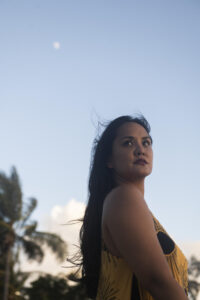
Hawaii State Poet Laureate Brandy Nālani McDougall has praised No'u Revilla's work as poetry "for the gut" and "ʻŌiwi poetry at its finest and fiercest." Photo courtesy Elyse Butler
"As I've gotten older, I've had the pleasure to see and bear witness to the fact that the technology of poetry is connection, because poetry insists on feeling," she said. "Poetry makes you feel things, and I think especially in today's world, going numb is the go-to coping mechanism for all the violence and greed that's warping the world. I understand why people want to go numb, and I understand why people don't want to feel as if they’re doomscrolling every day. But poetry insists that you feel. Poetry can't stop a bomb, poetry can't reverse climate change, but poetry can make someone feel something. And if you're lucky, that feeling can turn into new questions, those questions can lead to action, and those actions could lead to change."
As a Native Hawaiian poet, she emphasizes the importance of kuleana or responsibility.
"It's an ʻŌiwi approach to living in pono relations. It's an approach to living with integrity. This is the power of being able to communicate in your 'ōlelo makuahine (mother tongue). This is why it's so important when people say they study Hawaiian literature, or they study Hawaiian anything, that you are able to access and practice 'Ōlelo Hawaiʻi. Because if you can't speak the language, if you can't read the language, if you can't understand the language, you are missing so much."
She has also been thinking about her role in mentoring young writers.
"I'm thinking about kuleana in relation to access, like what does it mean to clear a path? What does it mean to show young writers, young Hawaiians, young women, that there are many ways to walk a path?" she said. "I've been thinking about that just because of people like Haunani, people like my mother who took me to the library. Path clearing is so important because it offers direction in an otherwise cloudy endeavor, especially the arts and humanities, given what the climate is right now for trying to be an artist and prioritize creativity and the imagination. I'm interested in reciprocity. So many of my mentors and family and friends have cleared a path for me to walk this, and now it's my turn."
Drawn to join those demonstrating against the construction of the Thirty Meter Telescope on Maunakea, she coedited with Bryan Kamaoli Kuwada "We Are Maunakea: Aloha ʻĀina Narratives of Protest, Protection, and Place," which served as a special issue of Biography: An Interdisciplinary Journal in 2020.
"Being able to stand at the Pu'uhonua at Maunakea with my lāhui (people) to protect our mauna was one of the most transformative experiences of my life," she said. "Standing with the people you love to protect what you love -- isn't that why we're all here?"
She said her second book centers on the idea of protection. "I wanted to write a book that declares unapologetically that Hawaiian women are not just worth protecting, but we are also worthy protectors, and aunties are absolutely the piko of the book. They are a foundational source of power in the book."
The Merwin Conservancy will present Revilla at the Hui No'eau Visual Arts Center at 5:30 p.m. June 4. Tickets are $28 or $12 for students at eventbrite.com.