
County seeks input on plans to restore Lahaina Royal Complex
Trending
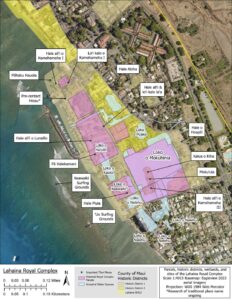
Maui County officials are developing a Lahaina Royal Complex Master Plan aimed at restoring portions of the historic center of the Hawaiian Kingdom, including Mokuhinia Pond and Moku'ula Island.
The island was once the home of Native Hawaiian royalty on Maui and later King Kamehameha I and his wives. It was the center of power and spirituality before the arrival of Westerners and solidified Lahaina as the capital of the Hawaiian Islands until the 1840s.
Following the 2023 fires, the Maui County Department of 'Ōiwi Resources is charting a course for the Royal Complex Master Plan for long-term cultural, ecological and community healing. Department Director Kapono'ai Molitau described the royal complex as having deeply sacred sites.
"While the sacred center of Mokuʻula and Mokuhinia will continue to be shaped primarily by cultural practitioners and those with ancestral kuleana, the broader ripple effect of the Royal Complex touches public access, infrastructure and traffic flow that impacts the entire island chain," Molitau said.
Residents, especially Lahaina kupaʻāina and kamaʻāina, are encouraged to complete an online survey at arcg.is/0mbmDy. The survey will help shape the master plan. Maui County Managing Director Josiah Nishita said the review will also include technical studies to measure potential hydrology, drainage and ecological impacts.
"Those all really need to be taken into account before we can do it well, and we want to do it well the first time," Nishita said.
The final master plan for the Lahaina Royal Complex is scheduled for completion in summer 2027.
The goals for the master plan were discussed June 3 during a Lahaina Community Monthly Disaster Recovery Meeting at Lahaina Intermediate School. A video of the meeting is available on the County of Maui Facebook page.
Moku'ula Island as the cultural center
In Polynesia in Rapa Nui (Easter Island) off Chile, Moku'ula is spoken of in oral traditions as a spiritual place.
According to legend, the lizard goddess Kihawahine once guarded Mokuhinia Pond.
The pond and surrounding area were buried during the sugar plantation era with portions becoming a baseball field, tennis court, basketball court and a parking lot mauka of a shopping center at 505 Front St.
A Bishop Museum archaeological study determined the general outlines of the pond and islet, and the nonprofit Friends of Moku'ula has been working since the 1990s to restore the royal site.
According to Friends of Moku'ula, at least 16 people of royal lineage were buried on the island. The remains of King Kamehameha's wife Keopuolani and other royalty were exhumed from Moku'ula and reburied at the nearby Waiola Church cemetery.
In the early 2000s, Maui Mayor Kimo Apana helped to halt the development of a shopping center that would have extended into part of the pond.
Giving historic places a voice
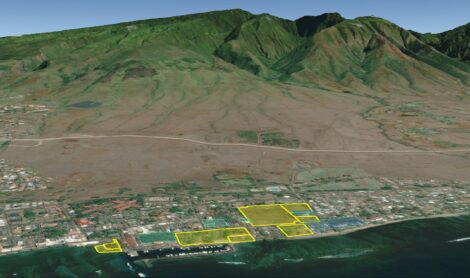
Several parcels extending north of Shaw Street in Lahaina and the former sites of King Kamehameha III Elementary School and the Lahaina Library have been identified as significant parcels associated with the Lahaina Royal Complex that are under state or county ownership.
Responding to a resident's question about what the department planned to do at the school, library and Lahaina Courthouse, Molitau said the plan has not been finalized.
"This is where you folks come in to help with that, right?" Molitau said.
He said the question is how best to honor the old royal complex and educate those coming from around the world about that complex.
During the community meeting, Molitau introduced the selection of the G70 design firm and its president, Kawika McKeague, who will help develop the master plan.
"We're going to take our time going through this work and making sure that we do it with everyone's involvement," Molitau said. "We want to rewrite narratives of our history, not cover it up and make baseball parks anymore, but making sure that the places and the area have a voice for themselves. Really, this is the reason why the Department of 'Ōiwi Resources exists."
According to the department, completing the plan will not translate to immediate construction. Rather, the plan will establish a living framework for subsequent environmental and historic reviews, permitting and multiphase implementation over generations.
During the meeting, the department's planning team introduced a tentative timeline for next steps, which include:
• Research and technical studies from summer 2026 to spring 2027
• Community gatherings and learning from summer 2026 to early 2027
• Planning, design and implementation gatherings from fall 2026 to spring 2027
• Draft plan review in the first quarter of 2027
• Community review and refinement from spring to summer 2027
• Final master plan delivery in summer 2027
A fast-fact webpage is available at tinyurl.com/muth4ww6. For questions about the Royal Complex Master Plan process or to submit feedback via email, contact LRC@g70.design.