
New UH tool allows Hawaii residents to track rainfall, drought where they live
Trending
Starting July 1, people in Hawaii can get free monthly climate updates specifically tailored to the state, individual islands, neighborhoods and coastlines delivered straight to their inbox.
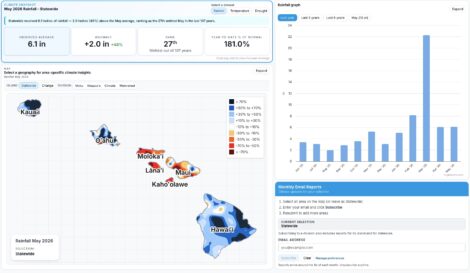
Developed by the University of Hawaii, the Hawaii Climate Data Portal is a new monthly climate summary tool that compiles complex metrics into easy-to-read localized updates on rainfall, temperature and drought conditions.
“Not everyone understands how much rainfall typically falls in their area of interest,” said Ryan Longman, director of the HCDP, in a news release. “But if you let them know that it was 50% below normal, or that it was the third driest month in the last century; that's the type of information that anyone can understand.”
Subscribers can customize their summaries using traditional Hawaiian geographic boundaries -- moku and ahupuaʻa -- as well as standard climate divisions and watershed boundaries.
To sign up, visit the HCDP Climate Summary page at hawaii.edu/climate-data-portal/climate-summary. From there, users can select an area of interest on an interactive map and enter their email address.
"We're heading into potentially a super El Nino and really keeping an eye on what's happening in terms of rainfall and temperature can protect livelihoods, protect infrastructure, protect natural resources," Longman said. "There's a lot of reasons to understand what's going on with the climate."
The release said the tool’s development was initially funded by NOAA's National Integrated Drought Information System until the grant was canceled in December 2025.
However, support from the Department of Land and Natural Resource's Commission on Water Resource Management allowed the team to complete the tool, and another grant helped support outreach efforts. The NSF EPSCoR Change Hawaii project provided the cyberinfrastructure foundation that makes it all run.
"We were too far along to stop," Longman said in the release.