
Plan to expand facilities at Makena State Park sparks criticism
Trending
Some Maui residents are critical of a plan to expand the facilities at Makena State Park in South Maui, saying the project would threaten endangered hawksbill turtles and increase the likelihood of serious spinal injuries.
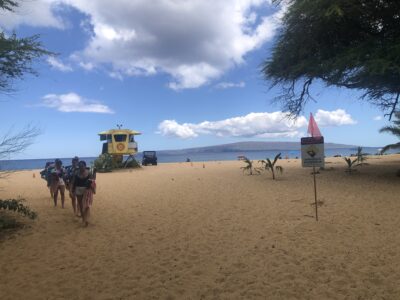
The 164.4-acre park stretches along the coastline for 1.5 miles and includes Oneloa, also known as Big Beach, One'uli or Black Sand Beach, and the Pu'u Olai cinder cone or Little Beach.
In May, the Department of Land and Natural Resources Division of State Parks announced it plans to submit a proposal to the Maui Planning Commission this month for phased construction at the popular state park.
A public hearing about the expansion is scheduled before the Maui Planning Commission at 9 a.m. June 23 at the Kalana Pukui Building in Wailuku.
The project calls for new men's and women's comfort stations and outdoor showers at Makena's north parking lot and the south parking lot. The comfort stations will replace existing portable toilets, while the showers will be a new feature.
The department also said expanding paved parking lot areas would help to address safety issues with overflow parking spilling out onto the shoulder of Makena Road. The plan calls for the number of parking spaces to grow from 97 to 235 stalls.
According to the department, an assessment found the proposed facilities will have no significant environmental impact, and the proposed upgrades are long overdue.
However, critics of the proposal argue it could harm endangered hawksbill turtles who frequent the sand dunes at Makena State Park.
Opponents also fear the new facilities could attract more visitors and lead to additional ocean-related injuries, as Makena State Park has historically recorded more spinal injuries than any other beach area in Hawaii.
Environmental concerns
Maui Tomorrow Executive Director Albert Perez said the department has not done a carrying capacity study to gauge what an increase in visitors could do to the environment. During an earlier evaluation, the Maui County Cultural Resources Commission expressed similar criticisms.
Perez also said he worries the proposed shower drainage will contribute to excessive chemicals in the groundwater, including shampoo, soap, sunscreen and food waste.
Hawaii Wildlife Fund Executive Director Hannah Bernard said studies have shown Oneloa Beach is rated as one of the most important beaches on Maui for nesting hawksbill turtles, which are on the endangered species list.
She said the quality of the sand and water along with the natural darkness at night contribute to the park’s favorable conditions.
Hawksbill turtles had four nests at the park in 2025, according to the fund.
"It's been highly successful," Bernard said.
Former lifeguard speaks out
Critics also warn that seeing more people at Makena State Park, especially visiting families and the elderly, will lead to an increase in spinal injuries.
According to the Hawaii Trauma Registry, Makena led the state with 40 recorded spinal injuries from 2009 to 2017, including 33 at Big Beach, one at Little Beach and six at unspecified areas in Makena.
Jasen Kaimikaua, a former county lifeguard lieutenant at Makena, agrees that increasing the comfort facilities would send the wrong message to the public.
Kaimikaua, who now works as the water safety manager at Kamehameha Schools Maui, said he is opposed to clearing land to create more parking spaces.
"It's inviting and making it more comfortable for people who don't have the right amount of knowledge and skill," he said. "It's very, very dangerous for the wrong people without the right information."
Kaimikaua said that during peak summer months, there could be multiple spinal injuries every week. He recalled an airplane pilot and a 15-year-old boy who were paralyzed in separate incidents at Big Beach.
"The boy broke his neck. He was face down in the water. He couldn't move," Kaimikaua said.
Kaimikaua said the shorebreak at Big Beach is worse than the infamous one at Sandy Beach on Oahu, where there is a trough of water about a foot or two deep after dropping into the wave.
At Big Beach, there is no trough and the waves can drive swimmers straight into the sand, Kaimikaua said. He explained that part of the reason is the topography of the Oneloa Beach, which is exposed to the waves' full power without a reef.
He likened the break at Makena State Park to throwing someone off an 8-foot tower onto the ground.
Even worse, many people don't realize the danger. Kaimikaua explained that in sports like skiing, the runs are rated and clearly marked based on the danger and required skill.
"There's no rating system here, so it's up to the lifeguards to say, 'Listen, you guys shouldn't be here,'" he said.
Conditions are manageable, state says
The department said it is aware of the dangers of spinal injuries, which is why it has lifeguards at Makena. Two lifeguard towers have been at Makena for a decade or more, and the department pays the county more than $1 million a year for lifeguard services.
The department said the proposed shower configuration is standard among beach parks throughout the state, and park officials plan to manage the use of soap and shampoo through signage and public messaging.
The department said it plans to grow native plants in a rain garden style near the showers to reduce the impact of potential pollutants.
Department spokesman Ryan Aguilar said the state also warns visitors of the dangers of the ocean by posting signs at the entry points to the park
He said new positions at state parks have been approved to increase public outreach through employing interpretive staff, such as rangers, and the department is in the process of filling the positions.
The department said it has worked closely with the Hawaii Wildlife Fund whenever nesting of Hawksbill turtles has occurred at the park and allowed the Wildlife Fund staff to remain in the park overnight to monitor active nests.
According to the state, the proposed comfort stations would use sealed underground tanks and their contents would be regularly pumped and taken to a wastewater treatment plant.