
‘The Conversion of Ka‘ahumanu’ brings a defining moment in Hawaii’s history to life
Trending
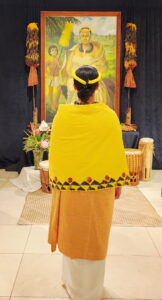
Opening Friday at the ProArts Playhouse, Victoria Nalani Kneubuhl's play "The Conversion of Ka'ahumanu" brings to life a defining moment in Hawaii's history when Hāna-born Queen Ka'ahumanu faced decisions that shaped the future of the Hawaiian Kingdom.
The play is directed by Hōkū Pavao of Collective Pilina Theatre, who starred in the films "Maui" and "The Wind & the Reckoning."
"This play takes place at a really pivotal moment for the Hawaiian community in that Ka'ahumanu, who has now become the queen regent, has decided to abolish the kapu system, leaving a very spiritual community with no spiritual guidance," Pavao explained. "She makes the decision very intentionally, and for many reasons, and within that, we find ourselves in a play where at that same time missionaries land in Hawaii and bring with them their spirituality."
A cast of five portrays the lives of three Hawaiian women and two missionary women as they experience personal and cultural changes in response to Western contact.
With original music by Stephen Henderson, Makalani Franco-Francis plays the role of Ka'ahumanu, Kailee Ka'eo plays Hannah Grimes, Ashlyn Hi'ilei Ani plays Pali, Leighanna Locke plays missionary Lucy Goodale Thurston and Rebecca Rhapsody plays Sybil Moseley Bingham.
"So it's the convergence of these two worlds -- one world saying farewell, essentially a hui hou to their spirituality and another one coming in," said Pavao. "We meet five women at the precipice of new world change, transformation, finding each other in a space void, of one void of their home, two void of their spirituality, and coming together. And essentially, as we know today, Ka'ahumanu then converts. So 'The Conversion of Ka'ahumanu' literally talks about the time."

Hōkū Pavao founded the Collective Pilina Theatre company. Courtesy photo
The play was written by Kneubuhl while she was a graduate student in theater at the University of Hawaii at Manoa and was influenced by British feminist plays she was studying at the time.
"Victoria wrote this in an actual British style of feminist playwriting," Pavao noted. "What I found beautiful about her storytelling is that it's told all through the lens of women. When I first went to see it, I went, 'Oh, I know it's going to say missionaries bad, Hawaiians good,' and I left dumbfounded. I literally couldn't talk for hours afterwards because there is no bad or good. There just is. And there is no one to blame, even at the end. There are five women navigating a new world, making the decisions that feel right for them, and trying to figure out each other in the midst of figuring out their own place in this new world."
Pavao feels the play's message is relevant for our time.
"It's very resonant to what's happening today in our society," said Pavao. "People are fighting over being right, instead of coming to this neutral space of trying to understand. These five women come to a space of really trying to understand each other, and what's happening in their world."
Born and raised on Maui, Pavao graduated from the American Musical and Dramatic Academy in New York City. As a student at Baldwin High School, "I got to train under Sue Ann Loudon for what would become my career," she said. "Then, when I trained in New York, I did a lot of student films."
She was cast in Brian Kohne's film "Maui" (previously titled "Kuleana") and subsequently in "The Wind & the Reckoning."
"The Wind & the Reckoning was really a turning point in my own career," she said. "I had the blessing of training in New York City and learning a Western style of storytelling. I come from a lineage of hula and mele being Hawaiian, but I also trained as a kumu growing up. I always knew I'd come back home to share what I had learned. 'The Wind & the Reckoning' was the first time I got to tell a Kanaka story. We were telling a story that essentially the big Hollywood producers had all backed out of and said, 'this wasn't viable anymore, and nobody wants to see it,' because it was 80% 'Ōlelo Hawai'i, even before 'Chief of War.'"
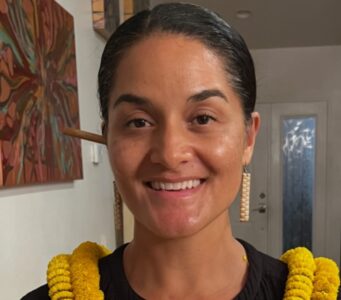
Makalani Franco-Francis plays the role of Ka'ahumanu. Courtesy photo
She realized, "how important it was to tell these stories, to see our people show up, and feel impacted by it," Pavao continued. "It made me realize as much as I am still in love of Western canon, I am a Hawaiian woman in Hawaii telling continent stories. So it really had me reassess my own kuleana as a storyteller and my gifts."
A former artistic director of the Maui Academy of Performing Arts, Pavao has been working with the Archive for Health, Arts & Spirit organization, a nonprofit born out of the Lahaina wildfires to support long-term recovery through the arts. She has also started her own theater company, Collective Pilina Theatre.
Pavao hopes "The Conversion of Ka'ahumanu" "speaks to our world today, if we try to come from a place of understanding with all that's going on in our world. This is a profound piece for me. I tell the cast I hope they (the audience) don't leave with answers. I hope they leave with more curiosity and questions."
Sponsored by Wave of Harmony, "The Conversion of Ka'ahumanu" will open at 7:30 p.m. Friday at the ProArts Playhouse. It continues Saturday and Sunday, June 11, 12, 13, and 14. Showtimes are 7:30 and 2:30 on Sundays. Tickets are $21 to $42 at ProArtsMaui.org or by calling 808-463-6550, with $5 off for kama'āina.