
Zenshin Daiko to present annual concert Saturday
Trending
Before founding Zenshin Daiko with his wife, Valerie Jones, Anthony Jones remembers a family relative showing them a videotape of Kodo, the internationally acclaimed Japanese taiko drumming ensemble.
"My son was 2 at the time, and she gave us a Kodo VHS tape, and that's all he watched," Jones said. "No Barney. No 'Sesame Street.' Night and day. Eventually we ended up starting our own group."
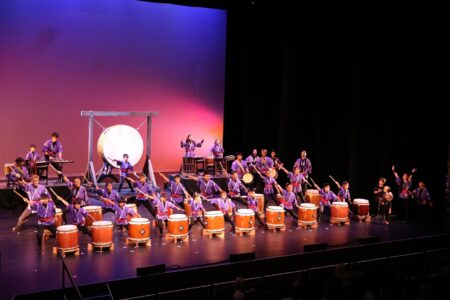
Hosting the longest-running annual taiko festival in Hawaii, Zenshin Daiko will present its 27th annual concert at 7 p.m. Saturday at the Maui Arts & Cultural Center with guests Stanford Taiko from Northern California and King Kekaulike High School's Na Ali'i Big Band. Tickets are $38 and $20 for children 12 and under at mauiarts.org.
Among the works to be presented at the concert, Maui's taiko drummers will collaborate with the jazz band on the Swing Era tune "Sing, Sing, Sing," recorded by Louis Prima in 1936. It's choreographed by former King Kekaulike High School student Teisha Nishimitsu, who drummed with Zenshin for 13 years.
"Our former student Teisha Nishimitsu, who started when she was 5, is going to graduate from Stanford, and she went to King K and used to be in the Big Band," Jones explained. "We're going to put her to work playing with us. Choreographing 'Sing, Sing, Sing' was part of her senior project at King Kekaulike."
Nishimitsu will be joined on "Sing, Sing, Sing" by Kalyssa Orikasa, Nikki Toyama and former Zenshin member Aliya Orikasa.
During the pandemic, Jones recalled how Nishimitsu played an important role with Zenshin Daiko helping inspire and motivate students. "She trained all the younger kids and taught them all the hard pieces," he said. "It was a rough time for us as a group because we could barely get together to practice."
The Na Ali'i Big Band will also play the postwar Japanese pop song "Koko ni Sachi Ari," originally recorded by Otsu Yoshiko in 1956, and the hard bop jazz classic "Moanin,'" which became the title track of Art Blakey & the Jazz Messengers' landmark 1958 album.
Stanford Taiko will perform "Go Go Go" by Nishimitsu, "3 Sizzlin' Beets" by Adam Toda and "Tatsumaki," composed by Hiroshi Tanaka, where they will collaborate with Zenshin Daiko on a piece that features swirling movements and powerful rhythms evocative of a force of nature.
"We're playing 'Tatsumaki' that one of Stanford's members wrote 25 years ago," said Jones. "He contacted Zenshin Daiko and said, 'I want you guys to learn this piece.' So we get to perform it with them. It's cool that we have some members playing with King K guys and a whole bunch of people playing with Stanford."
Zenshin Daiko will also perform "Kamitsuki," which originates in the Kamitsuki district of Japan's Miyake Island. In March, the Maui musicians traveled to the island to learn the piece from the group Kamitsuki Kyodo Geino Hozonkai. The visit marked the first time an international taiko group had visited the island to learn the piece.
Other pieces they will perform include "Yodan Uchi," the best-known composition by Sukeroku Daiko, the influential Tokyo-based professional taiko ensemble, and "Symmetrical Soundscapes" by taiko master Kenny Endo.
Endo's "Symmetrical Soundscapes" features four taiko players performing mirror imagery through sound, with the first part comprising traditional patterns found in Japanese classical drumming. It then flows into solos intertwined with images of mountains and valleys, and the last part mixes Brazilian rhythms, Tokyo festival music and an improvised "conversation" between the players.
Since forming in 1999, Zenshin Daiko averaged about 50 performances a year for its first 20 years. When the pandemic hit, that number fell to six in 2020 and 10 in 2021.
"It's coming back, but unfortunately, a lot of the community activities that we'd play at, they never revived after the pandemic," said Jones. "At least we're getting more and more performances."
The group adopted the name Zenshin from the Japanese word for moving forward and Daiko as a reference to the large taiko drum (Ō-daiko means large drum).
"Zenshin Daiko is pretty unique in that we don't have a sensei; we bring in professionals to work with the kids," said Jones. "We just went to Japan. We had workshops with legendary people, with literally the people who invented this style of playing, kumi-daiko which is ensemble taiko."