
A milestone in recovery: Ae‘o reclassified from endangered to threatened

Trending
The ae'o, or Hawaiian stilt, has taken a major step toward recovery after the U.S. Fish and Wildlife Service reclassified the bird from endangered to threatened under the Endangered Species Act.
The change, announced this month and published in the Federal Register, follows more than five decades of conservation work that has helped the long-legged shorebird rebound from an estimated population of about 200 birds in the 1940s to more than 1,500 today.
The reclassification is supported by a new study led by researchers at the University of Hawaii at Manoa's College of Tropical Agriculture and Human Resilience and published in Ornithological Applications, according to a news release from the university.
Once found throughout the Hawaiian Islands, the ae'o declined sharply because of overhunting, the loss of wetlands to agriculture and development, and invasive predators. The bird was listed as endangered in 1973, prompting long-term efforts to restore habitat, manage wetlands and reduce predation.
Researchers analyzed more than 50 years of nesting data from more than 2,000 nests at nine wetlands on Oahu between 1963 and 2020. The study found that both nesting success and chick survival improved over time, providing evidence that predator control and habitat restoration have helped the species recover.
“This is a bright spot story,” said Melissa Price, an associate professor in the university’s Department of Natural Resources and Environmental Management. “So many species across Hawaii are in decline. The ae'o demonstrates how community can work in partnership with conservation managers to achieve recovery and rebuild relationships with our native species.”
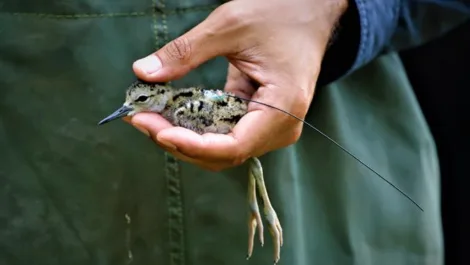
A researcher holds an ae'o chick during field monitoring. Scientists say continued monitoring, habitat restoration and predator control will remain critical to the Hawaiian stilt’s long-term recovery. Photo courtesy Melissa Price
Despite the improvement, researchers cautioned that the ae'o remains dependent on continued conservation efforts. The species still relies on predator control, habitat protection and water management, making it what scientists describe as "conservation reliant."
The Fish and Wildlife Service also adopted a species-specific rule intended to support continued recovery. The rule allows certain habitat management and restoration activities that benefit the ae'o to continue while maintaining protections under the Endangered Species Act.
Researchers said expanding managed wetlands will be critical to the bird's future, particularly as rising sea levels threaten coastal habitat.
Recent restoration projects have shown the birds readily return to restored wetlands, including Indigenous wetland agricultural systems.
“Downlisting doesn't mean the work is done,” said lead author Jessica Idle, a manager with the University of Hawaii at Manoa's Pacific Cooperative Studies Unit. “It means the work is paying off. Continued monitoring and management, especially expanding protected wetland habitat, will be essential to keep the population growing.”
The research was a collaboration among the University of Hawaii at Manoa, the U.S. Fish and Wildlife Service, the Hawaii Department of Land and Natural Resources, Tufts University and other partners.
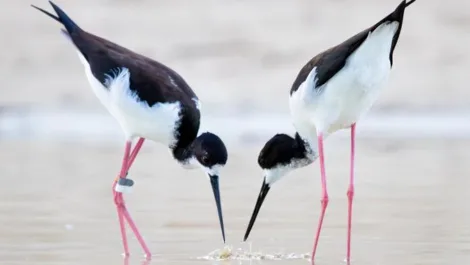
Two ae'o, or Hawaiian stilts, forage in a wetland. The U.S. Fish and Wildlife Service recently reclassified the native Hawaiian waterbird from endangered to threatened following decades of conservation efforts. Photo courtesy Melissa Price