
Council seeks answers on Maui safe parking pilot program
Trending
Maui County Council members are pressing Mayor Richard Bissen's administration for answers on why a safe parking pilot program for unhoused residents has not opened nearly four years after the council approved legislation allowing the county to create one.
The Maui County Council passed Ordinance 5419 in September 2022, with support from then-Mayor Michael Victorino. The ordinance allowed the county to create a pilot program for unhoused people to temporarily park their vehicles from 6 p.m. to 6 a.m. on county property, including county park parking lots.
The Water Authority, Social Services and Parks Committee, chaired by Council Member Shane Sinenci, deferred the discussion on the matter Tuesday after receiving an update from the administration and requests from committee members for more information. Another presentation is scheduled for July 27.
During the committee hearing, the Bissen administration said it was several months away from preparing a site at 43 Hansen Road in Puunene for safe parking for unhoused individuals on land provided by Maui Economic Opportunity.
Aegaeon SCS has received a $1.38 million contract through competitive bidding to implement and operate a safe parking program at the site for 12 months, including one-time costs for preparing the site.
Maui County Department of Human Services Director Margaret Willis, who was appointed in March, said project delays in Puunene are due to site preparation issues from flooding during the kona low storms in March and a re-evaluation of the site to ensure appropriate improvements, including exits.
There was an earlier plan to have a safe parking project at the J. Walter Cameron Center in Wailuku, where the center leases county land, but there were concerns about liability.
Also, some $162,500 added to the pilot project was never spent and has lapsed, according to the department.
Willis said the safe parking program is one of a variety of efforts underway at the direction of Bissen's administration. She said county officials have been working with a contractor to find solutions and keep the project moving.
Committee Vice Chair Gabe Johnson said the process for the Puunene safe parking project described by Willis is not moving as quickly as he would like.
"I don't really think this is the path forward with grub and grading permits slowing down this," Johnson said, while adding that if there were liability issues, the administration could have used the $162,500 for insurance.
Johnson asked Willis if she had spoken to any faith-based organizations for help, and Willis replied that it was on her list of things to do.
"I think there is a great deal of opportunity in the faith-based community," Willis said.
Bissen responds to questions
Responding to the committee's questions about strategies to address homelessness in Maui County, the Bissen administration said Wednesday that it has taken a comprehensive approach over the past three years, as the county has faced challenges from the 2023 Lahaina wildfire and unprecedented housing displacement.
The administration said its approach identifies more than 30 recommendations in a report titled "Recommendations to Address Homelessness in Maui County," released in December 2024.
"The assessment reinforced what we believed from the beginning: We couldn’t plan our way out of homelessness without first understanding it," Bissen said. "Before writing a long-term strategy, we needed to understand the problem, strengthen our partnerships, and build a system capable of delivering on that strategy.
"Homelessness touches every part of a person’s life, from housing and healthcare to behavioral health, substance use and public safety. If we’re going to address homelessness in our community better, we have to bring those pieces together in a way that treats every person with dignity and creates a more coordinated, effective system of care.”
Bissen said his decision to recruit Willis was an important step because of her experience and leadership in developing collaborative, systemwide approaches to address homelessness.
The administration said it is working to expand alternative sheltering options, including safe sleeping and tiny home communities. It also pointed to the expansion of substance use treatment capacity through Aloha House's new 12-bed dormitory, which increased residential treatment capacity by about 25%.
The administration said that during the past year, 876 individuals and family household members were placed into housing through Maui County's Coordinated Entry System, including veterans, individuals experiencing chronic homelessness and young adults.
The administration also said it has supported increased affordable housing production and administered federal emergency rental assistance through Catholic Charities Hawaii.
At the same time, the administration said it is advancing immediate priorities, including expanding shelter alternatives such as safe parking and safe sleeping, increasing treatment capacity for people with substance use disorders, expanding multidisciplinary street teams that connect people to medically based behavioral health care, and improving pathways to housing and supportive services.
"This work isn’t happening in phases where one step has to be completed before the next begins," Bissen said. "People experiencing homelessness can’t wait for a finished document before they receive help. We’ve been building the system, developing the long-term strategy and taking meaningful action at the same time because our community needs both immediate action and lasting solutions."
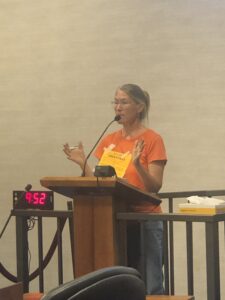
Maui resident Lisa Darcy said the safe parking program passed by the Maui County Council nearly four years ago was designed for people sleeping in their cars overnight on county land and isn't the same as the one that seems to be taking shape. Gary Kubota/The Maui News
Ordinance differs from action, critics say
During the committee hearing Tuesday, Maui resident Lisa Darcy said the Share Your Mana nonprofit supported the passage of the safe parking ordinance nearly four years ago.
She said the ordinance was intended to create a simpler program for people already living in their cars and parking overnight, and she doesn't know why it's taking so long to implement.
"The safe parking in general was designed for people who are living in their cars and would've overnight safe parking," Darcy said. "We were starting with just seriously the simplest, easier thing -- you drive your car in, you drive your car out."
Darcy suggested that parking lots at many parks already have infrastructure and would not require the kind of site preparation now being discussed for the Puunene site.
Makawao farmer Bill Greenleaf testified that when he leaves his farm, he often takes food to deliver to people living in their cars.
"We need to do something. They are human beings, and people face difficult circumstances," Greenleaf said.
Safe parking projects elsewhere
Speaking via a remote feed at Tuesday's meeting, operators of safe parking programs on the U.S. mainland said their programs have been successful.
Graham Pruss, executive director of the National Vehicle Residency Coalition, said he helped start Seattle's first safe parking program in 2011 and supports developing an overnight parking program for people sleeping in vehicles in Maui County.
Pruss said fire risks, safety concerns, vehicle conditions and access are important considerations, but they are manageable.
"Safe parking does not remove accountability," he said. "It creates accountability and connection. It gives outreach workers, safe service providers, police, fire and county staff a shared framework for knowing who is in their community, what supports they need and how to respond before a new crisis escalates."
Karina O'Malley, the safe parking coordinator at Lake Washington United Methodist Church, said she has operated a safe parking program for 15 years in Kirkland, Washington, for up to 50 cars.
"I know how easy it is," she said. "I know how you can just cut to sort of the core of what you need for a safe parking site and get it done very, very quickly."
O'Malley said she was in contact with the Maui County Department of Human Services about a year ago but has not been in contact since.
Council members seek information
Maui County Council Chair Alice Lee asked to see a copy of the contract between the county and Maui Economic Opportunity.
Lee encouraged the department to look at developing a project that would house women and children, reducing liability concerns.
The Bissen administration was also asked to narrow down potential county-owned parcels in Central Maui that might be appropriate for safe sleeping and parking and to provide a plan for the safe parking pilot project.
Council Vice Chair Yuki Sugimura said she would like another committee meeting where the Bissen administration can explain its plan.
"We keep on hearing, 'We're doing this. We're doing that. We're thinking of this. We've got to talk to the churches.' But what is your overall plan?" Sugimura said. "We need to build more shelters."
She said that instead of looking only at the safe parking project, she would like to know how many unhoused people are in Maui County and what the county's overall plan is.
Willis said that in the past 90 days since she took office, she has been compiling information to develop and organize a plan.
"Does the department have a plan now? No, we are working on it," Willis said.