
Kaanapali sand replenishment moves forward
Trending
A proposal to replenish eroding beaches at Kaanapali Beach Resort by returning offshore sand to the shoreline is moving forward through the state permitting process.
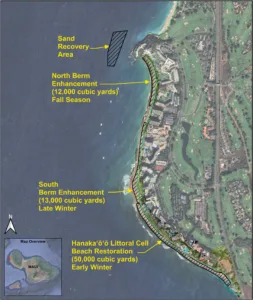
The proposal by the Pilikahakai Foundation and the Ka'anapali Operations Association would collect sand that has accumulated offshore beyond the reach of natural processes and redistribute it along the shoreline from Keka'a to Maui County’s Hanakao'o Beach Park.
The application has been filed with the state Office of Conservation and Coastal Lands, which reviews proposals and makes recommendations to the state Board of Land and Natural Resources. The project also would require a Special Management Area permit and a public hearing before the Maui Planning Commission.
The Pilikahakai Foundation said that, if approved, construction could begin in the fall of 2027.
The project would use a barge to recover about 75,000 cubic yards of offshore sand. Approximately 50,000 cubic yards would be placed between Hanakao'o Beach Park and Hanakao'o Point to restore the historic beach footprint, while another 25,000 cubic yards would be used to increase the beach berm between Hanakao'o Point and Pu'u Keka'a, where the shoreline naturally shifts with the seasons.
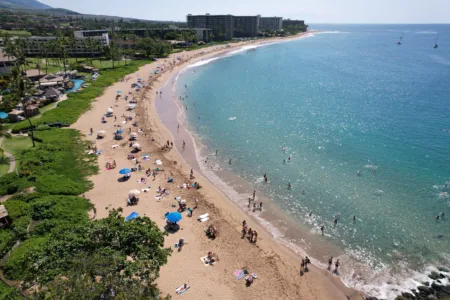
A proposal is moving forward to replenish sandy beaches at the Kaanapali Resort, where a number of major hotel chains have properties. A group representing resort properties has proposed removing an accumulation of sand in ocean waters off Keka'a Point and distributing it along the beach, including Maui County's Hanakao'o Beach Park. Photo courtesy of Pilikahakai Foundation
Supporters say the proposal is designed to restore the beach to approximately its 1988 profile.
At stake is the future of the 1,200-acre West Maui resort, which generates about $3 billion annually in gross revenues and supports thousands of jobs.
“Ka'anapali is the economic engine of West Maui,” said John Pele, executive director of the Maui Hotel & Lodging Association. “It’s not just livelihoods at risk. We stand to lose a place with deep cultural significance where Maui families have gathered for generations.”
According to the foundation, Kaanapali Beach Resort has been working to address shoreline erosion since 2006, when it retained Sea Engineering to study restoration options. A final environmental impact statement for the project was accepted in 2021.
Sea Engineering has participated in beach nourishment projects at Waikiki and Iroquois Point on Oahu.
Project supporters say the proposal has undergone significant changes over the past two years following meetings with community organizations, cultural practitioners and other stakeholders.
Those changes include reducing the amount of sand to be recovered by 20%, expanding the protective buffer around Pu'u Keka'a, eliminating construction staging at Hanakao'o Beach Park and scheduling in-water work outside canoe paddling season.
The proposal also calls for cultural monitors during construction, native dune vegetation and reef-safe landscaping. Water quality, coral reefs and beach conditions would be monitored before, during and after construction, including independent water-quality monitoring.
“We are grateful for the community’s feedback over the past two years,” said Raphael Wellerstein, president and general manager of the Ka'anapali Operations Association, which oversees maintenance of the resort.
“It has significantly reshaped this plan, with enhanced environmental safeguards and greater protections for cultural resources,” he said.
Pilikahakai Foundation Executive Director Keolahou Hinau said the proposal is intended to help the shoreline adapt to continued erosion and preserve the beach for future generations.
Sea Engineering said the proposal is based on three decades of scientific studies documenting changes along the Kaanapali shoreline. According to the company, rising sea levels associated with climate change are allowing more wave energy to reach the shoreline, accelerating erosion and shoreline loss while disrupting the natural processes that maintain beaches.
The state has previously approved beach nourishment projects at Waikiki and on Maui at Sugar Cove and the Kihei Boat Ramp.