
Haiku residents urge more action against coquis
Trending
Editor's note: This is the first article in a two-part series about efforts to control the spread of coqui frogs on Maui.
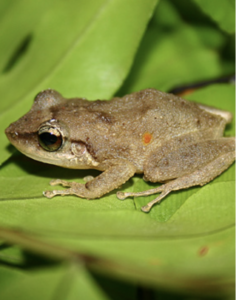
The shrill call of coqui frogs is as loud as a leaf blower.
The invasive species can also harbor parasites that cause rat lungworm disease, a rare infection that primarily affects the brain and spinal cord. On parts of the Big Island, including Hilo, some people wear ear plugs to deaden the frogs' shrill sound.
As Maui Invasive Species Committee staffing and resources have declined, some Haiku residents worry the island's long-running effort to contain invasive coqui frogs is losing ground.
With help from the state, county and MISC, the core coqui population has been contained mainly to a roughly 6-square-mile area in Haiku. However, Haiku residents say support has been waning and the frogs are expanding their presence.
The residents fear that without additional help, coquis could spread to other parts of Maui, including the East Maui rainforest.
"I think we're at the last stage. If we don't get it together and get an army out there soon, I don't think that we're going to be able to stop them," said Lucienne De Naie, president of the Haiku Community Association and chair of the Maui Group of the Sierra Club.
Short on staff
The Maui Invasive Species Committee had a staff of 20 for a brief time in 2021, but observers said it was short-lived and the staff was down to two field workers and a supervisor as of last week.
Similarly, a 2020 study found that coquis could be eliminated on Maui in 10 years for $63.5 million, but the effort never reached those funding levels.
Officials at MISC said they're grateful for the grants they receive from the state and county -- about $3 million annually from the county and $850,000 from the state.
While Maui continues to fight the spread of coqui, other invasive species, including little fire ants and coconut rhinoceros beetles, have reduced the group's ability to respond to reports of coqui frogs.
MISC said another major difficulty is navigating the changing systems of requirements for grants, which can delay payments, including payroll.
MISC education and outreach specialist Lissa Strohecker has worked for MISC since 2003 and is moving to a similar job on the U.S. continent. She said the delays in 2025 were extremely stressful, and part of her reason for moving is the uncertainty of funding for her job on Maui.
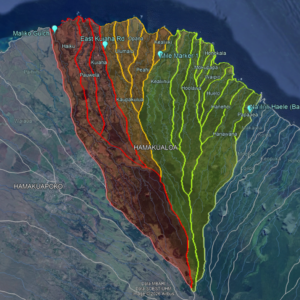
The Maui Invasive Species Committee breaks down Haiku into four zones with Zone 1, the red zone, being the most dense in coqui frogs. Image courtesy Maui Invasive Species Committee
Shifts in strategy
In mid-July, the Maui Invasive Species Committee updated residents on its coquis response, saying that, for the most part, field crews would no longer assist some residents in heavily infested areas of Haiku identified as Zone 1, or the red zone, near Maliko Gulch.
Residents in Zone 1 will continue to receive supplies of citric acid treatment, equipment and instruction, but they will be expected to apply the treatment themselves.
MISC said its highest priority is preventing the spread of coqui frogs into new areas in East Maui and other high-risk locations where an infestation could become impossible to manage.
Haiku resident Carmen Gardner Adams, who lives on West Kuiaha, said the location of coquis varies in Haiku and that neither her property nor nearby properties have coquis, even though MISC has included her property in Zone 1.
"I've been helping my children fix up a house in West Kuiaha, and I don't hear any coqui frogs," she said.
MISC manager Jorge Rentaria Bustamante said the management zones are intended to guide resource allocation based on coqui distribution, risk of spread, terrain and ecological factors.
"They do not mean that every property within a zone has frogs or identical conditions," he said. "We recognize that there may be uninfested properties or isolated populations within Zone 1, and requests for individual treatment will be reviewed case by case based on current conditions and available capacity."
Gardner Adams said she is still concerned about not receiving field assistance if coqui frogs appear on her property. She said she believes MISC's budget should be increased and there should be a more aggressive effort to control the frogs, including helicopter drops of citric acid treatment.
She said allowing coquis to continue expanding could result in lower property values and less income for the county.
"Are people going to want to rent here?" she said.
Adams said she has been to areas around Hilo on Hawaii Island where people have to wear earplugs to muffle the sound of the coqui frogs.
"I would rather have a lawnmower in my ear than what I experienced in Hilo," she said.
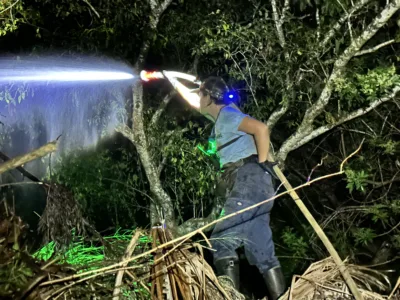
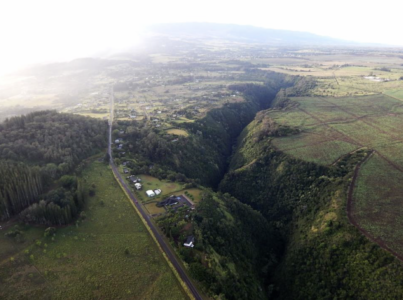
The epicenter of coqui frogs on Maui is Maliko Gulch in Haiku, partially because of its difficult access. Photo courtesy of Maui Invasive Species Program
Resident says more support is needed
Haiku resident Joyclynn Costa, who lives near Fukushima Store and Kokomo Road, said the sound of coquis has gotten worse.
She said that if someone had called her by telephone the previous night, with the sound of coqui frogs as loud as they have become, the person would have thought she was calling from Hilo, where coquis are abundant.
Costa said she has been following the issue for some time and has received support from MISC field workers in the past, sometimes with three or four workers walking down her street, listening for calls and then applying treatment.
"To me they went above and beyond," she said. "They would even come knocking on your doors and ask if they could come and check your yard."
Costa said she has attended Maui County Council hearings and seen MISC officials asking for additional funding.
"I mean they don't have enough manpower. They don't have enough for the supplies and equipment," she said.
Costa said part of the problem is the lack of pay needed to attract and retain workers. The pay is $19.62 an hour, with a 20% night differential, health insurance, vacation benefits and a retirement plan, according to the University of Hawaii.
"It's hard work for them, walking around, especially when it rains," she said. "If you cannot convince people to get wet and get dirty and get cold and work at night, they're not going to find the people. Then Maui will be at risk. They have to have more inspectors."