
Jonathan Helton: It’s too soon to applaud rebuilding in Lahaina
Trending
Maui County officials convened a community meeting in Lahaina on July 1 to celebrate that reconstruction of the wildfire-ravaged town is finally on track -- nearly three years after the world watched in horror as much of it burned to the ground.
But that jubilation is unfortunately mistaken, and permit delays are largely to blame.
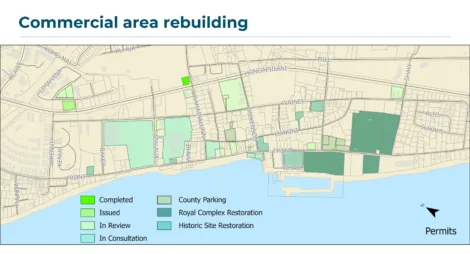
To support their excitement, officials displayed a map during the meeting, shown above, indicating that two commercial permits have been issued and one project has been completed.
On the surface, these permits mark a milestone in Lahaina's recovery. Dig deeper, however, and the reality is more complicated.
The completed permit can be traced back to a gas station at 263 Lahainaluna Road, but the project involved only site work and the installation of a new concrete pad. The property owners have yet to apply for a permit to rebuild the gas station itself.
One of the issued permits the county officials touted should also come with an asterisk. The backstory there is that a fast food restaurant at 127 Hinau Street applied for a permit on June 29, 2026, and the County approved it the same day -- because the building had just been built in 2022.
The owners qualified for an expedited permitting process because the Maui County Council passed an ordinance back in 2024 allowing property owners to reuse past permits that were approved within the five years of the fires.
Most other Lahaina commercial buildings destroyed in the fires were decades old, so only a handful of businesses in the area can benefit from that 2024 law.
To date, no other commercial rebuilds have been approved, although dozens are in the permitting queue.
That queue has been clogged by unclear documentation requirements, mandatory public hearings, months-long historic reviews and a host of other obstacles.
The state and county have attempted to address some of those barriers. For example, a few months ago, the Maui Office of Recovery issued a directive streamlining county historic reviews.
Additionally, Gov. Josh Green in February 2025 waived Special Management Area rules for most rebuilding work and signed a bill codifying that order a few months later.
But owners of the properties left out of that waiver -- primarily those within the shoreline setback area -- still must endure multiple rounds of public hearings to obtain an SMA use permit to rebuild. The reconstruction of the Iglesia Ni Cristo church north of Lahaina is just one project that must run this gauntlet, since part of the property lies in the setback area.
The State Historic Preservation Division also remains a major hold up.
The agency has been requiring extensive archaeological monitoring and surveys, even for property owners who simply want to rebuild exactly what was destroyed.
One project, a rebuild at 612 Front St., received notice in July 2025 that it had to complete an expensive archaeological inventory survey. SHPD wasn't satisfied with the results until June 2026.
Meanwhile, the Miyaki building at 764 Front St. has faced a similar fate. SHPD told the owners to complete an AIS in August 2025, and Maui County permitting records still do not list the survey as complete. Another project was initially reviewed by SHPD in fall 2025, and the agency did not notify the applicant until April 2026 that an AIS is required before the building permit can be approved.
If the 612 Front St. project is any indicator, those applicants face at least another year in permitting purgatory.
Each day a permit spends awaiting approval can add an average of $100 to $200 in construction costs to a project, according to the state's own research. And that estimate doesn't take into account lost business sales, employee earnings, government tax revenues or the immeasurable emotional toll Lahaina's sluggish recovery has taken on the community.
State lawmakers have attempted to improve the historic review process. In 2025, they passed a bill that provides permit exemptions for areas in which ground disturbance has occurred and no historic artifacts were identified, and for work on buildings older than 50 years that are not historically significant. Then this year, they approved a measure that imposes a 90-day deadline for SHPD to review certain projects.
But it is unclear whether those laws are too little too late for Lahaina’s business owners.
Instead, it might be time for Gov. Josh Green to intervene again through executive action.
Directing SHPD to prioritize rebuilding projects in Lahaina, setting firm review deadlines for them and providing exemptions from the archeological survey requirements, would be a good start.
The governor could also expand his emergency waiver of the SMA rules to allow projects inside the shoreline setback to be rebuilt without an SMA permit.
Rather than overstate Lahaina's recovery progress, officials need to recognize that the existing bureaucratic malaise could cause it to limp along for several more years while the historic whaling town fades into a fond memory.
Jonathan Helton is a policy analyst at the Grassroot Institute of Hawaii.