
Residents fear waning support in effort to combat coqui frogs
Trending
Editor’s note: This is the second and final article in a two-part series about efforts to control the spread of coqui frogs on Maui.
Every six to eight weeks for the past five years, staff from the nonprofit Maui Invasive Species Committee have filled a 2,500-gallon tank connected to plastic pipes to fight an invasion of coqui frogs on a hill overlooking Maliko Gulch.
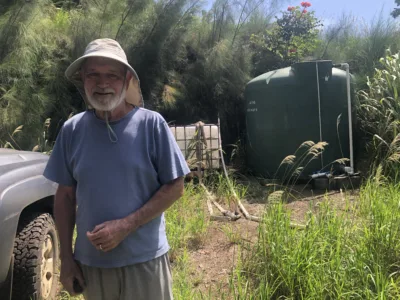
Haiku resident John Phelps said the committee has told his community of 37 residences it won't be continuing the service, leaving Phelps concerned the neighborhood could be overrun by the invasive species.
Phelps, a retired chief engineer for Lockheed Martin, said the pipe system has effectively served as the community's first line of defense, allowing residents to treat the border of their property lines above Maliko Gulch, reducing the number of coquis reinfesting the sprayed areas to a few coquis a month.
The homeowners rely on a pickup truck with a tank to treat the reduced number of frogs on individual properties.
In response to Phelps' concerns, MISC manager Jorge Renteria Bustamante said MISC values Haiku Hill residents' substantial contributions to coqui control. Renteria Bustamante said MISC is reassessing whether it can continue mixing and delivering the solution at its current level, and no final decision has been made to discontinue citric acid solution support at Haiku Hill.
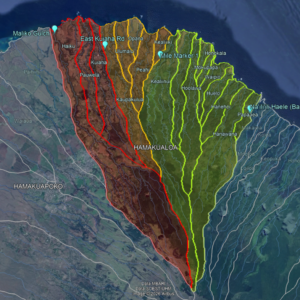
The Maui Invasive Species Committee produced this map identifying general hotspots for coqui frogs in red and orange. Image courtesy Maui Invasive Species Committee
MISC has distinguished itself
The task of fighting invasive species such as coqui frogs is shared among agencies, with the state Department of Land and Natural Resources protecting state lands and the state Department of Agriculture and Biosecurity focusing on screening at airports and harbors.
In the past, MISC has helped to fill the gaps with its specialized teams developing better methods of treatment.
In the 1990s, MISC was formed before other invasive species committees on other islands, including Oahu.
In certain instances, MISC has helped to take the lead on the Valley Isle, especially in the fight against Miconia calvescens on Maui -- an invasive evergreen tree that invaded roughly 70% of Tahiti's rainforest.
Working in collaboration with the University of Hawaii including the College of Tropical Agriculture, MISC is managing the spread of Miconia calvescens with field and aerial crews, pioneering electronic detection through artificial intelligence and developing a herbicide treatment using small projectiles similar to a paintball -- an idea developed by University of Hawaii researcher James Leary.
In 2019, MISC working with the Hawaii Ant Lab used a helicopter-deployed gel bait to treat little fire ants on 175 acres in Nahiku in East Maui, followed by ground crews to reach a monitoring phase where no ants have been detected.
That same year, MISC published "Eradication of Coqui Frogs from Maui County, Hawai'i: Strategic Plan 2020-2030" proposing to control and possibly eliminate the coqui frogs on the Valley Isle in 10 years.
The proposed schedule and cost analysis for the eradication project amount to an initial annual cost of $8 million, decreasing to $4.5 million over the 10-year timeframe, for a total of $63.5 million.
MISC recommended that the plan help to establish a larger, community-based task force that would bring together affected residents, elected officials, industry representatives and MISC staff and committee members.
MISC said the group's mandate should include a review of the proposed plan and ongoing operations, and help to identify and implement effective cost-reduction approaches.
The 10-year plan was never fully implemented, although MISC continued to receive some funds for its anti-coqui projects.
Biologist warns of consequences
Coqui frogs do not have natural predators in Hawaii like they do in their native Puerto Rico and their populations can explode up to more than 50,000 frogs per hectare or more than 20,000 per acre, said biologist Karen Beard, who has conducted studies on Hawaii Island.
"They eat all different types of insects," she said. "They help the invasion of other non-native species into the forest. We found there were more non-native birds where coquis are."
Beard's studies show the presence of coquis in Hawaii can increase the number of non-native birds like the common mynah and also the mongoose.
She said the coquis serve as a food source for non-native birds and mammals such as pigs and cats, and also increase non-native plants by changing the nutrient cycle.
The presence of coquis changes from the Big Island's nutrient-poor volcanic soil to higher levels of nitrogen and phosphorus benefiting invasive plant species.
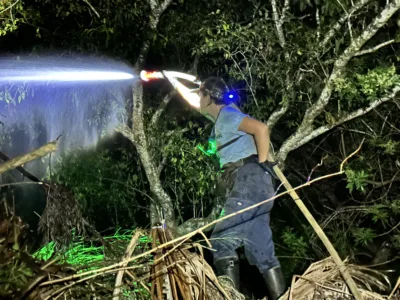
A chemical solution of citric acid is sprayed into an area in an effort to eradicate coqui frogs. Photo courtesy Maui Invasive Species Committee
Carrying diseases
Humans most commonly become infected by accidentally eating infected snails or slugs, or produce contaminated from them. The Centers for Disease Control and Prevention also note that animals including freshwater shrimp, crabs and frogs can carry the parasite's larvae, and eating them raw or undercooked may pose a risk, although the evidence is less clear.
While the parasites have been documented in many states, Hawaii Island is considered the epicenter for rat lungworm disease in the United States.
According to Dr. Susan Jarvi, a now-retired University of Hawaii biologist, a study by the U.S. Department of Agriculture tested 24 coqui frogs and found 87% of them were positive for the parasite.
Jarvi said it's not understood if coqui frogs are able to transmit the parasite directly to humans, but if the frogs get into water supplies, infective larvae can survive for long periods of time.
"A main concern of increasing populations of coqui frogs is that it could lead to increasing transmission of the parasite and rat lungworm disease," she said. "Increasing transmission means there's increasing potential for the parasite to find its way into humans and other animals."
Jarvi said there need to be more studies on rat lungworm disease, including an expanded examination of coqui frogs.
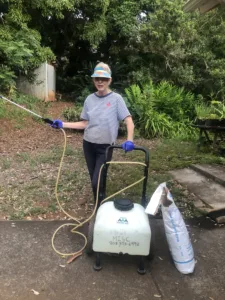
Haiku resident Cynthia Conrad is grateful for the Maui Invasive Species Committee providing the pesticide as well as equipment and instruction on how to spray her yard to reduce the presence of coqui frogs. Gary Kubota/The Maui News
Residents not giving up
Cynthia Conrad, who lives in Haiku near Maliko Gulch, does what she can to keep the coqui frogs away from her house to reduce the noise at night. MISC has provided a mobile mini tank with a bag of chemicals that she mixes with water and applies using a hand sprayer.
Conrad said a major colony of coqui frogs is in a bamboo forest across a small gulch by her property, and she's not physically able to treat the forest area.
Phelps said he still thinks the plan to eliminate the coquis in Maliko is a good one, but he said it will require a methodical approach and consistent support.
"You have to get them out of the area, totally out of the area. Then we've got to get them out of the washes to keep them from coming back," he said. "Pick a small area that you can get them out of, and then you've got to protect that area."
Phelps said getting the frogs out of an area requires three months of regular spraying and keeping them out requires regular spraying of the protected perimeter.
"That's the only method we've shown that works," he said.
He said part of the plan would involve a crew going down Maliko Gulch and other connected gulches around Haiku Hill to eliminate the frogs there.
"We've measured the frog density, and the gulches around Haiku Hill are the highest here on Maui. We've got to continue to get them out of the areas near the residents and to keep them out," he said. "We must also eliminate them from the gulches to keep them from re-infecting the areas near the homes. If not stopped they will ultimately end up in Hana.”