
‘The End of Oak Street’ has Anne Hathaway but not logic
Trending
Writer and director David Robert Mitchell's "The End of Oak Street" begins with a summer block party, as families play outside in a large community that is not tight-knit.
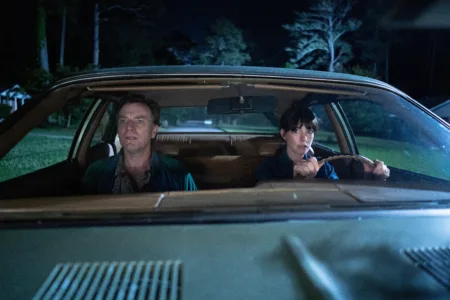
We watch as mom and friendly neighbor Denise (played by Anne Hathaway) have an ongoing war with an annoying neighbor, but Denise also has secrets she keeps from her children and even her husband Greg (Ewan McGregor). No specific date is established, but the conversations, attire and pop culture references suggest it takes place in the early 1980s.
One night, a series of flashing lights in the sky alerts the dog that something is off. The next morning, everything has changed drastically, including the location of their street as well as the beings that populate their neighborhood.
Despite the promotional materials that spoil most of the surprises, I'll refrain from giving away the biggest twists. Mitchell has certainly come up with a wild idea that is good enough for a short story, but the longer the film goes on, the more it seems like the film ran out of ideas.
The story comes across like an over-extended episode of "The Twilight Zone," minus Rod Serling's wit, a clever last-minute twist or even a point. More likely, this is less Mitchell's attempt to match Serling and more his encountering the mean-spirited last act of "The Lost World: Jurassic Park" (1997) and deciding to create a feature length extension.
Despite having J.J. Abrams as the producer, the film doesn't hit the sweet spot of "Super 8" (2011), but comes across a lot like "The Box" (2009), Richard Kelly's similarly 1980s-based sci-fi drama that managed to entertain, despite how similarly odd and off-putting it was.
Michael Giacchino's tonally off score suggests a warm-hearted Amblin Entertainment throwback, but it plays like "Gremlins" (1984) minus Gizmo or the Looney Tunes-infused sense of humor. The funniest scene, which involves a wild Polaroid photo, is out of place in a story this grim.
Hathaway gives a great scared-face and goes all-in, as does McGregor and the sporting cast, but they can't elevate the screenplay.
This is not for kids. The vivid, intense violence could traumatize any child. Thankfully, I decided to see the film first and not bring along my 10-year-old. Unlike the recent "Jurassic World" installments, this one stretches the PG-13 rating a lot further, with the monster attacks often gruesome and traumatizing. There will not be a line of action figures based on this movie.
The intensity of the carnage would be forgivable if the whole thing made sense and had a knockout finale, but it doesn't. The sci-fi premise makes no sense, and the conclusion offers no explanation for any of it. "The End of Oak Street" has its moments, but it doesn't work.
A subplot involving a neighborhood bully seeking revenge works in the first half but is bizarrely out of place once this becomes a creature feature. It's not the only scene that makes zero sense.
"The End of Oak Street" is at its best when Mitchell allows the camera to surveil the neighborhood, revealing danger looming over the housetops and where homes used to be. The special effects are very good, and I liked the moments where characters turn to the music of Steve Winwood and Bryan Ferry for comfort.
Mitchell's breakout film "It Follows" (2014) deserves its cult following, but far better is "Under the Silver Lake" (2018), his even wilder follow-up starring Andrew Garfield as a Hollywood sleuth searching for a lost neighbor, a film that is genre-fluid, insanely ambitious, truly strange and rewarding. Mitchell's latest is an accomplished work and his most appealing for popcorn summer audiences, but the humdinger of a setup doesn't have the crucial final kick -- let alone any real explanation -- that it needs. Even M. Night Shyamalan would have come up with something.
Mitchell's film certainly offers spectacle and some choice moments but thinking about it on the drive home only reveals how much of it doesn't connect and is downright nonsensical. Science fiction as a genre doesn't need to be airtight in concept, but this one doesn't add up.
(2 out of 4 stars)
Barry Wurst II is the founder of the Hawaii Film Critics Society and teaches film classes at University of Hawaii Maui College.