
UH oral history center receives $538K for Maui projects
Trending
Four grants totaling $538,000 will support University of Hawaii projects recording dozens of oral histories about Lahaina, water, women's history and the Lahaina Jodo Mission.
Researchers say documenting residents' experiences, cultural knowledge and memories will help preserve Maui's history for future generations and contribute to the island's recovery from the 2023 wildfires.
The projects are being led by the Center for Oral History, which is housed in the Department of Ethnic Studies at the University of Hawaii at Manoa. The center maintains a digital archive containing more than 1,000 oral histories.
"Taken together, these four projects form a complementary portfolio that documents Maui's people, places, environments and institutions during a critical period of transformation," said COH Director Mary Kunmi Yu Danico. "They intersect through their shared reliance on oral history, commitment to community collaboration, dedication to cultural preservation and focus on creating accessible and sustainable historical resources. Collectively, they not only preserve the past but also contribute to Maui's recovery, resilience and future generations' understanding of their heritage."
The largest award is $250,000 from the Hawaii Community Foundation's Maui Strong Fund for "Lahaina Memories: Preserving Oral Histories Through Intergenerational Storytelling."
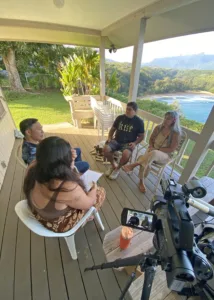
An interview is conducted for the Lahainaluna Native Hawaiian Boarding Student oral history project. Courtesy photo
The project will document the experiences and cultural knowledge of Lahaina residents following the August 2023 wildfire, which destroyed thousands of homes and businesses, as well as cultural and historic sites.
Researchers plan to produce as many as 100 hours of recorded interviews. Center staff will conduct approximately 40 hours, while trained educators, young people and community members will conduct another 60 hours.
The project will be conducted in five phases through January 2029. Its work will include community training, fieldwork, mentoring, transcription and long-term archival preservation.
A $159,000 National Endowment for the Humanities grant will support "Echoes of Wai (Water): Oral Histories from Maui." This project will record 30 interviews examining the history, current conditions and future of water on Maui from a range of cultural, generational and environmental perspectives.
According to the university, 20 interviews will be conducted in West Maui, with a focus on Lahaina residents affected by the wildfire. Ten others will involve residents of Na Wai Eha -- Wailuku, Waiehu, Waikapu and Waihee.
The center also received a $100,000 Digital Justice Grant from the American Council of Learned Societies for "Na Moolelo o Na Wahine," a project intended to preserve and make more accessible the histories of women of color on Maui.
The project also will create an accessible digital platform combining interview recordings, transcripts, photographs and supporting historical material. Training modules will teach students, educators and community partners on Maui and Oahu about oral-history digitization, digital storytelling and community archival practices.
A fourth grant, a $29,000 National Endowment for the Humanities Chair Grant, will support oral histories about the Lahaina Jodo Mission. Researchers will interview temple elders and people who attended or lived at the mission, documenting its history and importance to the Lahaina community.
The work will be conducted in collaboration with mission leaders and elders as the temple rebuilds following the wildfire.
The Center for Oral History was established in 1976 to record and preserve the experiences of Hawaii residents. Its collections include interviews about plantation life, labor, immigration, ethnic communities, land, cultural practices and major events affecting the islands.
More information is available at oralhistory.hawaii.edu.