
Volunteers join effort to protect Lā‘ie wetlands
Trending
With the blowing of a conch shell, the nonprofit Koʻiʻula and its supporters began a Mālama the Wetlands event Saturday, expanding efforts to restore the Lāʻie wetlands in South Maui.
"Places like Lāʻie remind us that caring for the environment and caring for our culture are not separate responsibilities," said Leiʻohu Ryder, president of the Koʻiʻula board.
Saturday's work was part of the group's ongoing stewardship of the wetlands where groundwater and streamwater meet sand dunes that have acted as natural retention basins, reducing flooding and erosion.
The streams going into Kihei, including the areas of Lāʻie and Waiohuli, used to flow nonstop, but the water has been diverted over the years, said Dustin Palos, a stewardship coordinator for the University of Hawaii Sea Grant Program.
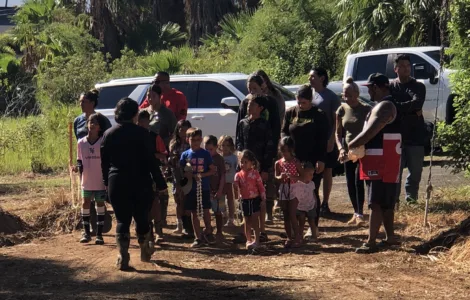
Under the nonprofit group Koʻiʻula, children were taught Hawaiian cultural protocols promoting environmental stewardship, before a volunteer cleanup Saturday. Gary Kubota/The Maui News
"You would have had tons of birds," he said. "Back then you had at least 125 different species. Today we have less than 24 species."
The species that continue to exist include honeycreepers like the i'iwi, amakihi, Maui 'alauahio, kiwikiu and ʻākohekohe. Palos said restoring critical forest habitat helps to encourage that kind of wildlife. He said the conditions for preserving wetlands and wildlife are improving in some areas, including conditions for the native aeʻo found in some wetlands.
"The aeʻo was classified as endangered but was just reclassified to threatened. The species has had a major comeback because of conservation efforts," he said.
Palos said the focus of the wetlands work is on creating critical habitat for native plants like naio, milo, lauhala and niu.
In the Lāʻie wetlands, there are coconuts and milo near a pond overlooking the ocean as well as competition from a non-native mangrove. Volunteers have made a major effort to rid the area of pickleweeds and fleabane, Koʻiʻula officials said.
"You can see how the mangrove outcompetes to have the rest of the space," Palos said.
Nearby are traces of Native Hawaiian habitation with a growth of 'uhaloa, used for tea and for colds and sore throats.
Palos said in Hawaiian culture, 'uhaloa is thought to be a physical manifestation of the sea god Kanaloa.
Ryder said the group has been working to restore the wetlands at Lāʻie and Waiohuli for several years, and the occasion Saturday marks a special gathering of other people joining in the effort, including the group Ho'aka Mana, with Kumu Kanoelani Davis-Wong.
The joint work of clearing the land of invasive weeds was also an occasion to reintroduce native Hawaiian rituals, passing down their culture from one generation to the next and showing respect for the land.
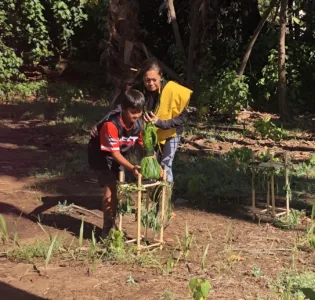
Part of the cultural protocol, organized by project manager Stephanie Kaplan, included asking permission to enter the land and offering gifts wrapped in ti leaves.
In this case, the selected youths carried and laid the offerings on a wooden platform.
Ryder said the event also strengthened the bonds between generations who care for the land.
"When our community comes together to restore native habitat and care for the wai and 'āina, we are also helping to preserve the knowledge, relationships and sense of kuleana that have sustained Hawaiʻi for generations," she said.
The event was supported by P.B. Sullivan Construction, which provided the trucks to remove the invasive plants.
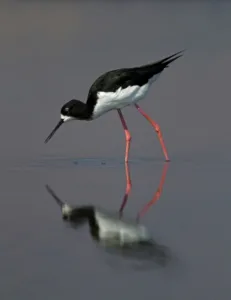
Following wetland conservation efforts, the aeʻo, or Hawaiian stilt, has been reclassified from endangered to threatened. Aeʻo and the migratory kōlea, or Pacific golden-plover, were spotted during a cleanup at the Lāʻie Wetlands on Saturday. Photo courtesy U.S. Fish and Wildlife Service