
Wurst: “The Odyssey” wins on visuals, but the new dialogue is its Achilles’ heel
Trending
Christopher Nolan's "The Odyssey" is exactly the kind of film you can only make after somehow directing a blockbuster movie about J. Robert Oppenheimer that wins best picture at the Oscars.
Presumably, someone at Universal Pictures, in what must have felt like a game of chicken, told the filmmaker, "We'll back whatever you want to do next," and he responded by handing them a copy of Homer's "The Odyssey." Leave it to Nolan to bet big and risk ridicule, even after he's already established himself as the Alfred Hitchcock of the 21st century.
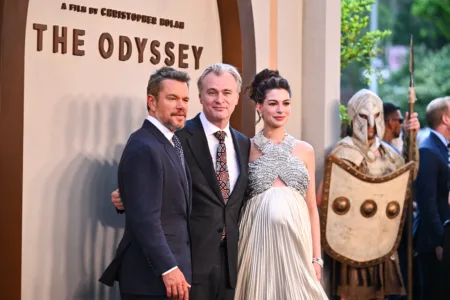
The story is more or less as you remember it (or as I barely remembered it from my 10th grade English class at Ka'ahumanu Hou -- sorry, Mrs. Donadio). After the Trojan War, Odysseus (played by Matt Damon) journeys far from home and his son Telemachus (Tom Holland) searches for him. Meanwhile at home, Odysseus' wife Penelope (Anne Hathaway) tries to maintain order and keep the sleazy Antinous (Robert Pattinson) from overpowering her.
This is Nolan's nerviest, strangest film yet, and it initially tests the patience of even his most devoted apologists. Once we arrive in the cave of the Cyclops (among the more haunting visuals of the year), the film takes off.
Despite the 173-minute running time, the length isn't a problem. The film's true Achilles' heel is the dialogue, which Nolan adapted from Homer with the intention of sounding contemporary. This foolhardy touch, presumably so high school teens will have an easier time following the story, is to the film's detriment. In exchange for all the Thy's and Thou's, we get, "Telemachus, get on the f--ing ship!" The clunky, occasionally embarrassing dialogue provides handholding for newbies but often undermines the work of the actors.
Samantha Morton as Circe the witch, Bill Irwin as the hungry Cyclops and John Leguizamo as Eumaeus, Odysseus' blind servant, are all unforgettable and steal the movie from the bigger names in the cast. As for the A-listers, the film is so long and episodic, the frequent cutting to different locations results in the biggest stars feeling like celebrity cameos: (Hey look, it's Zendaya! Wow, it's Charlize Theron!). I enjoyed the committed performances from Damon, Hathaway and Pattinson, even as I could never forget who was playing the role.
Ludwig Göransson's score is hard on the ears (where was Hans Zimmer when we needed him?) and some of the fight scenes appear overly choreographed.
For Nolan completists, I prefer "The Odyssey" over "Oppenheimer" (2023) and "Dunkirk" (2017) but still place "Tenet" (2020), "The Prestige" (2006), "Inception" (2010) and "Interstellar" (2014) as my favorites.
John Boorman's "Excalibur" (1981) and Tarsem Singh's "The Fall" (2006) are both better, tighter and far more surreal sword and sorcery fantasy epics, and even the Coen Brothers' "O Brother, Where Art Thou?" (2000) told this story better, despite being a spoof on Homeric conventions.
Since "Memento" (2001), now 25 years old and Nolan's first theatrical release, the filmmaker has continued his trademark of misaligned storytelling, reflecting on the fractured memory of his protagonists and forcing the audience to see his films more than once for full comprehension. Once again, this approach works to his benefit. So does having a rousing third act, full of crowd-pleasing power reversals and one satisfying moment after another.
Reading Homer's text is still preferable to any literal cinematic retelling thus far. Yet, Nolan's dedication to large-scale cinematic storytelling, presented on the biggest screen possible, is still a thing to cherish and experience. Ultimately a movie of moments, "The Odyssey" is worthwhile for its surface-level achievements and for its thematic exploration of the toll that time and moral compromise has on humankind. The extended journey, both Odysseus' and ours, is worth taking. That said, there's no intermission, so don't plan on any bathroom breaks. The next time Nolan gives us a two-hour-and-fifty-three-minute epic, he owes his audience a much needed break with a 15-minute countdown.
So, what are you waiting for, filmgoers? Suspend your disbelief and "get on the (expletive) ship!"
(3 out of 4 stars)
Barry Wurst II is the founder of the Hawaii Film Critics Society and teaches film classes at University of Hawaii Maui College.