
‘ʻAinakea’ portrays a pivotal time in Maui’s history
Trending
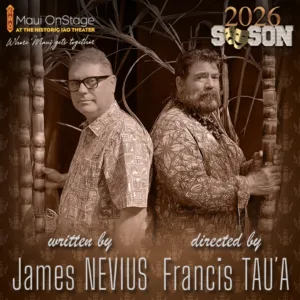
Inspired by Russian author Anton Chekhov's classic "The Cherry Orchard," Maui playwright James Nevius' new play "ʻAinakea" will open Oct. 2 at ʻĪao Theater.
Set in 1953, "ʻAinakea" transposes Chekhov's pre-revolutionary Russian estate to Maui during a pivotal moment in Lahaina's history. As the island's cane harvests give way to the beginnings of resort development, the play explores a community caught between a vanishing past and an uncertain new era on the eve of Hawaii statehood.
"It's a story that doesn't get put on stage that often about a Maui sugar plantation in 1953," Nevius explained. "The architecture of the story is Chekhov's 'The Cherry Orchard' that I fell in love with 40 years ago. Chekhov wrote this play, and then almost immediately died before the revolution. Every time I've seen it, I've thought there should be a way to adapt this, so that it would connect with a modern audience in a better way."
"ʻAinakea" centers on the Goodale family, descendants of missionaries who cling to a once-prosperous sugar plantation that has fallen on hard times. Into their fading world comes Lopaka with plans to transform the coastline into a new paradise for tourists. As the old order collides with an emerging vision of Hawaii's future, the play shifts from comedy to elegy as landowners, servants and the children of field laborers confront the price of progress.
Directed by Francis Tauʻa, the cast of "ʻAinakea" includes Cullen Mitchell as Lopaka, Layla Rohde as Mary, Sebastian Navarro as Johnny, Guy Henry as Kawika, Isadora Drew as Anna Goodale and Jennifer Fahrni as Amanda Goodale.
"I realized at a certain point that the prized cherry orchard of the original was very much like what had happened to the sugarcane plantations on Maui," Nevius said. "So I started doing some deep research into when there was this sort of pivotal moment of the plantations starting to close, and sugar production moving away from Hawaii, but before the hotel economy. So there's a west side sugar plantation, and a young man who grew up in a plantation camp comes to the family and says, 'You should cut down the sugarcane, and we should build hotels in Kaanapali.' I needed to set it at a moment before there were hotels in Kaanapali."
A few years ago, Nevius presented an early staged reading of the play as part of Maui OnStage's One Night Only series. "The response from our audience was extraordinary," recalled Maui OnStage Executive Director Luana Whitford-Mitchell.
"From that evening on, we knew we wanted to bring this story to the historic ʻĪao Theater as a full production. As a Native Hawaiian, this story resonates with me in a deeply personal way. I knew 'ʻAinakea' was a story that needed to be told. Although a work of fiction, it is firmly rooted in the history of our islands. The characters reflect the experiences, struggles and hopes of many who lived through Hawaii's pre-statehood era."
Nevius previously adapted Sophocles' renowned play "Antigone," reimagining ancient Thebes as a world similar to our current one, with a city reeling from the end of a devastating war and a new regime promising order. He is also the author of the award-winning play "Murder in the Nth Degree," which was named best new play by BroadwayWorld Hawaii and won the inaugural ProArts playwriting contest.
He chose the title for the new play from a prized type of white sugarcane, which translates from Hawaiian as "white land." "I needed to come up with a name for the plantation and I wanted it to be fictional," he said. "It's a fine, very white type of sugarcane, which by the 1950s was already becoming rare. I was writing about these plantation owners who own a plantation that is literally called 'white land.' Against them is an elderly Hawaiian character named Kawika, who was a boy when this was still the Kingdom of Hawaii. He's in every scene, like a Greek chorus to comment on the action."
Working with the actors in rehearsals, he saw how the play "has touched so many people who are involved in getting the show on its feet, who have personal connections to an element of the story," he said. "It's fictional, but one scene takes place at the Maui Fair, and people have all these incredible memories of going to the fair and growing up at the fair. I've met people who've grown up in plantation camps who have read the script and said, 'This is a great reflection of what life was actually like.'"
While set in Maui's past, the play is meant to reflect important issues on the island. "I have created situations and dialogue, and invested it with meaning that are very much about what questions still concern us on Maui to this day," said Nevius. "Whose land is it? How are we to be the best stewards of the land? Where do we get the water? Whose water is it? So it's very much about how do people deal with transformation and change?"
"ʻAinakea" will open at 7:30 p.m. Oct. 2. Performances will run through Oct. 18, with shows at 7:30 p.m. on Fridays and 3 p.m. on Saturdays and Sundays. Tickets are available at MauiOnStage.com or by calling 808-242-6969.
A talk story with the playwright will follow the Oct. 4 and Oct. 11 performances. The show is sponsored by the Wave of Harmony Foundation in partnership with Marji Knowles and Michael Tibbott.