
An exhibition of aloha: MACC puts vintage shirts by John Keoni Meigs on display
Trending
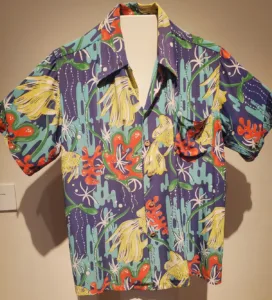
Long before the aloha shirt became a ubiquitous symbol of Hawaii, Chicago-born, self-taught painter and textile designer John Keoni Meigs created hundreds of unique, island-themed shirt designs beginning in the late 1930s.
Some of his innovative work is on display in the "Keoni of Hawaiʻi: Art of the Aloha Shirt" exhibit at the Maui Arts & Cultural Center's Schaefer International Gallery. Curated by Dale Hope, the show features an array of vintage shirts along with original textile artworks, draft sketches and swatches, documenting Meigs' design career.
"John Keoni Meigs was active in Hawaii from 1938 to 1951," explained gallery director Jonathan Yukio Clark. "He was one of the most established innovators of that time."
Arriving in Honolulu in 1937, Meigs initially worked as a newspaper reporter for the Honolulu Star-Bulletin and later the Honolulu Advertiser. He began creating textile designs drawing on Polynesian kapa patterns he studied at the Bishop Museum.
"This is a time where aloha shirts were still in their early years," said Clark. "They were the result of different cultural influences and the work of designers and shirtmakers, often like mom-and-pop shops or locally owned shops who would do tailor-made shirts in aloha print fabric that became more and more popular as Hawaii was shifting from an agricultural to a tourism-focused economy."
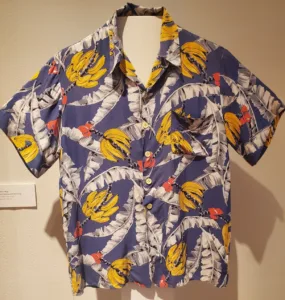
John Keoni Meigs created hundreds of unique, island-themed shirt designs beginning in the late 1930s. Jon Woodhouse/For The Maui News
One of the most innovative island fabric artists, Meigs is credited with creating around three hundred aloha shirt designs.
"Keoni was a designer, but he was not a shirtmaker," said Clark. "So he would create these designs and then sell them to different makers, either within Hawaii or on the continent."
Meigs once said: "In a sense, aloha shirts put Hawaii on the map. The first thing people did when they arrived was make a beeline for a department store to buy one. A lot of kooky things were designed, but I always tried to be a purist when it came to using motifs from Hawaiian sources."
He had a rather traumatic upbringing. Born in 1916, he was kidnapped as an infant by his father and his father's mistress at a Chicago hotel, and Meigs never saw his mother again. After his father's death, Meigs attempted to volunteer for military service following the attack on Pearl Harbor and learned that he had been living under an alias and that his "foster mother" was actually his abductor.
His father had adopted a new name, McMillan, and Meigs returned to using his birth surname.
Some of his designs became classics, like the celebrated "Waikiki Reef" shirt, based on his fascination with Hawaii's landscape and ocean environment. Waves, reefs, flowers, kapa-inspired forms and other island imagery could be arranged not merely as decoration, but as an artistic interpretation of Hawaii.
In the 1940s, he designed and released two shirts inspired by Gauguin's Noa Noa woodcut series, Gauguin Woodcut First and Gauguin Woodcut Second. A third shirt in the series was not released during Meigs' lifetime, but in 1996 the Japanese brand Sun Surf found an unpublished book of his works and revived the brand by re-releasing many of the original designs, including his "Waikiki Sand," which sells for around $230, and "Waikiki Reef" at $170.
Original mid-century aloha shirts featuring authenticated artwork by Meigs from the 1940s and 1950s command prices from $2,500 to $8,000.
After leaving Hawaii, he eventually established himself as a landscape artist in New Mexico.
Along with the exhibition, the gallery will host "Activations: After Hours at the Gallery" from 5 to 8 p.m. Friday with a runway fashion show of vintage aloha wear and a DJ, with food and beverages available for purchase. Ticketed reservations are required through the MACC box office. From 10 a.m. to noon Sept. 19, the MACC will host a free "Observe & Play Family Day," in honor of Shirley Yokouchi, inviting families to wear aloha attire, tour the exhibition and create their own patterns. Registration is not required.
The free exhibition runs through Oct. 3. It is open from 10 a.m. to 4 p.m. Tuesday through Saturday and before select Castle Theater shows.
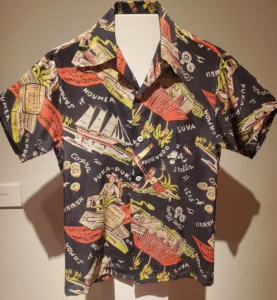
John Keoni Meigs created hundreds of unique, island-themed shirt designs beginning in the late 1930s. Jon Woodhouse/For The Maui News