
Hōkūleʻa: The voyage that reconnected a culture
Original crew member to share stories from landmark 1976 voyage
Trending
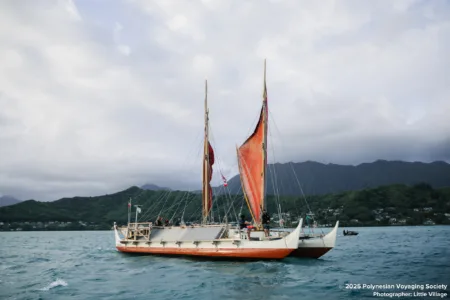
On May 1, 1976, the double-hulled ocean voyaging canoe Hōkūleʻa set sail from Maui's Honolua Bay on a 2,700-mile journey to Tahiti.
Guided by the stars, winds, ocean currents and other signs of nature, the crew crossed the Pacific using traditional Polynesian wayfinding techniques, without modern instruments, demonstrating the remarkable navigational knowledge that enabled ancient Polynesians to voyage thousands of miles across the open ocean.
The historic voyage became a defining moment of the Hawaiian Renaissance, helping ignite a cultural revival and inspiring renewed pride in the Hawaiian language, traditional arts and history.
"We knew we were on the verge of something exciting because the whole thing was part of the rising of Hawaiian culture," explained Dr. Ben Young, who crewed the 1976 journey back from Tahiti to Hawaii. "Hōkūleʻa was part of it and emerged as a project that really captured the minds and hearts of so many people in Hawaii and elsewhere."
Young will present a free talk, "Hōkūleʻa: The Canoe That Reconnected a Culture," at 12:30 p.m. Saturday during the Celebration of the Arts at the Ritz-Carlton Maui, Kapalua, in honor of the 50th anniversary of Hōkūleʻa's pioneering voyage.
"It's pretty exciting because 50 years ago, we never expected something like this," Young said. "When you think about it, 50 years later, what has transpired is really amazing."
Dreaming of building a double-hulled sailing canoe similar to the ones that his ancestors sailed, Hawaiian artist Herb Kawainui Kāne founded the Polynesian Voyaging Society in 1973.
Kāne asked Young to serve on the 1976 return to Hawaii. A renowned historian, Young is the first Native Hawaiian psychiatrist and a passionate advocate for cultural and health revitalization.
"Herb Kāne was the catalyst behind this whole movement," Young explained. "He asked me to participate. He had a hard time getting hold of any physician who wanted to be a part of it. It was easy for me because I was just getting through my residency training and so many other physicians were busy with their practice. It was the perfect timing for me."
Sailing on the canoe for around a month, Young experienced a range of emotions. "The expectations were there," he recalled. "The mental anguish was there, too, because soon after the launching of Hōkūleʻa in 1975, it swamped on a voyage from Oahu to Kauai. So there was a dangerous element involved, and you think, 'I'm going to be on this canoe. Am I going to survive?'"
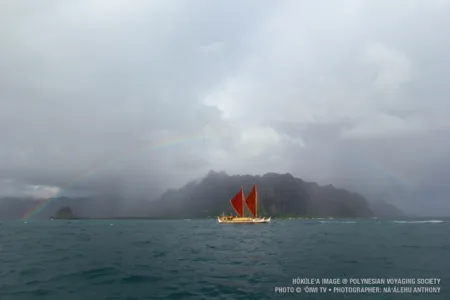
An ānuenue dances over Hōkūleʻa as she journeys onward to Lāʻie. Courtesy photo
The challenges included the sacrifices crew members had made. "They sacrificed their time to build a canoe," said Young. "They sacrificed their time and money away from their jobs to support their families. So financial issues were pretty significant. That alone, before the voyage, were significant items that really scared one. You talk about the swamping of the canoe, time involved, money involved, being away from family. Those were more significant than the voyage itself."
Out on the Pacific Ocean, "There were dark nights," he said. "There were windblown episodes where you felt the mast was going to break in two. There were waves 20 feet high crashing over the canoe every day, so you were wet all the time. But probably the internal struggles and the difficulties prior to the voyage were far more important."
The initial journey would not have been possible without the guidance of Mau Piailug, a navigator from the small island of Satawal in Micronesia. He had agreed to travel to Hawaii and guide Hōkūle'a to Tahiti using traditional wayfinding methods, including the stars, the wind and reading the sea.
His son, Sesario Sewralur, visited Maui in 2023. "Skills of navigation were not shared with others; it was just passed down within the families," Sewralur explained. "My father step outside the box and teach the navigation to the Hawaiians."
The voyage sparked a cultural revival and became a symbol of indigenous pride. "We had an idea. It was significant. It was meaningful," said Young. "It was an epic voyage, but none of us really had the sense of how important this would be in helping to perpetuate Hawaiian culture. We all suspected it would be, but none of this importance. Some people were not aware of the importance of such a voyage for Hawaiian culture."
Kāne had designed a poster to publicize the importance of building an ocean-voyaging canoe. Young and his wife helped sell the posters for $1 each.
He recalled: "A guy that came up to us and said, 'What are you guys trying to do?' I said, 'We're trying to build a canoe and sail to Tahiti and back to Hawaii without navigational instruments. And we want to take on board plants and animals to show that the early Polynesians settled these islands in that way.' That guy looked at me and he said, 'You guys are nuts.'"
At 2 p.m. Saturday, Young will offer a presentation titled "Hōkūleʻa at 50: Stories from the Original Crew," featuring surviving crew members from the voyage reuniting with rare film and photos.
Among the original crew in attendance Saturday will be legendary Lahaina waterman Abraham "Snake" Ah Hee, who graduated from Lahainaluna High School in 1964 and worked as a lifeguard on Maui, along with Penny Martin from Molokai, Billy Richards and Kimo Lyman.
The 2026 Celebration of the Arts will be held Friday and Saturday at the Ritz-Carlton Maui, Kapalua. A complete list of events is available at kapaluacelebrationofthearts.com.