
Ka‘ana Mana‘o: Our commitment to agriculture
Trending
Readers of this column know that we're committed to training Maui's future workforce and we're big on partnerships that help us achieve that goal.
One of the best examples of the confluence of these is our participation, along with other stakeholders, in the Hawai'i Farmers Union's Farm Apprentice Mentoring (FAM) Program. It's a free, seven-month training for aspiring farmers and, after the setbacks our state's farmers have faced following the spring and summer storms, it is particularly important to support folks who want to make their living feeding the rest of us.
The program consists of classroom and field components. Our college, with the help of a grant from the County of Maui, provides the classroom and equipment for once-weekly evening classes, and then on Saturday mornings, the "classroom" moves to farms all across Maui County for hands-on instruction from established farmers.
The field modules move through the working year of a farm -- from December to June -- and touch on every aspect of agriculture from design to planting, water management to composting and everything in between. And, of course, students learn about the cultural significance of farming in Hawai'i.
Since it began 12 years ago, the FAM program has graduated more than 250 students from Maui, Molokai and Lāna'i. John Yarborough is one of them. Initially, he wanted to learn about opportunities to lease or purchase land to farm. "The program offered a diverse range of agriculture education which opened up several ways of thinking about agriculture, sustainability, and conservation," says Yarbrough.
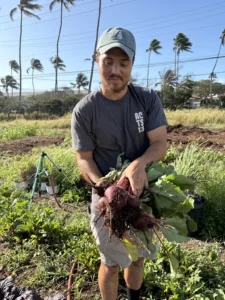
University of Hawaii Maui College WaiPono Farm coordinator John Yarbrough. Photo courtesy University of Hawaii Maui College
His open mind led him right back to us. Today, he's the full-time coordinator of our WaiPono Farm. He calls his work "incredibly purposeful." "Each week, we harvest fresh produce that goes directly back into our community. We support UHMC students through Basic Needs and we have a great relationship with our Culinary Arts Department, where our produce can be used to experiment, educate, and create a true farm-to-table experience," says Yarbrough.
"We also personally deliver produce to Lahaina to support fire-impacted communities, including new housing developments, the fire department, canoe club, aquatics programs, and elementary schools. In addition, we contribute produce bi-weekly to Maui Memorial Medical Center for a 'Food as Medicine' research project that is helping demonstrate the health benefits of consuming fresh, locally grown produce.
All of these efforts contribute to food security in different ways. Beyond providing fresh food to people who can use it, they help strengthen community connections, support education and research, and demonstrate the value of local farmers and sustainable agriculture in Maui."
There are even more innovative agricultural opportunities at our college this fall. "UHMC is excited to coordinate free regenerative agriculture courses this fall 2026 semester,” says Dr. Nicolette van der Lee, Program Manager for UHCC Workforce Innovation.
An eight-week Sustainable Aquaponics Systems course begins September 30 and aims to advance innovative, sustainable food-system methods for urban and rural settings using cutting-edge aquaponics and hydroponics technologies. Apply at tinyurl.com/mrxwucv8. The Practical Applications in Natural Farming workshop starts Oct. 6 and runs Tuesdays and Thursdays through Oct. 22. Register at tinyurl.com/t9y67rxv.
"Both courses provide hands-on training in agricultural methods that reduce reliance on imported inputs like expensive fertilizers, upskill both new and experienced farmers, and increase the amount of food we grow locally to support community food security," explains van der Lee.
Our new agriculture instructor Barry Henry, a graduate of GoFarm and founder of Happy Lau Farms, is both a proponent and a practitioner of natural farming methods. "True food security for Maui means empowering our community with sustainable, accessible agricultural practices. The Natural Farming workshop bridges a vital economic gap by using Jadam (an organic fertilizer and pesticide practice used in the Korean natural farming methodology) and natural farming techniques to give local growers the practical tools they need to cultivate resilient farms and gardens at minimal cost,” says Henry.
The deadline to apply for the FAM program 2026-2027 cohort is Oct. 15. The program accepts 30 students from across Maui, Molokai, and Lānaʻi. Apply at hawaiifarmers.org or by emailing fam@hfuu.org.
For complete information about UH Maui College, please visit maui.hawaii.edu/.
Dr. Lui K. Hokoana is Chancellor of the University of Hawaiʻi Maui College. Ka’ana Mana’o, which means “sharing thoughts,” is scheduled to appear on the fourth Thursday of each month. It is prepared with assistance from UH-Maui College staff and is intended to provide the community of Maui County with information about opportunities available through the college at its Kahului campus and its education centers.