
Lahaina Jodo Mission plans rebuilding
Trending
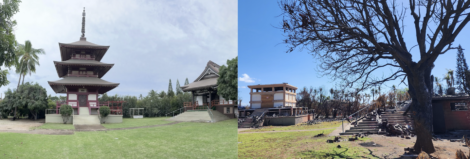
The 2023 Lahaina wildfire destroyed the temple, pagoda and social hall of the Lahaina Jodo Mission.
But the iconic bell and the statue of a large seated Buddha survived, and plans are moving forward to rebuild the destroyed structures with greater resilience.
"The path to our rebuilding and recovery has been very challenging and it will take time, but I am deeply grateful to many, many people who have shown tremendous support for our mission," said the Rev. Gensho Hara. "Their kindness gives us strength and hope for the future."
The mission has not only been a place for religious worship, where thousands have gathered to celebrate Obon season and release floating lanterns out to sea, saying farewell to the spirits of departed souls.
It has also been a cultural center for celebrating the heritage and contributions of tens of thousands of Japanese immigrants and their children who helped build Hawaii's sugar industry during and after the Hawaiian monarchy.
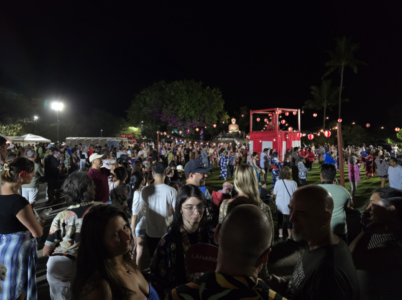
The Lahaina Jodo Mission showed its resilience and partnership with others by continuing to hold the annual Obon festival on temple grounds on Aug. 9, 2025, in partnership with members of Lahaina Hongwanji and Lahaina Shingon. In the background is the mission's statue of Buddha, which survived the 2023 Lahaina wildfire. Photo courtesy Lahaina Jodo Mission
At the peak of migration around 1920, people of Japanese ancestry made up 43% of Hawaii's population.
The Lahaina Jodo Mission was established in 1912. It had a plantation-style temple close to Front Street, but the temple was relocated closer to the shore when members purchased its current location.
Hara, born into a spiritual life as the first son of a temple priest, is an example of resilience. He helped lead the rebuilding of the temple and main hall in Lahaina after a 1968 fire.
The Buddha, 12 feet tall and weighing 3.5 tons, and the temple bell were installed in 1968 to commemorate the centennial of the arrival of the first group of Japanese immigrants to Hawaii.
Japanese donor Masao Omori, who had a deep affection for Maui, brought the specialized labor and expertise of traditional Japanese craftsmen from his hometown in Japan.
Omori, who viewed the island as his adopted home, was also the developer of the Lahaina Cannery Mall, designing it as an homage to the pineapple industry.
Maya Hara, the daughter of the Rev. Gensho Hara, said the mission is working in partnership with the University of Hawaii Sea Grant, Ecosolutions Hawaii and the Surfrider Foundation to develop a dune system with native plants to protect the coastline for future generations.
The mission also plans to build the social hall farther from the ocean.
The mission's rebuilding committee is looking at various options to rebuild the temple so its foundations will be stronger and able to withstand possible ocean surges.
Maya Hara said the reconstruction aims to preserve traditional Japanese architecture and cultural practices.
She said the mission is participating in the Federal Emergency Management Agency's Public Assistance program to help rebuild portions of the temple complex. The extent of the rebuilding remains under review.
The committee wants to continue setting aside an area for a park near the coastline and is still deciding on its configuration.
Gensho Hara said he is glad to have survived the wildfire.
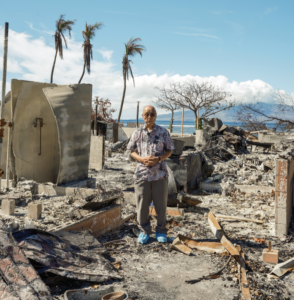
The Rev. Gensho Hara stands beside the ruins of the Lahaina Jodo Mission's temple and social hall. The mission is reviewing rebuilding plans, including the relocation of certain features farther from the shoreline. Photo courtesy Lahaina Jodo Mission
After battling the fire with a garden hose, he and his wife, Setsuko, fled and spent the night at his daughter's home in Wailuku.
After two and a half years in Wailuku, he and his wife are now living on the temple grounds again.
Hara recalled Lahaina going through a different kind of slump when he arrived in 1963, after the closure of the pineapple cannery.
The town seemed empty and without jobs, with hardly anyone on the streets.
Gensho Hara said that after the 2023 wildfire, he was grateful to see the faces of mission and community members. The mission remains committed to rebuilding.
"As we move forward one step at a time, we are not only restoring our buildings, but carrying forth our legacy of faith, compassion, culture, community and resilience for generations to come," he said.