
Maui entrepreneur builds self-sustaining farm model
Trending
Entrepreneur John G. Varel remembers growing up in a family of six children with his great-uncle and grandfather on a 120-acre farm in a small Illinois town 35 miles from St. Louis.
At the farm, they grew corn, soybeans and wheat to pay the rent and to feed the cows, chickens and pigs they raised. The family grew vegetables in the garden and canned fruits and vegetables such as peaches and tomatoes.
"It was self-sustaining," he said. "We rarely bought anything from a store."
Varel, 72, said he's doing a bigger version of that family experience on his 1,200-acre Waihe'e Valley Plantation, which he acquired from Wailuku Agribusiness in 2002.
The land includes a large portion of the macadamia nut farm. About 450 acres on the mauka portion of the property are designated conservation land, leaving the remainder available for agriculture.
With his retirement home overlooking the fields, Varel has kept busy making his farm as self-sustaining as possible. He has installed solar panels to power his food truck cafe and self-contained greenhouses and hydroponic vegetable operations. Waiheʻe Valley Plantation supplies produce to more than 30 bakeries and restaurants on Maui, including Mama's Fish House, the Seascape and Monkeypod Kitchen.
"Our farm is completely off-grid," he said. "Everything is on a Tesla power plant, and the tax credits helped me get that set up."
He added that they have never run out of power.
An abundance of solar panels powers the operation at Waiheʻe Valley Plantation. Gary Kubota/The Maui News
He said the operation has two composting machines that are exclusively used to fertilize the plants on the property. The downed trees and ground cover are cut or chipped and mixed into the compost with macadamia nut shells and husks, as well as manure from a 14-horse barn stable, and combined with soil brought down from four little streams.
"We're trying to be as self-sustaining as that definition will allow us to be," he said.
Varel recalled the fields had no roads or infrastructure when he bought the land, and large mowers were used to cut the tall grass between the macadamia nut trees.
"It was completely overgrown," he said. "We added utilities. It's a complete renovation of what the property was before."
The farm used to rely on hand labor to pick the macadamia nuts and shipped them out to the Big Island to have them husked and shelled, but Varel now harvests the nuts by machine and has acquired other equipment to process and package the nuts himself.
"We're all MacGyvered here," said Varel.
The end result is a vacuum-sealed bag of macadamia nuts he sells to dozens of Maui restaurants, along with vegetables and an expanded plantation of coconuts, vegetables and fruits, including bananas, papayas, mangos and dragon fruit.
At his Ula Ula food stand, he sells vegetable plates with tomatoes, six different leafy greens including romaine lettuce, mint and bok choy. He's also developing a farm-to-table fare featuring shrimp plates, fish tacos, vegetable salads and burgers for lunch.
His dragon fruit smoothies are a favorite.
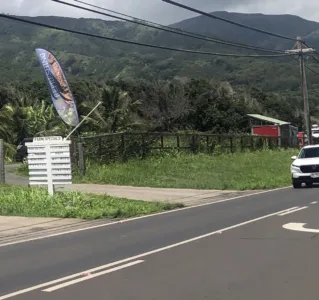
Part of the plan for business success for Waiheʻe Valley Plantation is the sale of farm-to-table meals at its food truck cafe. Gary Kubota/The Maui News
Background in commodities helps
Varel is accustomed to buying and selling commodities in volume. He was a commodities broker in Chicago at a time when the Hunt brothers were actively trying to corner the market on silver with prices moving upward.
He said he used the base of customers who had made millions of dollars to help him expand into business syndications and eventually founded FusionStorm in San Francisco in 1995, a business that provided tailor-made system-integration solutions to such companies as Dell, Microsoft, Cisco and Hitachi. It grew into a major company with over 400 employees doing work in 33 countries.
He was named a finalist for the Ernst & Young Entrepreneur of the Year Award in Northern California in 2008-09.
He eventually sold FusionStorm. He also sold his Kula property at the end of Thompson Ranch.
He said he bought the Waihe'e property because of its spacious privacy and potential as a farm.
"I thought, 'Well, if we move there, we won't have to worry about neighbors. It’s friendly. We got plenty of work to keep us busy for the rest of our lives,'" he said.
He said after selling his property, he and his wife Angie moved into the Waihe'e property in less than 60 days.
"I brought a Quonset hut from New Zealand, popped it up. It's now our guest cottage on the farm."
The guest cottage is now occupied by his 93-year-old mom and dad.
Varel said his farm has its ups and downs, especially after a drought last year yielded 22,000 pounds of macadamia nuts when it normally provides 80,000 to 90,000 pounds.
"This year, we have the rain finally," he said. "The season has just started. It looks like it's going to be a good year."
In addition to the 16,000 macadamia nut trees, he's planted 600 dragon fruit plants, 2,000 banana trees, 100 mango trees, 500 orange trees, 1,000 papaya trees and 150 avocado trees.
"We're going to continue more of all of the above," he said.
He said he's looking for other ways to also generate revenue.
Varel said his farm would like to start visitor tours of the farm operation, similar to pineapple tours, and a legislative bill is being developed to enable the activity.