
Ranching improves with fewer axis deer
Culling appears to be working, but struggles persist for some farms
Trending
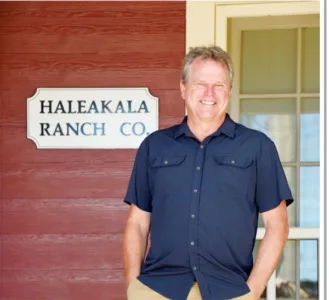
Haleakala Ranch president Scott Meidell has noticed that new fencing and the culling of wild axis deer have contributed to a steady gain in the ranch's breeding herds the last two years.
"Part of the increase is due to fewer deer," said Meidell, whose ranch has 23,000 acres of grazing land on the slopes of Haleakala.
"We're starting to see less impact on favorable forages in certain areas," he added. "I think it’s moving in the right direction. We just need to maintain our vigilance and discipline, and control the animals with maintenance and further installation of fences."
Meidell said the ranch, which has gained more than 8% in breeding herd capacity over the last two years, still has heavy deer concentrations in certain areas, but the fencing and control efforts are starting to show some recovery.
In 2021, the state Department of Land and Natural Resources' Division of Forestry and Wildlife estimated there were 145,000 to 167,000 deer in Maui County, including 60,000 to 70,000 on Maui, 60,000 on Molokai and 25,000 to 37,000 on Lanai. In 2025, the division estimated the population had decreased to 26,000 on Maui, Lanai and Molokai combined.
While the division is in the process of assessing the state culling program for 2026, the assessment is expected to show a continued decline.
Some axis deer occupy public land, but the bulk are on private property so state forestry and wildlife officials coordinate culling efforts with both Maui County officials and private landowners to manage deer populations.
The denuding of mountainsides from overgrazing by deer has also been a contributing factor in flooding on Maui in recent years, stripping away vegetation and destabilizing the soil. Meidell said the overgrazing has resulted in the pastures containing more weeds and less edible forage.
He said recovery is going to take some time because the vegetation profiles have changed after years of overgrazing by deer. "What has happened is the grasses that were in the understory have been replaced by non-palatable or unpalatable broadleaf."
Struggles continue
Maui Cattlemen's Association president Theresa Thompson said deer have been migrating uphill to Kula and higher mountain slopes because of the deer-culling program in low-lying areas.
"The big ranchers are kind of managing it, but the small ranchers are still struggling," she said. "They do what they can. They're harvesting what they can."
She said controlling the deer population has been difficult for many family-owned ranchers, especially when the deer come out of the forest to forage at night.
"They just start feeding in all the pasture land that’s supposed to be for the cattle, the horses, the goats, the sheep -- whatever we’re raising," she said.
"Keokea is just flooded with deer right now, and the little ranchers don't have employees. It makes it really difficult," she said.
William Jacinto, a former president of the Maui Cattlemen's Association who has a ranch in Kula, said the number of deer on his land have been increasing, although his family does some culling regularly.
He said because of the proximity to residences, culling is limited by state law, which forbids hunting at night unless the rancher has an appropriate wildlife permit.
Under the current axis deer incentive program for landowners, eligible deer must be taken during normal hunting hours, which are from half an hour before sunrise to half an hour after sunset. Deer taken during permitted nighttime control activities are not eligible for a $50-per-tail reimbursement.
Jacinto said many small ranchers are in tighter areas, nearer to residences where hunting is limited because of public safety. He said at one point, he had 36 breeding cows, but the lack of forage drove the numbers down.
"Eventually, it went to zero because the deer ate everything," he said.
An ongoing effort
According to the division, when the landowner incentive program was created, the axis deer population was large and widespread, and there was broad consensus that action needed to be taken to reduce the population.
"At the time, significant numbers of deer were being harvested, the majority of which were harvested by night operations under authorizations from wildlife control permits, including harvest by commercial operators that sell the meat," department spokesperson Andrew Laurence said.
He said even with those operations, the deer population continued to increase because the harvest levels were insufficient to overcome the deer's rapid reproduction rate.
Laurence said the purpose of the program is to provide incentives to increase the number of deer harvested beyond the baseline that existed at the time.
"Since most of that baseline was being done by night harvest under wildlife control permits, we initiated the program by seeking additional harvest from landowners not currently engaged in nighttime harvest," he said.
Jacinto said the state deer culling program is working, and he's working with state officials to try to find a way of improving culling for small ranchers.
"We're trying to figure out different things," he said.