
Religious, spiritual groups promote peace on Maui
Trending
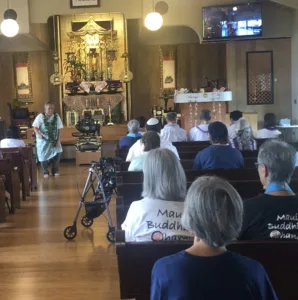
Members of various religious groups recently observed United Nations Peace Day on Maui, sharing meditations and prayers together to promote a greater understanding and compassion among faiths of the world.
The event, attended by more than 100 people at the Makawao Hongwanji Buddhist Temple on Saturday, provided an opportunity for interfaith alliances of religions and faiths to reiterate their commitment to peace.
Officially on Sept. 21, Peace Day has been declared by the United Nations as a day of nonviolence. The Hawaii Legislature adopted Sept. 21 as Peace Day in 2007. Bells are rung on Sept. 21 in Hawaii as part of the statewide and international tradition.
The Rev. Kealahou Alika, former pastor of Keawala'i Congregational Church in Makena, opened the event with an oli, or Hawaiian chant, written by linguist and scholar Mary Kawena Pukui.
Alika said peace does not always mean the absence of conflict or war.
"The deeper meaning is that it conveys the meaning of wholeness, completeness and well-being," he said.
Alika said it is this deeper meaning of peace that he finds in Pukui's words for the oli.
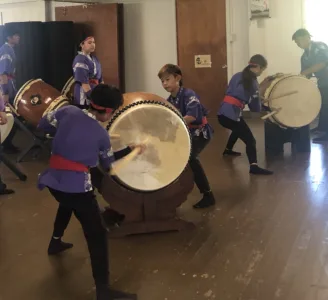
Zenshin Daiko youths performed as a part of the observance of Hawaii Peace Day at the Makawao Hongwanji Buddhist Temple Saturday. Gary Kubota/The Maui News
He said the wholeness and completeness and well-being of peace is not only among ourselves as human beings, "but also a wholeness to be a part of the creation, what we view here -- the flight of birds below the forest of the earth, the uplands, the trees of the forest, the sea, the fish of the sea, wherever there is a balance."
Performing a meditation from 10th century Japan, the Rev. Kerry Kiyohara of the Makawao Hongwanji Buddhist Temple tossed paper shaped like oak leaves, inviting all to come here to share their religious belief.
Kiyohara said that in some Buddhist teachings, promoting peace means achieving a state of nondiscrimination and regarding each being as one's only child.
"True peace of mind begins with the heart of compassion for all people and all forms of life," he said. "We are connected. We are dependent upon each other. This is Maui. It's a small place. When we realize we are connected, we are dependent upon each other."
Rabbi Raanan Mallek of the Jewish Congregation of Maui spoke of the Ten Days of Repentance and urged people to choose dialogue over destruction.
"We acknowledge that the world is fractured and our hearts are heavy with the pain of conflict," said Mallek. "As the High Holy Days call us to look inward, let us examine our own actions, clear the dust of apathy, prejudice and anger from our souls. Help us return to our highest values. Let it not be a call to arms but a universal wakeup call to justice, healing and reconciliation."
Nadine Ramelb, a representative of the Baha'i Faith of Wailuku, reiterated some of its foundational beliefs, including the elimination of cultural, religious and racial prejudice and the equality of men and women.
"Could you imagine a world where women govern as much as men? We would have a very different world," she said.
She said another principle is that science and religion should go hand in hand.
Ramelb said without science, religion can fall into superstition, and without religion, science is cold and lacks humanitarian compassion.
The United Nations adopted an International Day of Peace in 1981, declaring it a day of global cease-fire and nonviolence. The official date was later designated as Sept. 21, close to the yearly opening of the United Nations General Assembly.
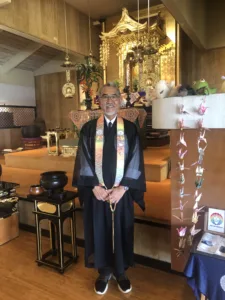
The Rev. Kerry Kiyohara of the Makawao Hongwanji Buddhist Temple said the state Legislature designated Sept. 21 as Peace Day. Gary Kubota/The Maui News
Kiyohara said members of the Junior Young Buddhist Association in Hawaii initiated the idea of having the state Legislature formally adopt the United Nations Peace Day in Hawaii.
In 2007, Hawaii Act 23 was passed by the state Legislature designating Sept. 21 as Peace Day in Hawaii, a day to promote peace programs, improve international relations and increase educational awareness about peace.
Peace Day on Maui also included a display of origami peace cranes, a demonstration and instruction in tai chi chuan by sifu Jan Osterneck, a Taiko for peace performance by the Zenshin Daiko youths, and a live exhibit by the Maui-based International Peace Poem Project, inviting attendees to write their lines of peace on a scroll that has peace poetry from scores of nations.