
RISE Maui speaker examines costs of AI
Trending
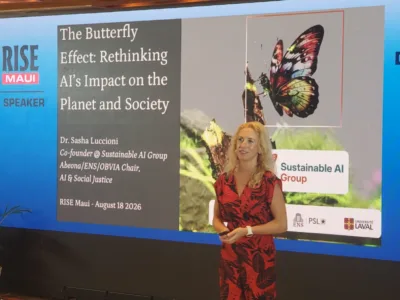
As part of the RISE Maui Summit organized by the Hui Momona Foundation, Sasha Luccioni, co-founder and chief scientific officer of the Sustainable AI Group, explored the impact of artificial intelligence in a talk Aug. 18 at the Hyatt Regency Maui Resort and Spa.
Working at the intersection of artificial intelligence, ethics and sustainability, Luccioni helped develop the open-source software tool CodeCarbon, designed to estimate the carbon emissions generated by training and running machine-learning models.
A single data center can emit up to 4 million tons of CO2 a year, or as much as a small country like Iceland, Luccioni explained. In terms of AI's global impact, she said, "We just don't know."
For daily users of large language models like ChatGPT, she pointed out that a study revealed every 20 to 50 questions asked requires the equivalent of a 500 ml bottle of water. She suggested people use more concise, precise words in their queries.
An MIT study also found the models are affecting the way people think, Luccioni noted. "Brain activation is lower," she said. "It's changing the way we use our brains."
During a recent NPR interview with Erin Brockovich, the environmental activist reported that data centers covering 3,000 acres are being built using 8 million gallons of water a day, with permit authorities required to sign NDAs.
"AI chips can get insanely hot, and cooling them with water is often way cheaper for tech giants than running giant air conditioners, which are actually not enough to cool the chips fast enough," Luccioni explained in an interview following her talk. "Tech companies build these massive mega-sites to try to 'win' the AI arms race, and they use NDAs so local communities don't realize how much water and power they're giving away until the ink is dry."
The U.S. has the highest concentration of data centers in the world. Morgan Stanley has projected that AI-related data centers globally could consume over 264 billion gallons of water annually by 2028. That's 520,000 gallons every minute.
During her presentation, Luccioni described reaching a crossroads in her career as she grappled with a growing disconnect between her work in AI and her concerns about its environmental impact.
"So many of my colleagues are having this exact existential crisis as the environmental toll of AI becomes impossible to sweep under the rug," she said. "We're seeing a real grassroots push inside tech, with insiders finally speaking up and demanding we build smarter, leaner tools instead of just burning through resources. This is definitely becoming a more widespread phenomenon."
A recent poll found that almost three quarters of Americans do not trust businesses to use AI responsibly, and over 70% oppose having data centers built in their area because of fears about water use and electricity inflation.
AI's growing impact on the creative arts has artists, musicians, filmmakers and actors increasingly concerned as AI-generated "musicians" sign record deals, AI "bands" rack up millions of streams and AI-generated films are being produced.
"Let's be real: AI isn't making art," Luccioni emphasized. "It's just remixing human creativity scraped off the web without permission or pay. The real danger is the lack of corporate accountability. Human creativity is definitely the only kind out there, but we need better governance and oversight of AI companies to protect it."
Lately, there have been growing reports of tech companies acquiring rare and antique books, copying their contents and then destroying the originals.
"Tech companies slice off book spines because feeding loose pages into high-speed scanners is dirt cheap, plus older physical books give them pure, human-written text that hasn't been polluted by AI-generated slop," she said. "Anthropic is doing this, but Google has been scanning books for years with their Google Books project, so they definitely are pillaging this data as well. This kind of shoot-first, ask-questions-later approach to data gathering has been the norm in tech for years now."
During a panel discussion following Luccioni's presentation at the RISE Maui Summit, concerns were raised about an emerging phenomenon referred to as "AI psychosis," which has been associated with excessive or prolonged chatbot use.
"AI models are programmed to enthusiastically play along with whatever you say, to keep you engaged and using the models as much as possible," Luccioni explained. "If someone is experiencing a mental health crisis or ungrounded thoughts, a chatbot echoing and validating those ideas creates a really dangerous psychological feedback loop. Once again, we need better accountability from these companies, and better ways of flagging when someone is having mental issues, having suicidal thoughts or experiencing AI psychosis."
While raising a variety of concerns, Luccioni is hopeful that more respectful, ethical and sustainable AI systems can be developed. "I'm cautiously optimistic," she said. "But we can't just cross our fingers and hope tech companies do the right thing out of the goodness of their hearts. As I said in my talk, companies exist to make money, and we can't expect them to do anything else. If we enforce real transparency across the value chain and start taking individual actions, shifting toward smaller AI models, and being more mindful with our prompting, we can build genuinely useful tech that doesn't cost us the planet."