
Threatened birds recently spotted on Kaho‘olawe
Trending
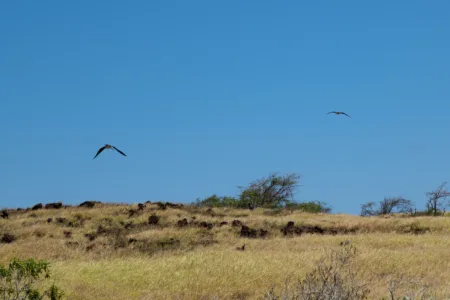
State natural resource specialist James Bruch and other workers were doing some restoration work on Kaho'olawe island in June, when a pair of aeʻo began swooping down upon them, which turned out to be a positive sign.
For the first time, the rare birds also known as Hawaiian stilts had been spotted on Kaho'olawe and they were raising three fledglings there.
The ae'o has recently been reclassified from endangered to threatened following decades of conservation work. In the 1940s, the population had dropped to about 200 individuals.
While working on Kaho'olawe, the state workers also spotted an ʻalae keʻokeʻo, or Hawaiian coot, which is an endangered species.
Kahoolawe Island Reserve Commission executive director Michael Nahoopii said the sightings are the culmination of decades of work to restore native vegetation on an island once used for military target practice and denuded by goats.
"One of our long-time goals has been to restore the environment," he said. "This is evidence that it's working."
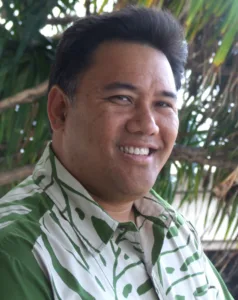
Commission executive director Michael Nahoopii said vegetation is growing back on Kaho'olawe, thanks to the absence of wild goats, irrigation improvements and decades of volunteer work. Photo courtesy Kaho'olawe Island Reserve Commission
Vegetation is growing back on the 28,800-acre island that the U.S. military used as a live-fire training and bombing range after the attack on Pearl Harbor in 1941. Following intense Native Hawaiian protests in the 1970s and 1980s, live-fire exercises ended in 1990, and control was transferred back to the state in 1994
Hundreds of restoration volunteers have been coming annually to this island -- equal in size to Oahu's metropolitan area from Waikiki to Moanalua -- since the late 1990s after the eventual transfer of the island from the military back to the state of Hawaii in 1994.
The commission has developed rain catchment tanks that hold 400,000 gallons of water that is used for irrigating thousands of plants, including native species.
The U.S. Navy spent $400 million to clean up unexploded ordnance on the island from 1994 to 2004 but has only been able to clear about 75% of the surface and 10% of the subsurface of Kaho'olawe. The rest of the island remains restricted and hazardous.
Volunteers no longer have to swim ashore from boats but board a troop landing craft from South Maui to Kaho'olawe. The landing craft's front drops onto the beach. They can stroll to dormitories and other buildings once occupied by the Navy.
Solar panels power the dormitories near the coastline and irrigation water pumps near the summit. The commission has also built a solar-powered seawater desalination plant to produce fresh drinking water.
Under a state law, Kaho'olawe is to be eventually turned over to a native Hawaiian sovereign entity recognized by state and federal governments.
A path for reconnecting
Native Hawaiians say the restoration effort has been a way for them to reconnect with their ancestral customs and the wisdom derived from them.
It also has been a way to mend fractured connections with native Hawaiian knowledge.
At the summit of Moa'ulaiki, native Hawaiians once studied the stars and learned celestial navigation and could view the channel Kealaikahiki, known as the pathway to Tahiti, the traditional point for departure and arrivals for deep-sea voyagers.
In October or November, a Makahiki is held on Kahoolawe to observe the harvest season through organized pilgrimages and ceremonies led by the Protect Kahoolawe Ohana, the group that advocated the cessation of military bombing and the return of the island to civilian use.
State recognizes early protesters
A memorial tribute including a plaque sits on a promontory at Hakioawa Bay, as a reminder of two activists George Helm and Kimo Mitchell, who were lost at sea in 1977 while supporting efforts to halt the military bombing and occupation of the island.
The University of Hawaii has designated a permanent website honoring Protect Kahoolawe Ohana leader Dr. Emmett Noa Aluli, who died in 2022 at the age of 78.
Aluli was among the first to occupy Kaho'olawe in 1976 and stayed on the island for two days along with native Hawaiian Walter Ritte Jr., defying military efforts to halt the native occupation of the island.
Aluli later helped to organize visits to Kaho'olawe under court-ordered religious freedom accesses, raising awareness of the cultural and spiritual importance of Kaho'olawe and its environmental degradation.
He also was recognized as one of the first five Native Hawaiian graduates of the University of Hawaii John A. Burns School of Medicine and as a trailblazer in rural health for his lifetime of service as a physician on Molokai.
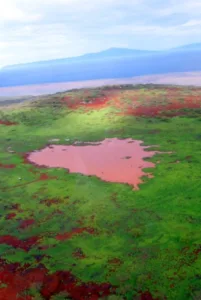
Aeʻo were recently spotted at Lua ʻO Keālialalo crater on Kaho'olawe after the crater turned into a wetland following the Kona low storms in March. Photo courtesy Kaho'olawe Island Reserve Commission
A crater full of water creates wetland
Bruch said the sightings of the native birds happened after the Kona lows in March filled the Lua ʻO Keālialalo crater on Kaho'olawe. The crater is about 800 feet above sea level, below the 1,500-foot-high Lua Makika crater.
"There were enough food resources for them," he said.
Shrimp, dragonflies, beetles and flies provided enough food for the fledglings.
Bruch said there aren't that many native birds on Kaho'olawe, and one of their biggest threats is feral cats.
"They limit the seabird reproduction on the island," he said.
He said the cats live on parts of the island that are still restricted -- about 25 percent remains off limits because it hasn't been cleared of ordnance.
Bruch said a strategic plan is being developed to eradicate the cats, so that the entire island could be a refuge for birds.
"We have a kind of seabird restoration plan," he said. "A lot of it comes down to money and funding."