
Trending
 Gary Kubota/The Maui News
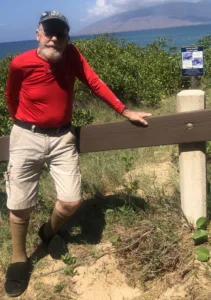
Buck Joiner is one of the residents being honored for supporting the county acquisition of the park and also leading volunteer efforts to clear the land and turn it into a park.
The wedge-tailed shearwaters, known as 'ua'u kani, have increased from a handful at Kamaole Point Park to a growing number in South Maui, totaling more than a thousand in less than two decades.
A public gathering to celebrate the 25th anniversary of volunteer efforts to create the park will take place from 1 to 4 p.m. Oct. 17. Community organizer Buck Joiner said the presence of the birds is like the candles on a birthday cake.
The cake itself took some 20 years of preparation, including protests against the mall as well as volunteer work on Sundays by hundreds of volunteers and businesses.
Michael Moran, a Kihei Community Association board member and past president, said Joiner had a lot to do with the park's creation.
"We're having a celebration to honor Buck for his hard work and other volunteers, and we hope the county will do something with the park," Moran said.
"It's been neglected for several years," Moran added. "This poor park could use some tender loving care. We're hoping it will get enough attention so the county will kick in some money."
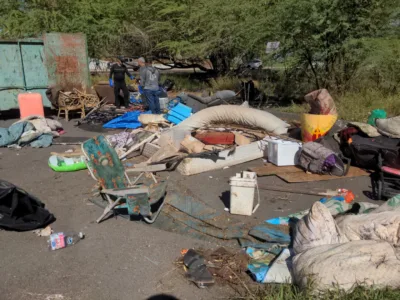 Photo courtesy Buck Joiner
Before it was Kamaole Point Park, the site was a dumping ground for abandoned vehicles, furniture, a collapsed house, and make-shift camping gear. The park is celebrating its 25th anniversary on Oct. 17.
Once surrounded by barbed-wire fences, the land was a dumping ground for burned-out cars, a collapsed house, fallen kiawe trees, abandoned beds and couches, makeshift tents and household trash.
After a 10-year struggle with the landowner to keep the coastal parcel in noncommercial use through public testimony, letter writing and petitions, the land was acquired by the county.
Joiner, who helped lead the community effort, promised to create a park with the help of volunteers if the county bought the property for a park.
Joiner recalled that a day after the county acquired the property for $6.35 million in 1998, he and more than a dozen volunteers began clearing the land and pulled out 65 contractor bags of trash on the first day.
Joiner said it took three years to clear the parcel and create a park, including installing plastic pipes for irrigation.
Joiner said he was grateful to dozens of volunteers and businesses with trucks and heavy equipment that contributed to removing the big stuff and for the many donations they received to help plant ground cover.
He said he didn't know the endeavor would take 10 years to stop the development and three years to create a park.
"We put in 170 Sundays of extremely exhausting labor," he said. "We worked every Sunday for three years. I had a very serious heart attack due to the extreme effort involved. The effort was so phenomenally strenuous that it took me four days to recover from each single day of work. I remember being in so much pain that even my eyeballs hurt."
Then, he said, there was the rebuilding of the sand dunes on the land, transferring many truckloads of sand that had been dredged from the Kihei boat ramp.
Volunteers also planted the Hawaiian shrub naupaka to help prevent erosion and rebuild the dunes.
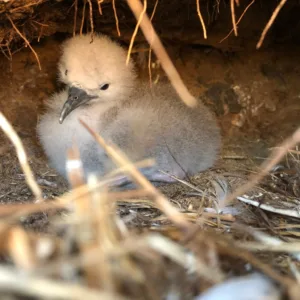 Photo courtesy of Maui Nui Seabird Recovery Project.
The number of burrows for wedge-tailed shearwaters, including this chick, has grown to more than 1,600 in a third of a mile in South Maui, including Kamaole Point Park.
Joiner recalled he was planting naupaka when he discovered an arm-length hole in the ground and couldn't figure out what animal would create such burrows.
He shared his discovery with state biologist Fern Duvall, who was overjoyed. Duvall said the burrows were made by wedge-tailed shearwaters.
Joiner said after the creation of Kamaole Point Park, a lot of support emerged from groups, including the Maui Nui Seabird Recovery Project.
He said the birds have made themselves at home, sometimes extending beyond a wooden fence marking where they dwell.
"We haven't been able to come up with a sign that tells them, 'This is your part and this is our part,'" he said.
Joiner turned over the park to the county on Oct. 7, 2001.
The Maui Nui Seabird Recovery Project said the shearwater colony has been growing along a third of a mile of coastline stretching from the park northward to the Keawakapu boat ramp.
The project said that with the removal of mongoose and free-ranging cats from the area, the number of burrows has increased from 376 in 2017 to 1,394 in 2025.
Each pair lays one egg a year and takes turns watching the nest and fishing.
Joiner hopes either the county or a nonprofit will develop the park into an educational place where various native plants could be exhibited.
It definitely took many to build it.
"This property is a park because of many dedicated volunteers putting forth phenomenal amounts of energy and the amazing, incredibly generous businesses who donated thousands of dollars of professional services," Joiner said. "Now, it has been a park for 25 years. I kept my promise."